
 Call (323) 5215131
How Long Does It Take to Rewire a House in Los Angeles?
Once a homeowner or property manager has decided that a rewire is necessary, the next question RG Electric (License C10 #910807) hears most often is about timeline. How long is the house going to be without full power, how disruptive is the process going to be, and when can normal life resume. The honest answer depends on the size of the property, the scope of the rewire, and the permit and inspection schedule, but there is a predictable range and a predictable sequence of stages that every rewire in Los Angeles follows. Understanding both helps property owners plan realistically rather than guessing.
The Typical Timeline for a Full Home Rewire
For a single-family home in Los Angeles undergoing a full rewire, the on-site work typically takes between five and fifteen working days, depending on the size of the home and the condition of the existing wiring. This is the active construction period, not the total project timeline, which also includes permit issuance and inspection scheduling on either end.
A smaller home, under 1,500 square feet, with straightforward wall and ceiling access, can sometimes be completed in five to seven working days. A larger home, particularly one with multiple stories, finished ceilings that require more careful access, or a layout that complicates running new conductors, can extend to ten to fifteen working days or more. Apartment buildings and multi-unit properties scale differently, since each unit effectively represents its own rewiring project, and the total timeline depends heavily on how many units are involved and whether work can proceed in multiple units simultaneously. A property owner asking about timeline should expect a range rather than a single number, since the final figure depends on conditions that are only fully known once the assessment is complete.
The cause of timeline variation is the physical condition and configuration of the property. The effect is that no two rewire timelines are identical even for similarly sized homes. The consequence for planning purposes is that an accurate timeline can only come from an on-site assessment, not from a general estimate based on square footage alone.
The Stages of a Rewiring Project
A full rewire moves through a sequence of stages, and understanding each one helps property owners anticipate what is happening at each point in the process and why certain stages take longer than others.
Assessment and planning
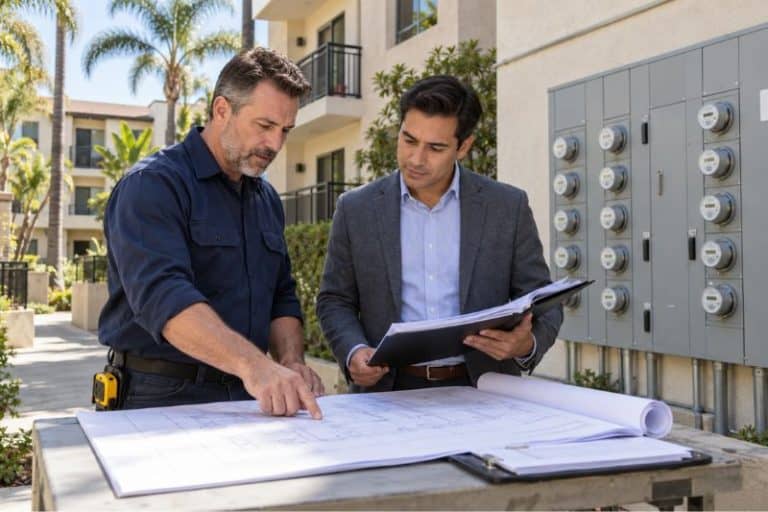
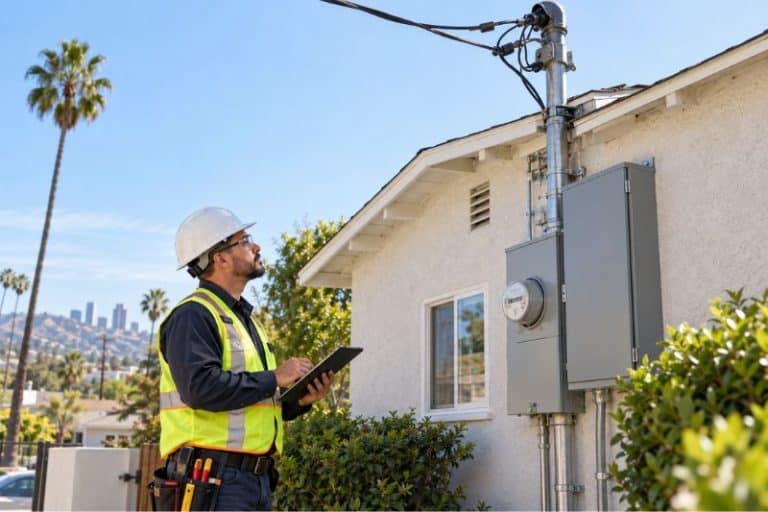
Before any work begins, a technician assesses the property, identifies the scope of wiring to be replaced, evaluates the panel and whether it also needs replacement or upgrade, and develops a plan for how new conductors will be routed through the structure. This stage typically takes a single visit, and findings are reported to Roy, the owner and master electrician, who builds the project estimate and timeline.
Permit application and issuance
A full rewire requires a permit from the Los Angeles Department of Building and Safety. For straightforward residential rewires, permit issuance is often handled quickly. For larger or more complex projects, particularly those involving multiple units or significant load calculations, LADBS may require plan review before issuing the permit, which can add one to several weeks before on-site work can begin. This stage is outside the contractor’s direct control, since it depends on the city’s processing time, but RG Electric submits complete, accurate applications to avoid the delays that come from incomplete submissions being returned for correction.
Rough-in work
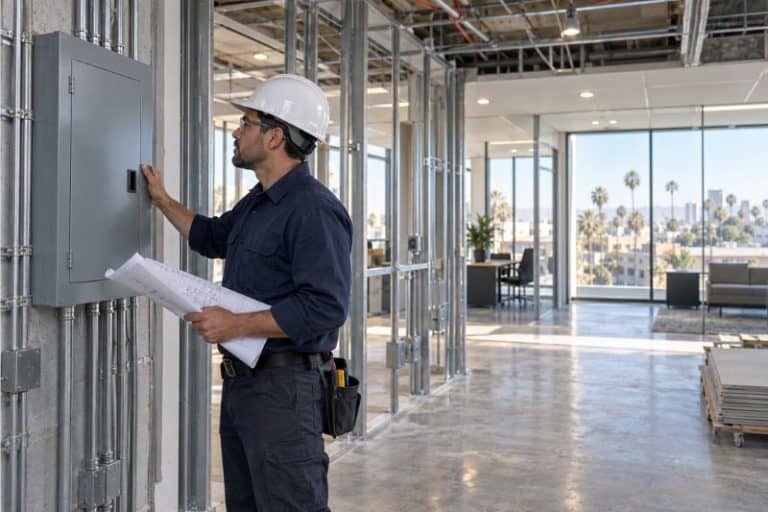
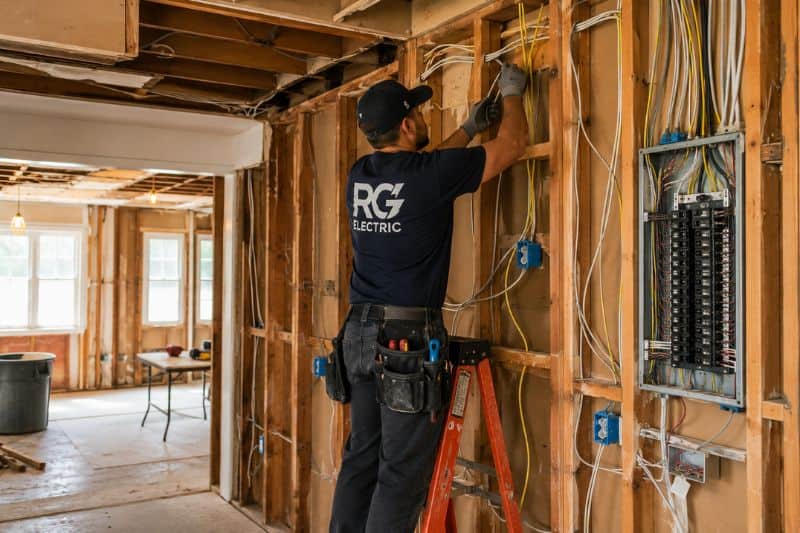
This is the most visible and most disruptive stage of the project. New wiring is run through walls, ceilings, and attic or crawlspace areas. Depending on the property’s construction, this may require opening sections of drywall, which are patched after the wiring is complete. This stage represents the majority of the on-site time in the five to fifteen working day range described earlier.
During rough-in, the property typically experiences intermittent power interruptions as circuits are taken offline section by section to allow safe work. A full home is rarely without power entirely for the duration of the rough-in stage, but specific rooms or circuits will be without power while work is actively happening in that area.
Rough-in inspection
For larger rewiring projects, LADBS may require a rough-in inspection before walls are closed, allowing the inspector to verify wiring methods, conductor sizing, and box placement while everything is still visible. Scheduling this inspection depends on LADBS availability, which can range from a few days to a couple of weeks depending on current inspector workload across the city. Work generally cannot proceed to wall closure until this inspection passes.
Finish work and wall closure
Once the rough-in inspection passes, drywall patching, device installation, and panel finishing take place. This stage is generally faster than rough-in and is when outlets, switches, and fixtures are connected to the newly run wiring.
Final inspection
A final inspection confirms that all devices are properly installed, the panel is correctly labeled, and the completed system meets code. Once this inspection passes, the permit is finaled and the project has full documentation of completed, code-compliant work.
Factors That Extend the Timeline
Several conditions specific to older Los Angeles properties commonly extend a rewire beyond the baseline timeline, and anticipating them helps set realistic expectations from the start.
Finished ceilings and limited attic or crawlspace access slow down the rough-in stage significantly. A home with an accessible attic that spans the full footprint of the house allows conductors to be run relatively quickly. A home with a finished ceiling on every floor and no attic access requires more invasive and time-consuming methods to route new wiring, often involving more extensive drywall work.
Discoveries made once walls are opened, such as the inspector finding violations in connected systems that were not part of the original scope, can pause progress on the permitted work until those findings are addressed. This is the same dynamic that affects panel replacements in older buildings, where opening one part of an aging system reveals conditions in adjacent areas that were not previously visible.
LADBS inspection scheduling is the most variable factor in the entire timeline and the one least within a contractor’s control. During periods of high demand across the city, inspection wait times extend, which directly extends the overall project timeline regardless of how efficiently the on-site work itself is completed.
Multi-unit buildings add coordination complexity that single-family homes do not have. Scheduling service interruptions across multiple tenants, sequencing which units are worked on first, and managing common area access all extend the practical timeline even when the technical scope per unit is straightforward.
Partial Rewires Versus Full Rewires
Not every property requires a complete rewire. In many Los Angeles homes, only specific circuits or wiring types need attention, such as aluminum branch circuit wiring in a 1960s home or knob-and-tube wiring isolated to one section of an older property. A partial rewire addressing a specific area or wiring type has a proportionally shorter timeline than a full home rewire, often completing in two to five working days depending on the scope.
Determining whether a partial or full rewire is appropriate is part of the initial assessment. RG Electric evaluates the condition and age of the wiring throughout the property to determine whether isolated corrections are sufficient or whether the overall condition of the system justifies a complete rewire. This distinction affects both cost and timeline, and the recommendation is based on the actual condition found during assessment rather than a default to the larger scope.
When the Timeline Is Driven by an External Deadline
A meaningful share of rewiring projects in Los Angeles are not discretionary renovations but responses to an external deadline, most often an insurance notice requiring wiring corrections or a pending home sale where a buyer’s inspection flagged the wiring condition. These situations add a layer of timeline pressure that does not exist for a homeowner rewiring on their own schedule, and the property owner facing this kind of deadline needs different guidance than one planning a renovation with flexible timing.
The cause of this pressure is straightforward: an insurer’s 30 to 60 day compliance window or a closing date in an escrow timeline does not adjust to accommodate LADBS inspection scheduling. The effect is that property owners facing these deadlines need to begin the assessment and permit application process immediately rather than waiting, since the permit and inspection portions of the timeline are the least flexible parts of the entire project. The consequence of waiting too long to start is that the property owner may reach their deadline before the permitted work can be fully inspected and finaled, even if the physical rewiring itself was completed quickly.
RG Electric prioritizes scheduling for projects connected to insurance compliance deadlines and pending real estate transactions, and communicates realistic timelines upfront so property owners can plan around what is achievable rather than what would be ideal. In situations where a full rewire cannot realistically be completed and inspected before a hard deadline, a partial rewire addressing the specific flagged conditions is often a faster path to resolving the immediate requirement, with the remainder of the property addressed on a longer timeline afterward.
Coordinating Timelines Across Multi-Unit Properties
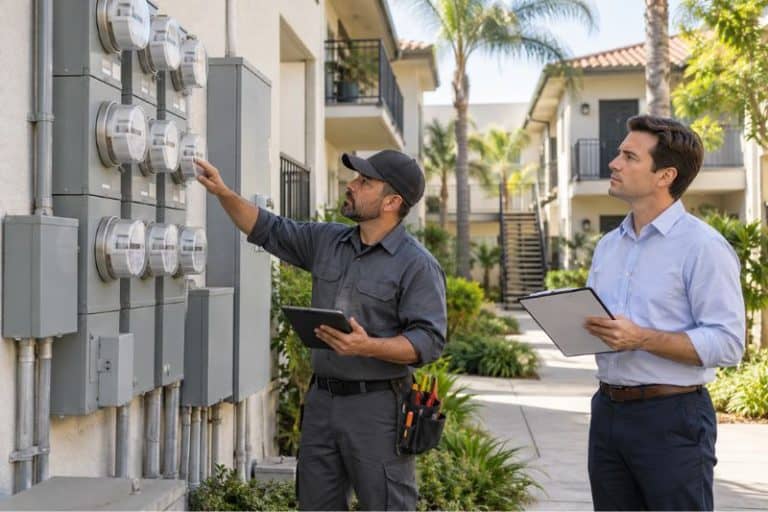
For property managers overseeing apartment buildings, the timeline question is rarely about a single unit. It is about sequencing work across multiple units while keeping the building as habitable as possible throughout the process. A building with twelve units undergoing a comprehensive rewiring program is not a twelve-times multiplication of a single-unit timeline, since common area work, shared electrical infrastructure, and tenant notification requirements all factor into the schedule differently than they would for a single-family home.
RG Electric typically works with property managers to stage multi-unit rewiring in phases, completing a small number of units at a time so that tenant disruption is contained and predictable rather than building-wide. This phased approach extends the total project timeline compared to working on every unit simultaneously, but it produces a more manageable experience for tenants and avoids the liability exposure that comes with displacing an entire building’s occupants at once. Property managers planning capital improvement budgets around electrical upgrades should factor this phased timeline into their planning rather than assuming a single, compressed project window.
Living in the Home During a Rewire
Most homeowners do not need to vacate the property during a rewire, though the experience involves some disruption. Power is generally maintained to most of the home throughout the project, with specific circuits or rooms losing power temporarily as work progresses through different sections.
The most disruptive period is typically during rough-in, when access to walls and ceilings requires moving furniture, covering belongings to protect against dust, and tolerating noise from drilling and fishing wire through wall cavities. RG Electric coordinates with property owners to minimize disruption where possible, including discussing which rooms can remain functional longest and sequencing work to limit how many areas are affected simultaneously.
For occupied multi-unit buildings, RG Electric works with property managers to stage work in a way that maintains habitability for tenants throughout the project, communicating clearly about which units will experience interruptions and when.
How to Get an Accurate Timeline for Your Property
Because rewiring timelines depend so heavily on property-specific conditions, the only way to get a reliable estimate is through an on-site assessment. During this visit, RG Electric evaluates the property’s construction, wiring condition, panel status, and access considerations, and provides a written timeline alongside the project estimate.
That estimate accounts for the realistic range of permit processing and inspection scheduling based on current LADBS conditions, rather than assuming the fastest possible scenario. Property owners and managers planning around a rewire, whether for an insurance deadline, a renovation schedule, or a property sale timeline, benefit from this realistic planning rather than an optimistic estimate that does not account for the variables outside the contractor’s control. A timeline that builds in realistic permit and inspection windows from the start is far more useful for planning purposes than one that only reflects the contractor’s working days and ignores everything else the project actually depends on to reach a finaled, inspected conclusion.
RG Electric communicates timeline updates throughout the project rather than providing a single estimate at the outset and going silent until completion. If permit processing takes longer than anticipated, if an inspection reveals additional findings, or if the scope changes once walls are opened, the property owner is informed promptly with an updated timeline rather than discovering delays after they have already occurred. This ongoing communication is part of the same direct, no-call-center approach that applies to every project RG Electric undertakes, regardless of size or complexity.
RG Electric’s wiring services in Los Angeles include full and partial rewires for properties throughout the San Fernando Valley, Koreatown, Culver City, and across greater Los Angeles, with permit management and inspection coordination handled as part of every project.
For properties where the rewire is connected to a panel replacement, RG Electric’s electrical panel services in Los Angeles coordinate both projects on a single timeline, which is typically more efficient than scheduling them as separate, sequential projects.
For immediate assistance or to schedule a professional evaluation, call RG Electric directly at (323) 521-5131.