
 Call (323) 5215131
Why Your GFCI Outlet Won’t Reset in Los Angeles, and What It Usually Means
Updated August 2026
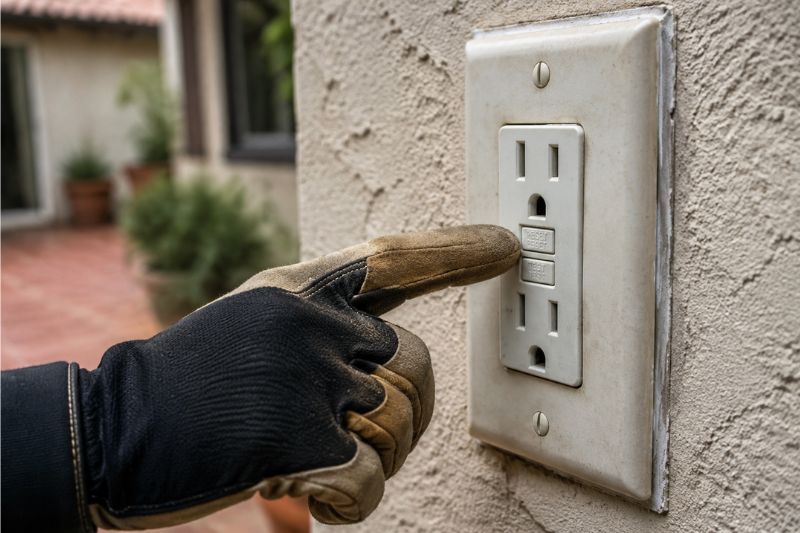
You press the reset button on the GFCI outlet in your kitchen, bathroom, or garage, and nothing happens. No click, no indicator light, no power. You try it again, and again, and the outlet stays dead. This is a different problem than an outlet that trips occasionally and resets fine when you press the button, and it usually means something more specific is going on behind the wall. RG Electric is a licensed C10 #910807 electrical contractor serving homes, apartment buildings, and commercial properties throughout Los Angeles, and a GFCI that refuses to reset is one of the more common reasons property managers and homeowners call us for a diagnostic visit.
A GFCI that won’t reset is not the same problem as one that keeps tripping
It helps to separate two situations that get described the same way over the phone but point to different causes. An outlet that trips and resets successfully, then trips again later under specific conditions such as when a hair dryer or space heater is plugged in, is usually responding to a real but intermittent fault or an overloaded circuit. That is a recurring pattern, and it is a different diagnostic path than the one this article covers.
An outlet that won’t reset at all, no matter how many times you press the button, is telling you something more immediate. Either the GFCI device itself has failed internally and can no longer complete the reset cycle, or there is an active fault somewhere on the circuit that is preventing the reset from holding, or the outlet has lost power upstream entirely and the reset button has nothing to engage. In every one of these cases, repeatedly pressing the button will not fix the underlying condition, and continuing to try can mask a fault that needs attention.
The most common reasons a GFCI won’t reset
A handful of conditions account for most of the won’t-reset calls we get across Los Angeles, from older homes in Encino and Sherman Oaks to apartment buildings in Koreatown and Downtown LA.
A dead or internally failed GFCI device
GFCI outlets have a limited service life. The internal components that sense ground faults and mechanically hold the reset can wear out or fail outright, particularly on units that have been in service for ten years or more, or that have taken repeated trips from a garage door opener, an outdoor irrigation timer, or another connected device with a small current leak. When the device itself has failed, no amount of resetting will bring it back, and the correct fix is a straightforward replacement with a new UL-listed GFCI rated for the circuit.
An active fault downstream of the GFCI
A single GFCI outlet often protects other outlets wired downstream of it, sometimes an entire bathroom, kitchen counter run, or a string of outdoor outlets around a patio. If one of those downstream outlets has moisture intrusion, a damaged cord plugged into it, or a wiring fault, the GFCI will refuse to reset because it is still detecting the fault condition the instant power is restored. This is one of the more frequent findings in older Los Angeles homes where outdoor outlets were added without weatherproof covers, or where a previous renovation left a splice exposed to moisture in a crawlspace or attic.
A wiring fault at the outlet itself
Reversed polarity, a loose or backstabbed connection that has arced, or incorrect line and load terminal wiring can all prevent a GFCI from resetting correctly, even when the device itself is otherwise healthy. This is common when a GFCI was installed by a handyman rather than a licensed electrician. The line and load terminals on a GFCI are not interchangeable, and wiring them backward can cause the outlet to appear dead, refuse to reset, or fail to protect any downstream outlets the way it is supposed to.
No power reaching the outlet at all
Sometimes the reset button appears unresponsive because the outlet has no power to work with in the first place. A tripped breaker at the panel, a loose neutral connection upstream, or in older buildings a failing connection at the panel bus can cut power to the circuit entirely. In this situation the GFCI is not malfunctioning. It simply has nothing to reset. Checking the panel before assuming the outlet itself is bad can save an unnecessary service call, though a breaker that has tripped for no obvious reason is itself worth having looked at.
What the reset button is actually doing
A GFCI outlet constantly compares the amount of current flowing out on the hot conductor to the amount returning on the neutral. Under normal operation those two numbers match. If even a small amount of current, as little as a few milliamps, is finding a path to ground instead of returning through the neutral, the device senses the imbalance and interrupts the circuit in a fraction of a second, well before that stray current could pass through a person standing in a puddle or touching a wet surface. Pressing the reset button closes the internal contacts again and re-arms the sensing circuit. If the imbalance is still present the instant power is restored, the device either will not reset at all or will trip again immediately, which is why a GFCI that senses an active fault often behaves as though it is simply broken.
This is also why swapping in a brand new GFCI does not always solve the problem. If the fault is downstream on the circuit rather than inside the device, a new GFCI will refuse to reset for the same reason the old one did. Diagnosing a won’t-reset outlet correctly means determining whether the problem lives inside the device or somewhere else on the circuit before any parts are replaced.
Two examples of how this plays out
A homeowner in an older Sherman Oaks house calls because the bathroom GFCI stopped resetting after a storm. The breaker is on, the outlet is dead, and pressing reset does nothing. On inspection, the fault traces to an original 1970s exterior outlet on the same circuit that was never upgraded to a weatherproof, in-use cover. Rainwater reached the contacts and created a ground fault that the GFCI correctly detected. Once the exterior outlet is replaced and properly sealed, the bathroom GFCI resets normally on the first try, because the fault it was sensing is gone.
A property manager overseeing a Koreatown apartment building calls because a tenant reports the kitchen GFCI in one unit will not reset at all. In this case, the device itself has failed internally after years of service, unrelated to any external fault. Replacing the GFCI with a new device resolves it in one visit. Both calls start with the identical phrase, the outlet won’t reset, but the causes and the correct fix are completely different, which is exactly why a proper diagnostic matters more than guessing and swapping parts.
Why this deserves attention rather than a workaround
A dead GFCI outlet is often more than an inconvenience. Kitchen counter outlets, bathroom outlets, garage outlets, and outdoor outlets are required to have GFCI protection under California electrical code specifically because those locations carry a higher risk of shock. If the outlet won’t reset, in most cases you have lost power to that location and any outlets downstream of it, and if a homeowner or handyman bypasses the GFCI with a standard outlet to restore power quickly, the location loses its shock protection entirely. That is a life safety issue, not just a convenience one, and it is also the kind of workaround that shows up as a code violation during a home sale inspection or an insurance review.
For property managers, a GFCI that won’t reset in a tenant-occupied unit carries additional weight. A dead outlet in a kitchen or bathroom is a habitability and liability issue, not a maintenance inconvenience, and documenting the repair with a licensed contractor protects the building if the condition is ever questioned later.
What we check during a GFCI diagnostic visit
When RG Electric is called out for a GFCI that won’t reset, the technician starts at the panel to confirm the breaker for that circuit is on and to check for heat or looseness at the bus connection. From there, we test the GFCI device itself to determine whether it has failed internally, trace the circuit to identify what else is wired downstream of it, and inspect those downstream outlets and any exposed splices for moisture, damage, or loose connections. If the device wiring itself is suspect, we verify the line and load terminations are correct, since a reversed connection is an easy thing for an unlicensed installer to get wrong and a straightforward thing for us to correct.
Once we identify the cause, we explain what we found in plain terms before any repair begins, whether that means replacing the GFCI device, correcting a wiring fault at the outlet, or addressing a moisture or damage issue downstream. If the diagnostic uncovers a broader condition, such as multiple outlets on the circuit needing GFCI upgrades to meet current code, we provide a written estimate for that scope rather than performing partial work that leaves part of the problem unresolved.
Diagnostic visits like this are scheduled as service calls, with an upfront fee that covers the technician’s time and travel, explained clearly before the appointment is confirmed. Once the technician identifies what is causing the outlet not to reset, that finding is reported back and turned into a written estimate with every line item explained, so there is no ambiguity about what the repair involves or why it is needed. If a related issue shows up after the repair is complete, whether it is the same GFCI or something connected to it, we come back and correct it without billing a second service call. You are already a customer at that point, and the work is meant to hold.
When it’s reasonable to try once more, and when to call
If the outlet has never given you trouble before and you know a specific appliance was just plugged in or unplugged, or if there was a storm or a moisture event nearby, it is reasonable to check the breaker at the panel and try the reset button one time. If it resets and holds, the immediate issue may have cleared on its own, though a single unexplained trip is worth mentioning if you have other electrical work scheduled.
If the outlet has already failed to reset more than once, if you smell anything burning, if the faceplate is warm or discolored, or if this is an outdoor, kitchen, or bathroom outlet in a rental unit, it is time to call rather than keep testing it. Continuing to press a reset button on a device that has an active fault does not fix anything, and it delays finding out what is actually wrong.
What this means for older Los Angeles housing stock
Los Angeles has a large share of homes and small apartment buildings built well before GFCI protection was required, in Van Nuys, Encino, Culver City, Inglewood, and throughout the San Fernando Valley. Many of these properties have had GFCI outlets added over the years by different owners, different contractors, and occasionally an unpermitted handyman visit, which means the wiring behind any given GFCI outlet is often a patchwork rather than a single coherent installation. That history is part of why won’t-reset calls are common here specifically. A GFCI added in 1995 protecting a circuit that was extended in 2008 and had an outdoor outlet added in 2015 has three separate eras of workmanship to account for, and a fault anywhere in that chain will show up at the original GFCI as a refusal to reset.
For a homeowner, this usually means the fix is a single dead device or one damaged downstream outlet. For a property manager overseeing an older multi-unit building, it is worth treating a persistent won’t-reset outlet as a signal to have the full circuit reviewed rather than only the one device, since the same patchwork wiring history often repeats across multiple units in a building constructed during the same era of ownership.
Our electrical outlet and switch repair services in Los Angeles cover exactly this kind of diagnostic and correction work, from a single dead GFCI to a full outlet upgrade across a unit or building. When what we find points to a wiring condition beyond the outlet itself, such as deteriorated branch wiring or a panel-level issue, that work is handled through our broader electrical repair services in Los Angeles.
If your GFCI outlet keeps tripping rather than refusing to reset outright, that is a related but distinct pattern covered in our article on why a GFCI outlet keeps tripping and when it is not the outlet.
Electrical work is hazardous. Consult a licensed electrician like RG Electric before working on GFCI devices, panels, or wiring.
For immediate assistance or to schedule a professional evaluation, call RG Electric directly at (323) 521-5131.