
 Call (323) 5215131
Indoor Lighting Installation Services in Los Angeles
When the lighting in a home, apartment, or commercial property is wrong for the space, people feel it before they can name it. Rooms feel dim or harsh, kitchens lack the task light needed to work comfortably, common areas in apartment buildings fail inspection, and older fixtures create code problems that slow down sales and insurance renewals. RG Electric, License C10 #910807, installs and upgrades indoor lighting throughout Los Angeles for homeowners, property managers, and commercial tenants, with work that is inspection-ready, correctly permitted where required, and built to last.
Call (323) 521-5131 to schedule a free estimate for new lighting work.
What Brings Most Customers to Us
The calls we receive about indoor lighting fall into a few predictable categories. Homeowners in older properties across Sherman Oaks, Koreatown, and the West Side are still running original fixtures on circuits that were never designed for modern load demands. Property managers in Culver City and Downtown LA are fielding inspection failures because common area lighting does not meet current code. Landlords in the San Fernando Valley are dealing with tenant complaints about dim corridors and lobbies that feel unsafe at night. And homeowners throughout Encino and Beverly Hills are mid-remodel, trying to add recessed lighting without knowing whether their panel has the capacity to support it.
Each of these situations calls for a licensed electrician, not a handyman. Lighting work that touches wiring, circuits, junction boxes, or the panel requires code-compliant installation, correct box support for fixture weight, and in many cases a permit. Work done without those elements creates liability at the point of sale, during insurance underwriting, and when an inspector walks the property.
How Lighting Work Is Quoted: Free Estimate or Service Call
Two calls about the same ceiling can lead to very different visits. Say you want five recessed lights in a kitchen ceiling. That is new work, so we look at the area and give you a free estimate. Say instead that one recessed light has stopped working. A technician has to find out whether the fixture needs replacing or whether there is a short in the attic, and that takes time and skill, so it is a service call with a fee up front.
In both cases we do not bill by the hour. We scope the work and give you a written estimate, and everything necessary is in it, so there are no hidden fees. We also stand behind our work for 12 months. If something we installed misbehaves in that window, you are already our customer, and we come back without charging another service call.
Recessed Lighting Installation
Recessed downlights are the most requested lighting upgrade we handle, and they are also the most likely to be done incorrectly when a homeowner hires someone without the right license or experience. The fixture selection, the housing type, the spacing, the circuit sizing, and the control compatibility all matter, and they all interact.
Housing and trim selection
We install IC-rated, airtight housings where the fixture is in contact with insulation, which applies to most first-floor ceilings and any ceiling directly below an attic. Low-profile remodel-rated fixtures go in where plenum space is limited or attic access is not available, allowing us to work cleanly without tearing into ceilings. For vaulted and sloped ceilings throughout the Hollywood Hills, Los Feliz, Echo Park, and other hillside neighborhoods, we use gimbaled trims so the beam angle lands where it should regardless of ceiling pitch.
Spacing and aim
Consistent spacing prevents the scalloping effect on walls that comes from fixtures placed too close to vertical surfaces. We map fixture locations relative to ceiling height, room width, and furniture layout before any holes are cut. In kitchens, we aim downlights at counters and away from the cook’s eyes. In living rooms, we stagger fills and accent positions so the room has depth rather than flat even light. This planning step is where the difference between a professional installation and a DIY attempt becomes most visible.
Dimmer compatibility
Not every dimmer works with every LED driver, and the wrong combination produces flicker, hum, or a dim range that starts too high. We select dimmers rated for the specific fixtures being installed, verify minimum load requirements, and test the full range from zero to full before the job closes. Multi-location dimming for larger rooms requires correct traveler wiring, which is a common point of failure in unlicensed work.
Kitchen, Bathroom, and Task Lighting
Spaces where people perform close work need lighting that reduces eye strain without creating glare. A single ceiling fixture in the center of a kitchen or bathroom produces shadows on the work surface directly below it, which is exactly where accurate light is needed most.
Kitchen lighting
A well-lit kitchen combines ceiling fill with dedicated task light at counters and islands. Under-cabinet lighting should wash the counter surface rather than the backsplash, and it should operate on a separate circuit from the overhead fixtures so levels can be adjusted independently. Island pendants should be sized proportionally to the surface below, hung at a height that clears sightlines without creating hot spots, and fitted with diffusers that soften the source. We pull dedicated circuits for under-cabinet runs and coordinate with any ongoing kitchen renovation to rough in while walls are open.
Bathroom lighting
Bathroom lighting needs accurate color rendering for grooming and makeup, and it needs to be placed to eliminate facial shadows. Ceiling downlights alone create shadows under the chin and brow. The arrangement that works is vanity light at face height on either side of the mirror, supplemented by ceiling fill. We install GFCI-protected circuits where code requires them, select fixtures rated for wet or damp locations near the shower or tub, and match color temperature to the rest of the home so the bathroom does not feel like a different building.
Home office and task spaces
Home offices, craft rooms, and laundry spaces benefit from higher lumen levels and careful glare management for screens. We position fixtures to avoid reflections on monitor surfaces and select color temperatures that support alertness during working hours. For dedicated home office circuits that also power workstation equipment, we evaluate panel capacity and add a dedicated circuit if the existing load is already at or near the breaker limit.
Chandelier and Fixture Installation
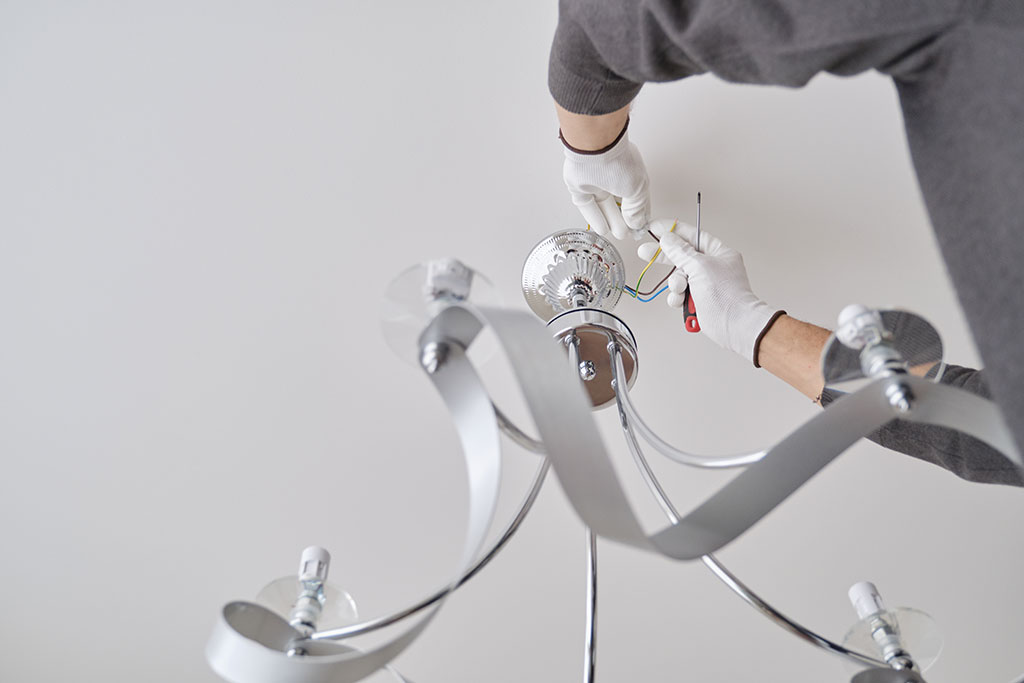
Chandelier and heavy pendant installations require a junction box that is rated for the fixture weight, mounted to solid blocking or a rated ceiling brace, and wired with conductors sized for the load. The standard pancake box used for lightweight fixtures is not rated for chandeliers, and an installer who does not check box rating before hanging a 40-pound fixture is creating a safety problem.
We assess the existing box before any fixture goes up, replace it with a fan-rated or heavy-fixture-rated box where needed, and verify that the circuit conductor and breaker are appropriately sized. For very large fixtures in entry halls and dining rooms across Beverly Hills, West Hollywood, and Sherman Oaks, we confirm clearances and chain length before installation so the fixture hangs at the right height relative to the table or floor. The result is a fixture that is safe, level, and correctly aimed.
Smart Dimming and Lighting Controls
Lighting controls are where a good installation becomes a genuinely useful one. The options range from simple single-pole dimmers to scene controllers, occupancy sensors, and smart switches that integrate with voice assistants and home automation platforms.
Scene control and multi-location dimming
Scene-capable systems let you set a lighting configuration for cooking, dining, entertaining, or watching a film and recall it with a single tap. Multi-location dimming allows a large room to be controlled from multiple switch points without running additional switch legs, which is particularly useful in open-plan spaces where the original wiring was laid out for a single switch. We install these systems with correct traveler wiring and verify every control point before the job closes.
Occupancy and vacancy sensors
Sensors in hallways, closets, laundry rooms, and garages prevent lights from being left on in unoccupied spaces. For apartment common areas, sensors reduce energy cost and maintenance calls without requiring tenants to remember to switch lights off. We select sensor type, vacancy or occupancy, based on the room use and set sensitivity and timeout to match the space so the light does not cut out while the room is still in use.
Indoor Lighting for Apartment Buildings and Commercial Properties
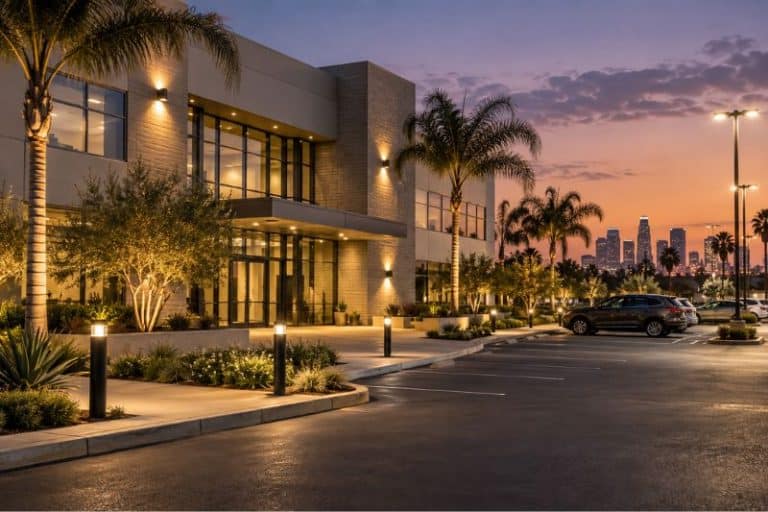
Property managers face a different set of problems than homeowners. Common area lighting in apartment buildings throughout Inglewood, Torrance, Koreatown, and the San Fernando Valley is subject to inspection by LADBS, habitability standards under California tenant law, and increasingly, insurer requirements tied to policy renewals. A lobby or corridor that does not provide adequate light, or that has poorly supported fixtures, is a liability exposure and not just an aesthetic problem.
Common area upgrades
We standardize fixture types across corridors, stairwells, laundry rooms, and lobbies so that future lamp replacements are straightforward and maintenance staff does not need to track multiple fixture models. Vandal-resistant fixtures go in where the installation environment requires them. For covered parking structures and carports, we specify fixtures rated for the exposure level and verify that emergency egress lighting meets code requirements for the occupancy type.
Tenant improvement lighting
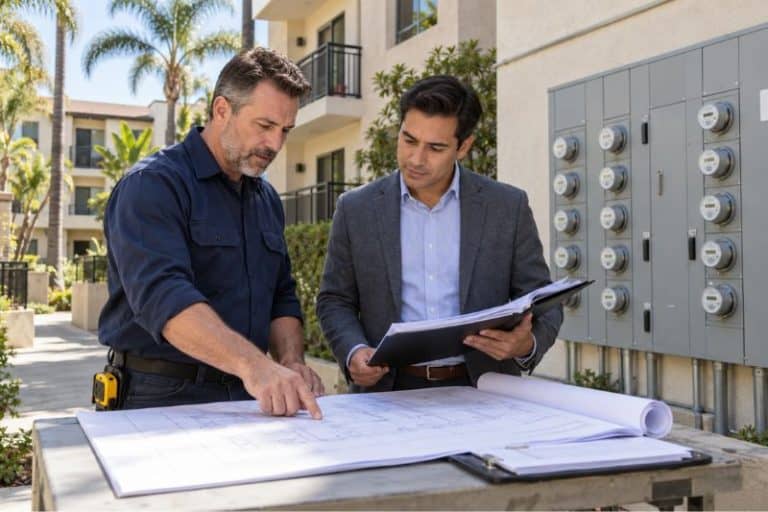
Tenant improvement projects often require new circuits, additional junction boxes, and panel capacity evaluation before any fixtures go in. We work from the panel forward, confirm available capacity using our electrical panel services, and pull permits where the scope requires them. Property managers ask first for permits and a certificate of insurance, and we provide both on commercial projects. For commercial tenants in office and retail spaces throughout Downtown LA, Culver City, and West Los Angeles, we also provide labeled circuit schedules and documentation suitable for the building’s property management records.
Title 24 and energy code compliance
California’s Title 24 energy code applies to lighting alterations in commercial occupancies and new construction. Requirements include occupancy sensor controls in certain spaces, daylight controls where glazing is present, and fixture efficacy minimums. We are familiar with these requirements and design lighting plans that satisfy them without over-engineering the installation. For property managers navigating a compliance upgrade, we provide documentation that satisfies the inspector at final.
Retrofit and Upgrade Work
Most indoor lighting upgrades in Los Angeles happen in occupied homes and buildings, which means the work needs to be clean, targeted, and minimally disruptive. We do not default to opening walls or cutting large access holes when smaller solutions are available.
LED retrofits
Existing recessed cans can often be retrofitted with high-quality LED modules that clip into the existing housing without requiring ceiling work. The result is a significant improvement in light quality, color accuracy, and energy consumption without the disruption of a full replacement. We select retrofit modules matched to the existing housing type and verify dimmer compatibility before the work begins.
Circuit additions and panel capacity
Older homes in neighborhoods like North Hollywood, Van Nuys, and Northridge frequently have lighting circuits that are shared with outlets and already carrying close to their rated load. Adding fixtures to an overloaded circuit is a code violation and a fire risk. Where capacity is the constraint, we add a dedicated lighting circuit using our wiring services, routed cleanly from the panel with minimal disruption to finished surfaces. If the panel itself is the limiting factor, we coordinate a capacity evaluation before the lighting work begins.
Protecting finishes during installation
We protect floors and furniture before any work starts, use strategic access points that minimize the number and size of openings, and handle any patching from small cuts so the room looks finished when we leave. For custom millwork, plaster ceilings, or tile surfaces, we take additional care with layout and access to avoid damage that would cost more to repair than the lighting work itself.
Permits, Inspections, and Code Compliance
In Los Angeles, new recessed lighting counts as permitted electrical work through LADBS, and so does anything that adds circuits, adds junction boxes, or changes the wiring. A straight swap of one fixture for another is a different question from adding new fixtures, and we confirm which one applies at the estimate. Unpermitted work creates problems at the point of sale, during refinancing, and when an insurance claim involves electrical equipment. We pull permits when required, meet the inspector on site, and provide a documentation packet at closeout that includes the permit, the inspection sign-off, and photos of the completed installation.
Code requirements for lighting include listed junction boxes with adequate support ratings for fixture weight, correct conductor fill in boxes, GFCI protection in bathrooms, kitchens, and outdoor locations, and AFCI protection on bedroom circuits in newer construction and significant renovations. We verify compliance at each stage rather than leaving it for the inspector to catch.
Our Process, Start to Finish
The process starts with a site visit or photo review of the existing panel, the rooms being upgraded, and any fixtures the customer has already selected. We confirm goals, evaluate circuit capacity, propose layouts and fixture options where the customer wants guidance, and provide a clear estimate before any work begins. The estimate reflects the full scope, including any circuit additions or panel work the project requires.
On site, we protect floors and furniture, install boxes and supports first, pull conductors, and set controls before fixtures go in. We test dimming range for smooth operation without flicker, verify GFCI and AFCI protection where required, aim accent fixtures, and confirm that the panel directory is labeled accurately at closeout. For permitted work, we schedule and attend the final inspection. You receive a complete documentation packet, including photos of the finished installation, for your records.
Costs and Timeline
Pricing depends on fixture count, ceiling type, access above the ceiling, whether new circuits are needed, control complexity, and permit requirements. A focused retrofit in one or two rooms may complete in a half day. Multi-room installations, common area upgrades in apartment buildings, or tenant improvement projects with new circuit runs are scoped individually and may be phased to work around occupancy. To speed the estimate process, a photo of your existing panel with the door open, the rooms being upgraded, and ceiling heights helps us prepare before the visit and give you a more accurate range upfront.
Related Electrical Services
Lighting projects often surface other needs. See our work on outlets and switches, our circuit breaker services, and our smoke detector installation, which pairs well with hallway and stairwell lighting upgrades.
Frequently Asked Questions
Do I need a permit to install recessed lighting in Los Angeles?
In most cases, yes. LADBS treats new recessed lighting as permitted electrical work because it adds fixtures and new wiring to the system. We confirm the scope at the estimate, pull the permit, and schedule the inspection. Skipping the permit shifts the risk to you at sale, at refinancing, or during an insurance claim.
Can you add recessed lighting without cutting into the ceiling?
Usually. Remodel-rated recessed fixtures install through a cutout in the finished ceiling without attic access or ceiling demolition. Where attic access is available, we can also fish wire without opening walls. We assess your ceiling construction at the estimate and choose the approach that disturbs the least.
My dimmer switch hums or flickers with my new LED bulbs. What is wrong?
Dimmer and LED driver incompatibility is the most common cause. Not every dimmer is rated for LED loads, and some dimmers have minimum load requirements that a small number of LED fixtures cannot meet. We select dimmers rated for the specific fixtures being installed and verify the full dimming range before the job closes. If you already have an installation with this problem, we can diagnose it and replace what needs replacing.
How do I know if my electrical panel can support additional lighting circuits?
Capacity depends on your service size, the existing load, and the breaker spaces available. We evaluate it during the site visit, before recommending new circuits. If the panel is at its limit, or is a legacy brand that needs replacing, that comes first, so the lighting work rests on a reliable foundation.
Do you install smart lighting systems?
Yes. We install smart switches, dimmers, and occupancy sensors compatible with common home automation platforms. For larger installations with scene control, we design the system, install the hardware, and verify that every control point works before we leave. We do not program third-party apps, but we confirm the hardware is ready for setup.
We manage an apartment building and our common area lighting failed an inspection. What is the process?
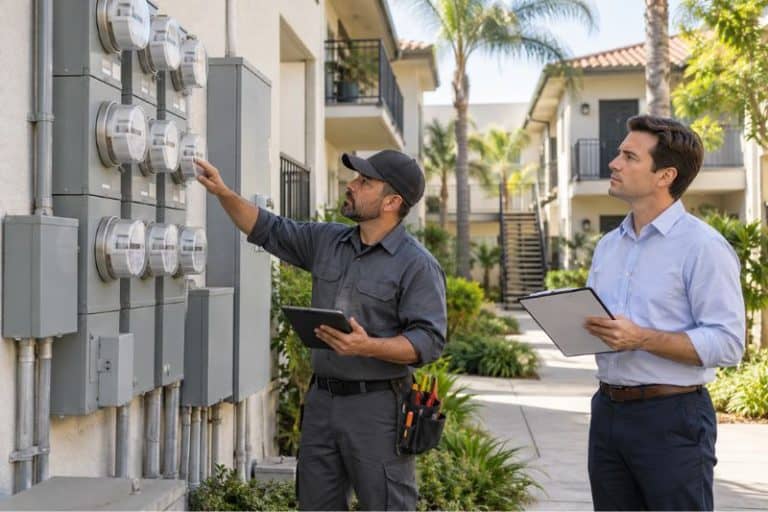
We start with a walk of the affected areas to learn exactly what failed, whether that is fixture support, missing GFCI protection, inadequate light levels, or something else. Then comes a scoped estimate, any required permits, the corrections, and a re-inspection. At closeout we provide documentation that satisfies LADBS and, if coverage was a factor, your insurance carrier.
For immediate assistance or to schedule a professional evaluation, call RG Electric directly at (323) 521-5131.
Electrical work is hazardous. Always consult a licensed electrician like RG Electric before working on electrical systems.