
 Call (323) 5215131
What Triggers an LADWP Service Change During an Electrical Panel Upgrade in Los Angeles
Updated September 2026
A homeowner in Tarzana books a 100 amp to 200 amp electrical panel upgrade expecting the crew to show up, swap the panel, and be done in a single day. Three full weeks later the project still has not started, and the delay has nothing to do with RG Electric’s schedule. It is sitting with LADWP, waiting on a step most homeowners never knew existed. RG Electric, license C10 #910807, spends a genuinely fair amount of time explaining this exact gap to customers, because a panel upgrade and a service change are two different pieces of the same project, and only one of them is something a licensed electrician controls the timeline for.
What a Service Change Actually Is
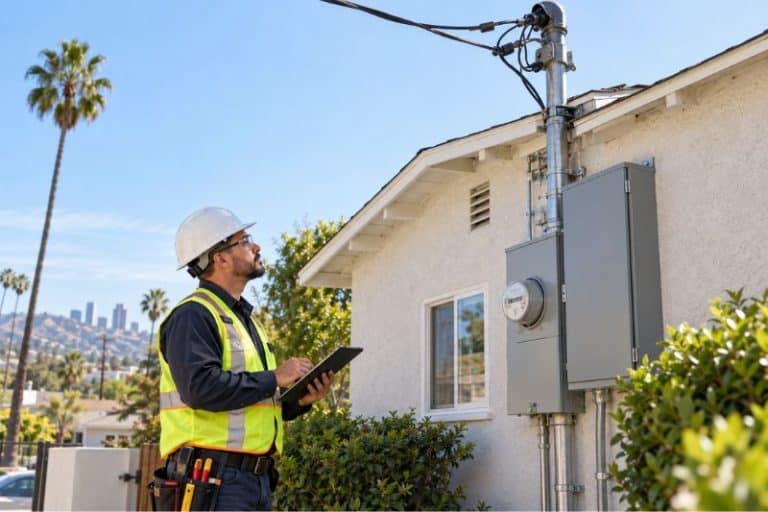
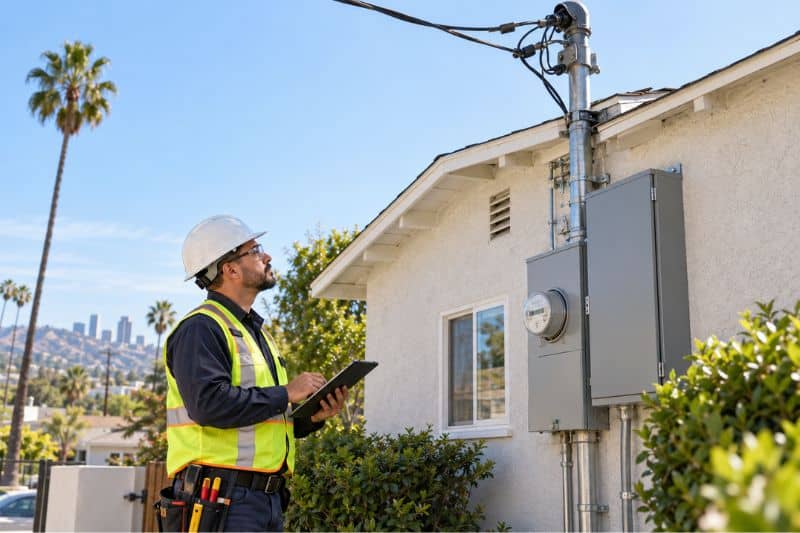
A panel upgrade replaces the equipment inside the home, the breaker panel itself, the main disconnect, and the wiring that connects to it. A service change is a different scope entirely. It covers everything on the utility’s side of the meter, the meter socket, the service drop or underground lateral bringing power from LADWP’s system to the property, and in some cases the transformer serving that section of the street. RG Electric can complete a panel upgrade on its own timeline once permits are pulled. A service change depends on LADWP’s construction crews, and that is a schedule RG Electric coordinates but does not control.
The distinction matters because the two halves of the project answer to different authorities. LADBS inspects and signs off on the panel work happening inside the home. LADWP owns and maintains everything upstream of the meter, and no amount of contractor scheduling changes how quickly their construction crews can get to a given job. A homeowner frustrated with a slow timeline is often, without realizing it, frustrated with the wrong party, since the contractor may have finished their portion of the work weeks earlier and simply be waiting alongside the customer for LADWP’s queue to clear.
Most homeowners hear “panel upgrade” and assume the entire project is one continuous piece of work performed by one contractor on one timeline. In Los Angeles, a panel upgrade that increases the size of the electrical service is really two projects running in parallel, one that RG Electric performs directly and one that depends on LADWP’s own construction queue.
The Amperage Threshold That Triggers LADWP Involvement
Any project that increases the size of the main electrical service, a 100 amp panel becoming a 200 amp panel, or a 200 amp service moving up to 320 or 400 amps, requires LADWP coordination. The existing service drop and meter equipment were sized for the old service, not the new one, and LADWP has to confirm and often physically upgrade that equipment before the larger panel can be energized. This is true regardless of how straightforward the panel work itself is on the house side.
LADWP treats services between roughly 0 and 400 amps single phase as small electric services, handled by an assigned Electric Service Representative. Larger services, and any service fed underground, require a more formal submittal, a Service Planning Information Form along with a site plot plan, which adds both paperwork and review time to the front end of the process. A straightforward single family 100 to 200 amp upgrade moves through the small service path. A larger multi-unit or commercial service, or any underground fed property, should expect the more involved version from the start.
The practical difference between these two paths is significant enough that it is worth asking about early rather than assuming every service change follows the same timeline. A single family home moving from 100 to 200 amps on an overhead service is a well worn path that LADWP processes routinely. A commercial property or a multi-unit building requesting a larger service, or any property whose service is fed underground rather than overhead, is working through a review process with more variables and correspondingly less predictable timing.
Why Adding Load Can Trigger a Service Change Even Without a Bigger Panel
This is the part that catches people off guard. A service change is not only triggered by asking for a bigger panel number. Utilities generally size the equipment serving a property based on historical demand, and they assume future demand will look similar unless someone tells them otherwise. Adding a significant new load, a Level 2 EV charger, an electric heat pump replacing gas heat, or new construction like an ADU, can push actual demand past what the existing service was ever sized to deliver, even if the panel itself technically still shows the same amperage rating on its label.
A homeowner who adds an EV charger to an existing 100 amp service without ever formally upgrading the panel can end up needing LADWP involvement anyway, once the added demand is accounted for. This is exactly why a load calculation matters before equipment gets ordered. It answers the question of whether the existing service can actually absorb the new demand or whether the project has quietly become a service change project whether or not anyone called it that at the start.
Solar installation follows a related but distinct process, since adding generation to a property changes the relationship between the home and the grid in ways a straight load addition does not. Solar interconnection has its own LADWP application and review path separate from a standard service change, though the two sometimes overlap on a single property, particularly when a homeowner is adding solar and an EV charger in the same project. Treating these as one undifferentiated LADWP process rather than two related but separate applications is a common source of confusion during planning.
The Meter Spot Process
Before a new or relocated meter panel goes in, LADWP requires a meter spot request, a free service that verifies the correct placement of the meter equipment. This is not a formality that can be skipped by a contractor confident about where the panel should go. Code and safety requirements sometimes require a new meter panel to sit in a different location than the old one, and LADWP’s confirmation happens before installation, not after.
Skipping ahead of this step is one of the more avoidable ways a project loses time. A panel mounted in a location LADWP has not approved can mean removing and relocating equipment that was just installed, which costs far more in time and materials than waiting the extra few days for meter spot confirmation would have cost in the first place.
Meter spotting exists because meter placement affects more than just convenience. Access for LADWP meter readers, clearances from doors and windows, and proximity to gas meters or other utilities all factor into where a meter panel is allowed to sit. A contractor who mounts new equipment based purely on what looks convenient from inside the house, without confirming it against LADWP’s own requirements, is gambling with a step that has no real upside to skipping.
Fault Current and Why Larger or Unusual Services Take Longer
For a standard single family home, mobile home, or duplex, LADWP guarantees a specific available fault current figure, the amount of current available from the serving transformer during a ground fault, 10,000 amps for a 200 amp service and 22,000 amps for a 320 amp service. This guaranteed figure lets a standard residential project move through review quickly, since the electrical equipment can be specified against a known number. Anything outside that standard category, larger commercial services, unusual configurations, unusual load profiles, requires the fault current to be calculated individually by an LADWP engineer, which means submitting plans and waiting for that calculation before the project can move forward. This is one of the clearest reasons a commercial or multi-unit service change consistently takes longer than a single family one, independent of how much bigger the actual panel work is.
Fault current is not a detail an electrician can simply estimate and move forward with. Equipment rated for the wrong fault current is a genuine safety issue, not a paperwork technicality, since breakers and panels need to be able to safely interrupt the actual fault current available at that service point. This is part of why the guaranteed figures for standard residential services exist. They let a common, well understood project move quickly while still guaranteeing the equipment specified will actually perform correctly if something goes wrong.
Always consult a licensed electrician like RG Electric before working on electrical systems.
Why This Matters More for Property Managers Planning Capital Work
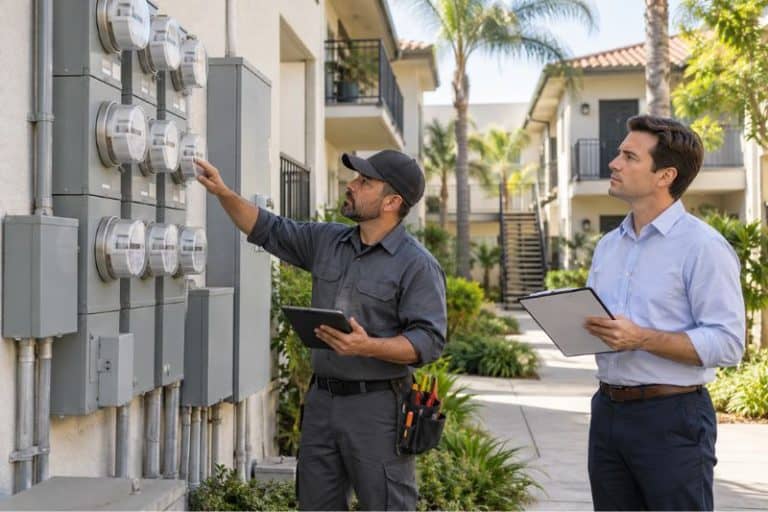
A homeowner absorbing an unexpected few weeks of delay on a personal panel upgrade is an inconvenience. A property manager scheduling a capital improvement across a multi-unit building, coordinating tenant notifications, contractor availability, and a budget cycle around a service change that runs longer than expected, is a more expensive problem. Building an LADWP timeline buffer into the project schedule from the start, rather than assuming the electrical contractor’s timeline is the only variable, is the difference between a capital project that finishes on schedule and one that quietly slips by a month because nobody accounted for a step outside the contractor’s control.
This is particularly relevant for buildings across Koreatown, Downtown LA, and the San Fernando Valley planning EV charging infrastructure or electrification upgrades tied to California’s broader push away from gas appliances. Any of these projects can trigger a service change even on a building whose panels were only recently updated, since the trigger is the added load, not the age of the existing equipment.
Multi-unit buildings planning a phased electrification rollout, replacing gas water heaters or gas ranges building by building rather than all at once, deserve particular attention here. Each phase adds load to the same underlying service, and a service that comfortably absorbed the first phase can be genuinely inadequate for the third or fourth, even though no single phase looked dramatic on its own. Evaluating total planned load across every phase up front, rather than reacting to a service change trigger only once it has already been hit, gives a property manager the chance to size the service correctly once instead of returning to LADWP repeatedly as each phase adds more demand.
How RG Electric Manages LADWP Coordination
RG Electric evaluates whether a project will trigger a service change during the free estimate, before any equipment is ordered or work is scheduled, so the timeline conversation happens up front rather than partway through the job. Where a service change is required, RG Electric submits the meter spot request, handles the LADWP paperwork for small services, or prepares the Service Planning Information Form and plot plan for larger and underground services, and keeps the customer informed of where the project actually sits in LADWP’s queue rather than leaving them to guess.
This means a customer signing off on an estimate knows from day one whether their project is a straightforward panel swap or a two track project waiting on both a contractor and a utility. That distinction changes what a reasonable question about progress looks like partway through the job, and it changes what a customer should expect to hear when they ask for an update.
This coordination is part of what RG Electric means when it describes its approach as following code to the teeth. A service change is not an optional step to work around. It is a required part of the process for any project that increases service capacity or adds significant new load, and treating it as a footnote rather than a planned phase of the project is how timelines quietly slip and customers end up frustrated with a delay that was never really in their contractor’s control to begin with.
RG Electric is licensed, bonded, and insured, and that standing matters specifically during LADWP coordination, since the utility is working with a contractor of record on every submittal. A homeowner or property manager trying to navigate meter spot requests, service planning forms, and fault current calculations without a licensed electrician managing that relationship is taking on a coordination burden that most people have no reason to already understand, on top of everything else an electrical project already involves.
Planning Around the Part of the Project Nobody Controls Alone
A panel upgrade and a service change are not the same project, even though most homeowners experience them as one. RG Electric handles electrical panel upgrades across Los Angeles with LADWP coordination built into the estimate from day one, and works alongside the same team that handles circuit breaker services once the new service is energized and the panel itself needs to be finished out.
Customers who understand this distinction going in tend to have a much smoother experience than customers who assume any delay is their electrician falling behind. Knowing which part of the timeline belongs to LADWP and which part belongs to RG Electric turns a frustrating unknown into a schedule that can actually be planned around, rather than a source of ongoing uncertainty for the entire length of the project.
For immediate assistance or to schedule a professional evaluation, call RG Electric directly at (323) 521-5131.