
 Call (323) 5215131

Choosing a Commercial Electrical Contractor in Los Angeles: Permits, Licensing, and Multi-Unit Experience
Updated October 2026
A tenant calls about flickering lights in the hallway. Your insurer wants proof that the building’s electrical system has been maintained. A city inspector has just failed a job that was supposed to be finished last week. Any one of these puts a property manager in the position of hiring an electrician quickly, often without a clear way to tell a strong contractor from a risky one. RG Electric is a licensed C10 #910807 electrical contractor serving commercial and multi-unit properties across Los Angeles, and this guide lays out how to evaluate any contractor before the work starts, including us. It covers what to verify, what to ask, how to read an estimate, and what working in an occupied building should look like.
Why Contractor Selection Is a Risk Decision for Property Managers
Hiring an electrician for a commercial building is not the same decision as hiring one for a house. A homeowner who picks the wrong contractor carries the consequences alone. A property manager who picks the wrong one carries them on behalf of an owner, a lender, an insurer, and every tenant in the building.
What goes wrong when price is the only filter
The lowest bid is usually the one with the most left out. Permit fees, patching and painting after wall work, testing, and correction time all vanish from a thin estimate and reappear later as change orders. A contractor who skips the permit can quote lower still, and that saving is the most expensive one on the page, because unpermitted electrical work leaves no record for an insurer to read and can force the work to be opened up and redone.
The other cost is time. A job that fails inspection stalls the building. Tenants wait, the schedule slips, and the property manager fields the complaints. The bid that looked cheapest at signing rarely stays cheapest by closing day.
Why multi-unit buildings raise the stakes
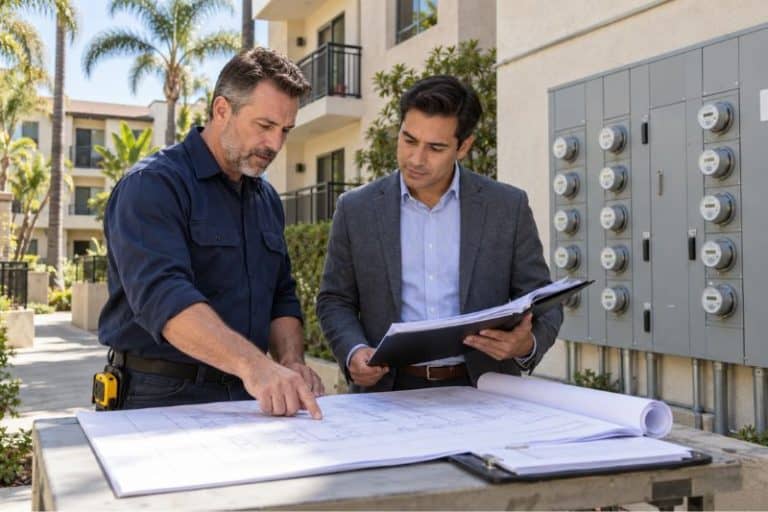
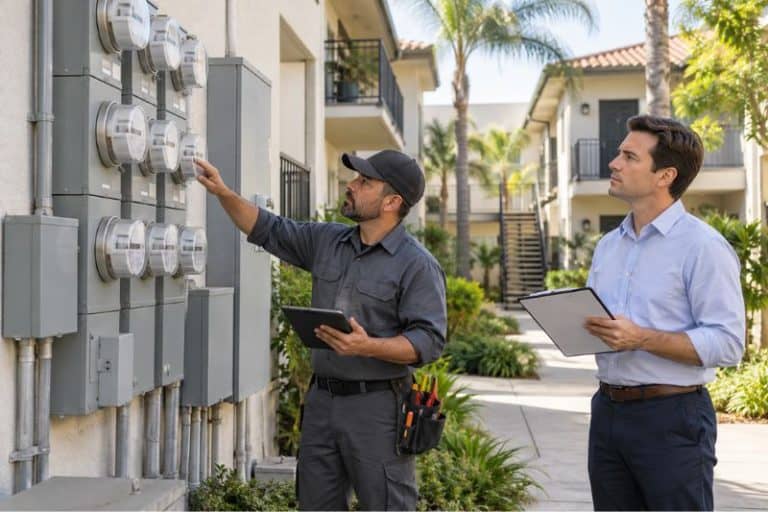
In an apartment building or mixed-use property, the electrical system is shared. One service feeds a meter room, a house panel, unit panels, and common loads such as corridor lighting, elevators, garage doors, and fire alarm equipment. A mistake in one place can take out power in another. Work that would be a quiet afternoon in a single-family home in Encino becomes a coordination exercise in a forty-unit building in Koreatown, with tenants to notify, shutdowns to sequence, and an inspector who needs to see the whole picture.
That is why a contractor’s experience with properties like yours matters more than a general reputation. Ask what they have done in buildings of your size and age, and listen for specifics about meter rooms, shared panels, and phased shutdowns. A contractor who has worked those conditions will describe them without prompting.
Verifying the License, Insurance, and Bonding
Every commercial electrical contractor in California must hold a C-10 license from the Contractors State License Board. Verification takes a few minutes and is the single most useful step you can take before signing anything.
Start with the CSLB record
Search the contractor’s license number on the CSLB website and read what comes back. You are looking for an active license in the C-10 electrical classification, a business name that matches the one on the estimate, and the status of the contractor’s bond and workers’ compensation coverage. A license that is expired, suspended, or listed under a different name than the person you are talking to is a stop sign, not a paperwork detail.
Our own license number is C10 #910807. We would rather you look it up than take our word for it, and you should do the same with every bidder.
Ask for the certificate of insurance
The CSLB record does not replace proof of liability coverage. Ask for a certificate of insurance, and ask that the building owner be listed as an additional insured for the work. Most commercial leases, lenders, and insurers expect this, and a contractor who works in commercial buildings regularly will have the process ready. If a contractor hesitates or offers a certificate that has lapsed, that tells you how they handle paperwork once the job starts.
What a Multi-Unit Electrical Contractor Should Be Able to Show You
Credentials say a contractor is allowed to do the work. Experience says they can do it well in your kind of building. The two are different tests.
Work history in comparable properties
Ask for recent projects similar to yours: a panel replacement in an older apartment building, a lighting retrofit in a retail center, a service upgrade to support new loads. A contractor should be able to describe the problem, the scope, and how the inspection went. References from other property managers are worth a phone call, and the useful questions are about communication and cleanup, not just whether the lights worked afterward.
Familiarity with older Los Angeles building stock
A large share of commercial and multi-family buildings in Van Nuys, Downtown LA, Inglewood, and Koreatown were built decades before today’s loads existed. Panels were sized for far less demand than tenants place on them now. Wiring may have been added in layers by different contractors, and the original labeling may no longer match reality. A contractor who knows older buildings will plan for surprises behind the wall and tell you at the estimate stage that surprises are possible, instead of after the walls are open.
Capacity planning, not just repair
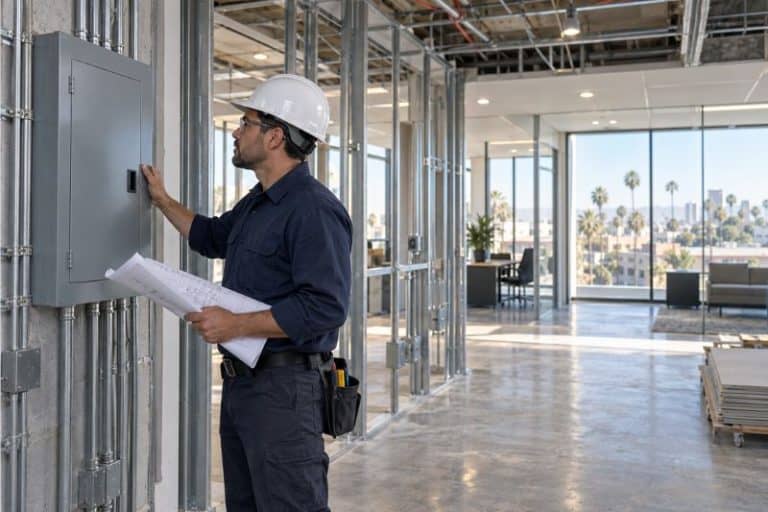
The strongest contractors think about what the building will need next. Tenant improvements, heat pump HVAC, EV charging, and added kitchens all draw on the same service. Our electrical panel services start with a load calculation for exactly this reason, because a panel that is adequate today and undersized next year only moves the problem. Ask any contractor how they size equipment and whether they account for planned additions.
Named equipment, not generic descriptions
Ask what will actually be installed. We use Siemens panels. A contractor who can tell you the brand and series of the equipment going into your building is working from a real scope, and a contractor who says only that they use quality materials has told you nothing you can compare across bids.
Permits and LADBS Inspections: Who Pulls Them and Who Is Accountable
Permitting is where careful contractors and careless ones separate most clearly, and it is the part of the process property managers have the least visibility into.
What the permit process looks like in the City of Los Angeles
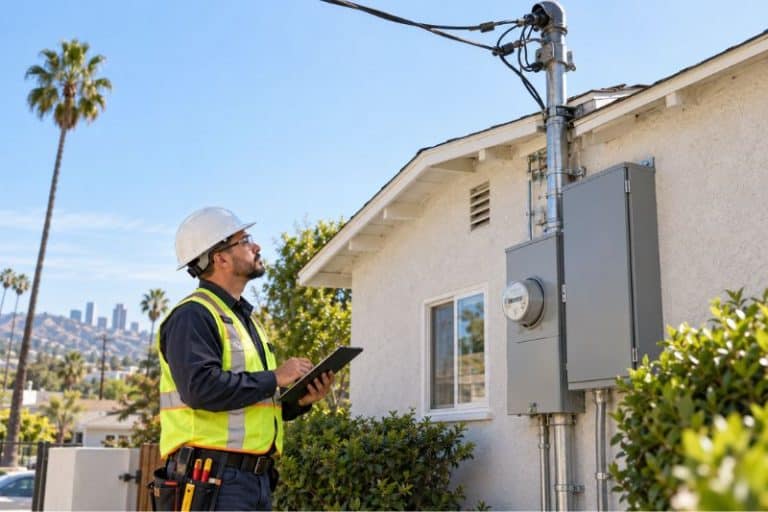
Electrical work in the City of Los Angeles is permitted through the Los Angeles Department of Building and Safety. The permit is pulled before the work begins, the work is inspected, and the inspector signs off when it meets the electrical code in force. California adopted the 2025 California Electrical Code statewide effective January 1, 2026, and local amendments apply on top of it. Larger commercial projects may need plan review before a permit is issued, so ask early whether your scope triggers it, because plan review changes the calendar.
LADBS also keeps permit and inspection records that can be looked up online by property address. That record is useful in two directions. It lets you see what work has been permitted at your building in the past, and it will show the work you are about to authorize once the contractor completes it.
Not every address answers to LADBS
This catches property managers with portfolios. LADBS covers the City of Los Angeles. Beverly Hills, Santa Monica, Culver City, Inglewood, and Torrance each run their own building departments with their own permit processes and their own inspectors. If you manage properties across several of those cities, a contractor’s comfort with one jurisdiction does not automatically carry to the next. Ask whether they have pulled permits and passed inspections in the city where your building sits, not just in Los Angeles generally.
Who pulls the permit, and what you should receive
The licensed contractor should pull the permit in the contractor’s own name and be accountable for the inspection. Be cautious about any arrangement where you are asked to pull the permit yourself to save a fee, because it shifts responsibility for the work toward the owner. When the job is done, ask for the permit number and the final inspection sign-off. Keep both in the building’s file. They answer the questions an insurer, a lender, or a future buyer will eventually ask.
Reading an Estimate: Scope, Exclusions, and Change Orders
Three estimates for the same job can look nothing alike. Your task is to make them comparable.
What a complete estimate contains
A usable estimate describes the work in plain language: what is being replaced or installed, where, and to what specification. It states what is included in the price, including permit fees, inspection coordination, and testing, and what is excluded. It names the equipment. It says how long the work will take and how the building will be affected during that time.
When estimates are missing these elements, you are not comparing prices. You are comparing guesses.
Exclusions deserve the most attention
The line that costs property managers money is usually an exclusion. Common ones include patching and painting after wall work, trenching or concrete cutting, corrections required by an inspector, and work that is discovered to be needed once a panel is opened. None of these is unreasonable by itself. Each one should be stated, so that the final number holds.
How change orders should work
Changes happen, especially in older buildings. What matters is that a change is priced and approved in writing before the work proceeds. Ask how the contractor handles a scope change, who approves it, and how quickly a revised price arrives. A contractor who answers clearly is one who has done it before.
Lien releases at payment
California has statutory lien release forms that contractors provide in exchange for payment. For an owner or manager, collecting a signed release with each payment is standard protection against a subcontractor or supplier claim after the fact. Ask how the contractor handles this and consider it part of the paperwork you expect to receive.
How we handle estimates at RG Electric
Our process depends on the kind of work. When something is wrong and the cause is not yet known, such as repeated breaker trips or a failed circuit, the first step is a service call, which carries a fee up front. The technician reports what was found to our supervising electrician, who writes the estimate, and someone on our team then calls to walk through it line by line. When the work is new installation or replacement, the estimate is free and we do not bill by the hour. You see the scope and the price in writing, and we stand behind our work with a 12-month guarantee.
Working in Occupied Buildings: Tenant Notice, Shutdowns, and Scheduling
The electrical work is only half the job in an occupied property. The other half is making sure tenants are not surprised by it.
Plan shutdowns around the building, not the crew
Any panel replacement or service work involves cutting power. The question is for how long, to whom, and when. Ask the contractor to describe the shutdown plan in advance: which areas lose power, for how many hours, and what the sequence is if the building has more than one panel. For a property with elevators, fire alarm systems, or occupants with medical equipment, that conversation has to happen before the date is set.
Tenant notice
California law generally requires advance written notice, commonly 24 hours, before a landlord or agent enters an occupied unit for repairs, and utility interruptions bring their own expectations. The specifics vary with the circumstances, so confirm the right notice for your building with your attorney or property counsel. A good contractor will give you what you need to write that notice accurately: dates, time windows, and which units are affected.
Scheduling around commercial tenants
Retail and office tenants have hours that matter to their revenue. Work that is scheduled for evenings or weekends costs more in labor and costs less in tenant complaints. Ask the contractor whether they will schedule around your tenants’ operations and how that affects the price. The answer should be on the estimate, not discovered at invoice time.
Red Flags During the Bidding Process
You can learn a lot about a contractor before any work begins.
Signals to take seriously
A contractor who will not give a license number, who asks you to pull the permit, or who offers a price before seeing the property has told you something. So has one whose estimate is a single line with a lump sum, or whose references cannot be reached. Slow responses before the sale are not likely to speed up after it.
Missing warranty terms
Ask what happens if something fails after the job is done. A real warranty has a defined period, a defined process, and a person to call. Our 12-month guarantee means that if something we installed misbehaves in that window, you are already our customer, and we come back without charging another service call.
What to Expect From RG Electric
When you call, you reach someone on our team. We work with property managers and building owners across the San Fernando Valley, Downtown LA, Culver City, Santa Monica, Inglewood, and Torrance, on projects ranging from a single failed circuit to a full service upgrade. For the broader range of what we do in commercial and multi-unit properties, see our commercial electrical services page.
We handle the permit, coordinate the inspection, and provide the documentation an insurer or lender will ask for later. We tell you what we find and what it will cost, and we explain why each line is on the estimate. That is the standard we would hold any contractor to if we were the ones hiring.
Questions Property Managers Ask Before Hiring
How do I check that an electrician is licensed in California?
Search the contractor’s license number on the CSLB website. Confirm an active C-10 classification and that the business name matches the estimate. The same record shows bond and workers’ compensation status.
Should the contractor or I pull the permit?
The contractor, in the contractor’s own name. Having the licensed contractor pull the permit keeps responsibility for the work and the inspection where it belongs. If a bidder asks you to pull it instead, treat that as a reason to look elsewhere.
What should I ask for when the job is finished?
Four things: the permit number, the final inspection sign-off, the contractor’s invoice with a clear description of work, and a signed lien release for the payment. Together they form the building’s record of the work.
For immediate assistance or to schedule a professional evaluation, call RG Electric directly at (323) 521-5131.
Electrical work is hazardous. Always consult a licensed electrician like RG Electric before working on electrical systems.