
 Call (323) 5215131
What Happens During an Electrical Service Call at RG Electric
Updated August 2026
One of the most common reasons people hesitate before calling an electrician is not knowing what happens after they do. Will someone show up and start tearing into walls? Will they get a bill for hours of work before understanding what the problem is? Will the technician explain what they found, or leave them with a repair bill and no context? RG Electric is a licensed C10 electrical contractor, License #910807, serving homes, apartment buildings, and commercial properties across Los Angeles County. This post walks through exactly what happens from the moment you call to the moment the job is done, so that uncertainty is not the reason a problem goes unaddressed.
The first call: what to expect when you contact us
When you call RG Electric at (323) 521-5131, you reach a person, not a call center. Our customer care coordinator takes the call directly. They are not an electrician, but they have enough working knowledge of common electrical problems to understand what you are describing and to ask the right follow-up questions. They are also the person who will call you back after the technician’s visit to explain the findings and walk through the estimate.
On that first call, our customer care coordinator will ask you to describe what you are experiencing. Where in the building is the problem? Is it affecting one outlet or multiple? Is a breaker involved? Is there any burning smell, discoloration, or sound coming from the panel? When did the problem start, and has anything changed recently in how that part of the building is being used? The more detail you can provide, the better prepared the technician will be when they arrive.
If the problem sounds like it requires a diagnostic visit, our customer care coordinator will explain the service call fee before scheduling anything. That fee covers the technician’s time and travel to your location. It is explained upfront, not invoiced as a surprise at the end of the visit. If what you are describing sounds like new work rather than an existing problem, such as adding a circuit, installing an EV charger, or replacing a panel on a building that is otherwise functioning, our customer care coordinator will schedule a free estimate instead.
The conclusion: the first call takes five to ten minutes and produces a clear understanding of what type of visit is needed, what it costs to schedule, and what to expect. No ambiguity, no pressure.
Service call versus free estimate: the distinction that matters
Understanding the difference between a service call and a free estimate prevents the most common source of confusion customers have before calling an electrician.
A service call is scheduled when there is an existing problem that needs to be diagnosed. Something has stopped working, is behaving inconsistently, or is showing signs of a fault. The technician’s job on a service call is to find the cause of the problem, not just describe the symptom. That diagnostic process requires a licensed electrician’s time and expertise, which is why there is a fee.
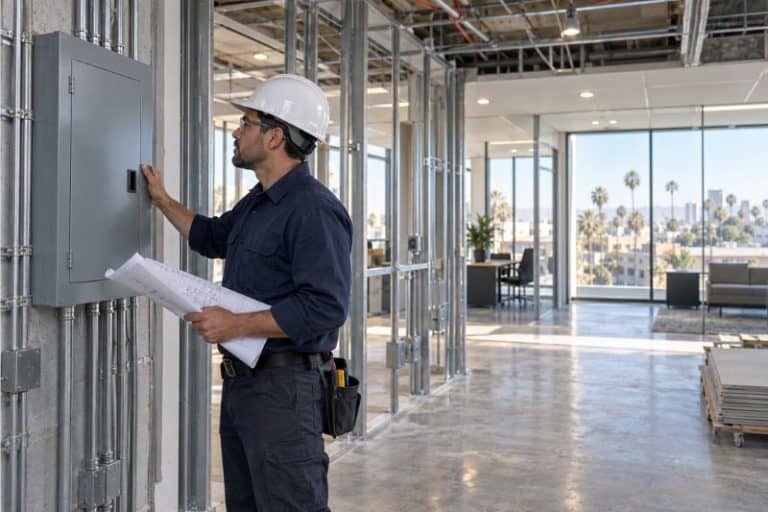
A free estimate is scheduled when there is no existing problem, just new work to be planned. A homeowner who wants to add a dedicated circuit for a home office, a property manager who wants to replace a panel before an insurance renewal, or a landlord who wants to add EV charging stations to a parking structure are all examples of new work scenarios. There is nothing to diagnose. The electrician assesses the scope, the materials, and the labor, and returns a written estimate at no charge.
The practical distinction: if something broke, it is a service call. If nothing broke but you want something new or upgraded, it is a free estimate. If you are not sure which applies to your situation, describe what you are experiencing when you call and our customer care coordinator will tell you.
The technician’s visit: what they do and why
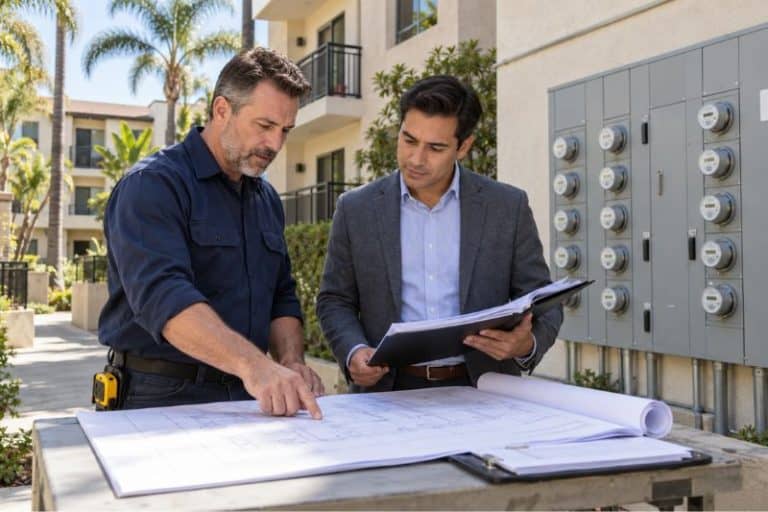
The technician arrives with the information our customer care coordinator gathered on the initial call. They know what you described, which part of the building is affected, and whether there are any specific concerns about the panel or wiring history. That context shapes where they start.
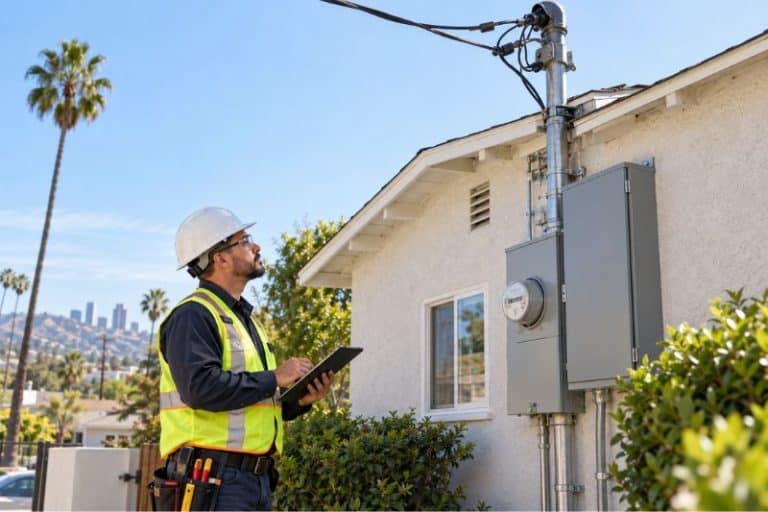
For most service calls, the diagnostic begins at the panel. The technician opens the panel and performs a visual inspection: breaker condition, bus bar condition, signs of heat damage or corrosion, whether the panel brand is one of the four recalled types, and whether the circuit directory is accurate. This panel review tells them a great deal about what may be causing the problem before they ever look at the specific outlet, switch, or circuit the customer called about.
From the panel, the technician traces the affected circuit. They use voltage and continuity testing to isolate whether the problem is in the breaker, the wiring between the panel and the device, or in the device itself. For GFCI-protected circuits, they test all outlets on the circuit and look for what may have caused the GFCI to trip. For circuits with intermittent problems, they assess load conditions and look for signs of wiring that is at or near its capacity.
When the cause is identified, the technician does not start working. They document what they found, take photos where relevant, and call Roy, our supervisor and master electrician. Roy reviews the finding and prepares a written estimate for the corrective work. That estimate comes back to our customer care coordinator, who contacts the customer with a full explanation of what was found and what correcting it involves.
The conclusion: the technician’s job on a service call is to find the cause of the problem and document it accurately. The repair comes after the customer understands and agrees to the scope, not before.
How Roy builds the estimate
Roy is our master electrician and the person responsible for every estimate that leaves RG Electric. When the technician calls with their findings, Roy assesses what the correction requires: the specific work involved, the materials needed, any permit requirements, and the time the repair will take. He does not use a price chart with fixed rates. Every estimate is built from the actual scope of the specific job.
This matters because electrical problems are rarely identical. A tripping breaker in a 1960s Encino home with aluminum branch circuits and a Zinsco panel is a fundamentally different problem from a tripping breaker in a 2010 Sherman Oaks condo with a modern Siemens panel. The correct repair is different, the materials are different, and the permit implications may be different. An estimate built from a price chart would not reflect any of that. An estimate built from the actual diagnostic finding does.
Roy also factors in what the inspector will likely require. For jobs that involve a permit, Roy’s estimate accounts for the full scope of what the city will expect to see when the inspector arrives, not just the minimum work needed to address the immediate symptom. This prevents the situation where a repair passes immediately but generates a correction notice because related conditions were left unaddressed.
The conclusion: the estimate reflects the real scope of the real problem in the real building. It is not a ballpark, a range, or a starting point for negotiation. It is what the job actually costs to do correctly.
How the customer care coordinator communicates the findings to you
After Roy has reviewed the diagnostic and built the estimate, our customer care coordinator contacts the customer. They do not just send an email with a number on it. They call, explain what the technician found, why it matters, what correcting it involves, and what the estimate covers. If the customer has time to go through the estimate on the call, our customer care coordinator walks through each line item. If not, they confirm the customer received it and follow up the next day.
The goal of this communication is understanding, not just acknowledgment. A customer who understands why a repair is needed is in a position to make an informed decision. A customer who receives an estimate without an explanation has to choose between trusting a number they cannot evaluate and calling a second electrician to get a second opinion. Our customer care coordinator’s job is to make the first option the obvious one by explaining the finding clearly enough that the second is not necessary.
For property managers who deal with electrical issues regularly, this communication style makes a practical difference. A property manager who can call our customer care coordinator back with a question about a line item in the estimate and get a clear answer is in a better position to present the repair to a building owner or include it in a maintenance report. The communication chain is always: technician to Roy to the customer care coordinator to you.
The conclusion: the customer care coordinator’s call after the diagnostic visit is not a formality. It is the moment where the customer gets the context they need to decide whether and how to proceed. No one is asked to approve work they do not understand.
What happens when work is approved
When the customer approves the estimate, the repair is scheduled. For most residential service call repairs, the corrective work happens on the same visit or is scheduled within a day or two depending on parts availability and the scope of the job. For larger repairs that require permits, the permit application is submitted before work begins and the timeline reflects the permit processing period.
The repair work is performed by a licensed electrician, not a helper or an apprentice working unsupervised. All connections are made to manufacturer torque specifications. All devices are correctly rated for their location and load. All replaced equipment is removed and disposed of properly. When the work is complete, the technician tests the repaired circuit under load to confirm the problem is resolved before leaving the property.
For repairs that required a permit, the city inspection is coordinated after the work is complete. We are on-site for the inspection, and we handle any inspector questions directly. The property owner receives the closed permit and inspection sign-off as part of the project documentation.
Our electrical repair services in Los Angeles cover the full range of corrective work that a service call diagnostic may identify, from a single breaker replacement to rewiring a circuit that has been incorrectly installed by a prior contractor.
The 12-month workmanship guarantee
All work completed by RG Electric is covered by a 12-month workmanship guarantee. If a related issue surfaces within that period, we come back without charging a second service call fee. The guarantee is not a limited warranty with exclusions and conditions. It is a straightforward commitment: if something we repaired or installed has a problem within 12 months that is related to the work we did, we fix it at no additional charge.
The reasoning behind this policy reflects how we think about the quality of the work we do. A repair that holds is the only repair worth doing. If we diagnose a problem correctly and correct it properly, the 12-month guarantee should never need to be invoked. When it does, we want customers to call us, not wonder whether they will be charged again for a problem they already paid to have fixed.
Repeat customers receive additional consideration. If you have used RG Electric before and have a new issue, we send a technician for a free assessment before determining whether a service call fee applies. Customers who have worked with us previously are not treated like first-time callers with a problem we have never seen.
What to have ready when you call
A few practical steps before calling make the initial conversation more useful and the technician’s visit more efficient.
Take a photo of your panel with the door open before you call. If there are subpanels in the building, photograph those too. A clear photo of the panel shows us the brand, the approximate age, the condition of the breakers, and the state of the circuit directory. That information shapes the diagnostic approach before the technician arrives and can sometimes clarify immediately whether the problem is panel-related or circuit-related.
If the problem is in a specific location, note whether it is affecting one outlet, one circuit, or multiple circuits. Has the breaker tripped? Did it reset and trip again? Is the problem constant or intermittent? Has anything changed recently in how the affected area is being used, such as a new appliance, a new tenant, or recent renovation work in that part of the building?
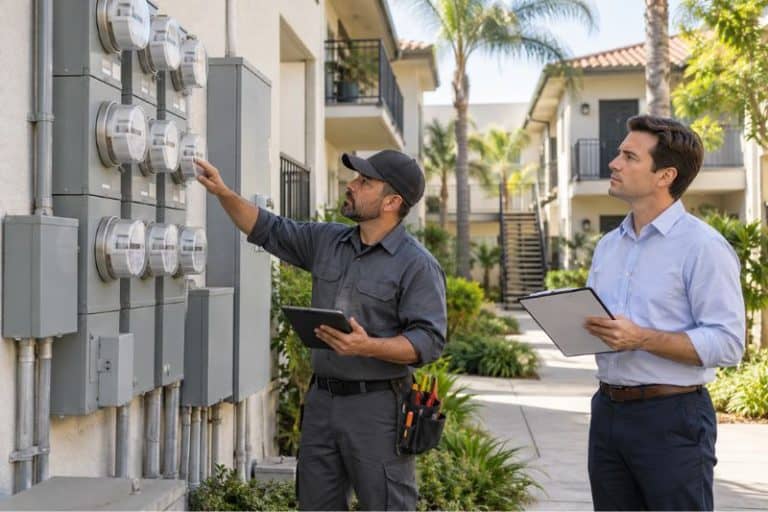
For property managers calling about a multi-unit building, it helps to know which unit or units are affected, whether the problem is in a common area, and whether there have been prior complaints about electrical issues in that part of the building. The more context you provide, the more efficiently the technician can use their time on-site.
Our circuit breaker services in Los Angeles include the full diagnostic process for breaker-related problems, including assessments of whether a tripping breaker is an isolated issue or a signal of something more significant in the panel or the circuit behind it.
Scheduling and what to expect
Service calls are available throughout Los Angeles County, including Encino, Sherman Oaks, Van Nuys, Beverly Hills, Culver City, Koreatown, Inglewood, Torrance, and the San Fernando Valley broadly. Scheduling is arranged on the initial call with our customer care coordinator. Service call fees are explained before the appointment is confirmed. There are no hidden charges and no work performed without written agreement on scope and price.
For immediate assistance or to schedule a professional evaluation, call RG Electric directly at (323) 521-5131.