
 Call (323) 5215131
How do I know if my electrical panel needs to be replaced or just repaired in Los Angeles?
Updated July 2026
This is one of the most common questions property owners and homeowners ask before calling an electrician, and it is exactly the right question to ask. The answer determines the scope of the work, the cost, and whether a permit and city inspection will be involved. RG Electric is a licensed C10 electrical contractor, License #910807, serving homes, apartment buildings, and commercial properties across Los Angeles County. The short answer is that the distinction between repair and replacement comes down to what the diagnostic finds. A panel that has one failed breaker and is otherwise sound may need only a repair. A panel that is a recalled brand, has deteriorating bus bars, cannot support the building’s current load, or is generating repeated problems across multiple circuits is a replacement. This post walks through how that determination gets made, what the warning signs look like, and what each path involves.
What a panel repair actually involves
Panel repairs address specific, identifiable conditions within an otherwise serviceable panel. The most common panel repairs are breaker replacements, where a single breaker has failed mechanically and is no longer tripping correctly or is tripping under loads it should be able to carry. A failed breaker in a panel that is otherwise in good condition, correctly sized for the building’s load, and not from a recalled brand is a legitimate repair rather than a replacement trigger.
Other panel repairs include correcting double-tapped breakers, where two conductors have been landed on a single breaker terminal, addressing loose connections at the bus or terminal lugs, correcting bonding and grounding deficiencies, and replacing a damaged panel cover or interior component. These are conditions that can be corrected without replacing the panel itself, provided the underlying panel is sound and suitable for continued service.
The key distinction is that a repair addresses a discrete condition in a panel that is fundamentally capable of serving the building safely. When the panel itself is the problem, repair is not the correct path. Replacing a breaker in a Zinsco panel does not make the panel safe. Correcting a loose connection in a Federal Pacific panel does not resolve the panel’s documented failure to trip under fault conditions. In those cases, the repair addresses a symptom while leaving the cause in place.
The warning signs that point toward replacement
Several conditions, when found during a diagnostic, indicate that replacement is the correct path rather than repair. Understanding these conditions helps property owners and managers ask the right questions when an electrician presents findings.
The panel brand is the first and most definitive factor. Four panel brands have documented reliability problems that make them unsafe for continued service regardless of their current apparent condition: Zinsco, Federal Pacific Electric, Challenger, and Pushmatic. These panels appear in Los Angeles homes and apartment buildings constructed primarily between the 1950s and 1980s. Zinsco panels have a known failure mode in which breakers fuse to the aluminum bus bar, preventing them from tripping under overload. Federal Pacific Stab-Lok panels have breakers that fail to trip at rates far exceeding what code allows. Challenger and Pushmatic panels have their own documented reliability problems. A panel from any of these four brands warrants replacement, not repair, regardless of how it appears to be functioning.
Bus bar condition is the second factor. The bus bar is the metal bar inside the panel that conducts power to each breaker. When a bus bar shows signs of heat damage, corrosion, pitting, or arc marks, the panel has experienced conditions that compromise its structural integrity. A bus bar in that condition cannot be repaired in the field. The panel needs to be replaced.
Capacity is the third factor. A panel that was correctly sized for the building when it was installed may no longer be adequate for the building’s current load. A home that has added an EV charger, a home office, central air conditioning, and a hot tub since the panel was installed in 1975 is running loads through a panel that was never designed to handle them. A panel that is consistently running near its rated capacity has no margin for the load additions that are common in Los Angeles homes. Upgrading to a higher-capacity panel is not a repair. It is a replacement driven by a load assessment.
Repeated problems across multiple circuits are the fourth factor. A panel that generates repeated breaker trips, intermittent power loss to multiple circuits, or unexplained failures in circuits that have not changed is telling you something about the panel itself, not about individual circuits. When problems are isolated to one circuit, the circuit is the likely cause. When problems are appearing across the panel, the panel is the likely cause.
Insurance requirements are the fifth factor. California insurance carriers are increasingly flagging recalled panel brands and aging panels as conditions of coverage. A property owner who receives a renewal notice requiring a panel replacement is not being asked to make a discretionary upgrade. The carrier has identified the panel as a risk it is not willing to carry. That determination effectively answers the repair versus replacement question for the property owner.
What the diagnostic process looks like
The repair versus replacement determination is made during a diagnostic, not before it. A property owner who calls describing a tripping breaker cannot be told over the phone whether the panel needs to be replaced. The answer requires opening the panel and evaluating what is there.
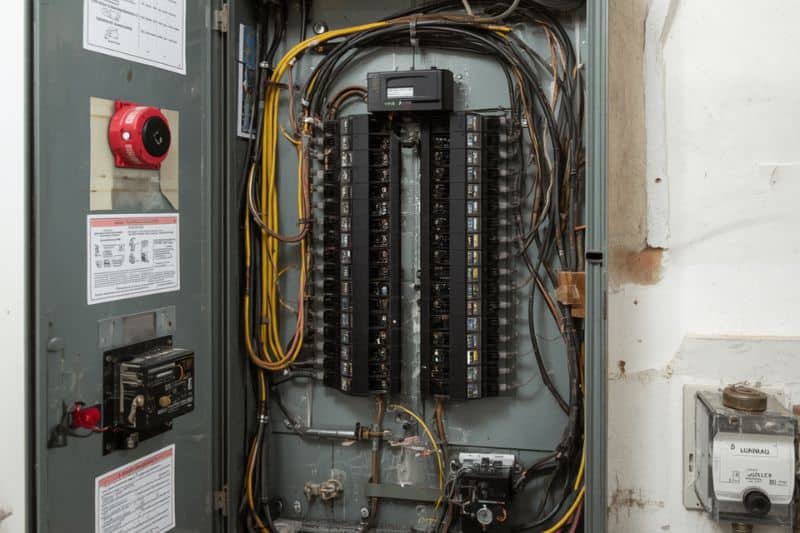
A proper panel diagnostic begins with a visual inspection of the exterior: panel brand and model, age if identifiable from the label, any visible damage to the cover or enclosure, and the condition of the service entrance conductors. Inside the panel, the inspection covers bus bar condition, breaker condition across all slots, the presence of double-tapped breakers or other wiring violations, bonding and grounding connections, the accuracy and completeness of the circuit directory, and any signs of heat damage, moisture intrusion, or corrosion.
The diagnostic also includes a conversation about the building’s load demands: what has been added since the panel was installed, whether the building has experienced capacity-related problems, and what the owner’s plans are for the property going forward. A building that is adding EV charging capacity or planning a major renovation needs a panel assessment that accounts for future load, not just current condition.
When the diagnostic is complete, the findings are explained clearly before any work is proposed. The electrician should be able to tell you specifically what was found, why it points toward repair or replacement, and what either path involves in terms of scope, cost, permits, and timeline. A recommendation to replace the panel without a specific explanation of what the diagnostic found is not a complete answer.
What a panel replacement involves in Los Angeles
A panel replacement in Los Angeles is a permitted project. The permit application includes a load calculation that confirms the replacement panel is correctly sized for the building’s current and anticipated demand. LADBS reviews the application and issues the permit before work begins. After the installation is complete, a city inspector reviews the work and issues approval. The closed permit is the documentation that satisfies an insurance carrier requiring a replacement and a real estate buyer asking for proof of permitted electrical work.
The physical replacement involves disconnecting the service entrance conductors, removing the existing panel and enclosure, installing the new panel, reconnecting all branch circuit wiring to the new panel’s breakers, verifying bonding and grounding, labeling all circuits in the new directory, and restoring power. In older Los Angeles homes, the replacement often surfaces additional conditions in the branch circuit wiring that need to be addressed as part of the project. Double-tapped circuits, undersized conductors, and wiring conditions that were obscured by the old panel frequently become visible during the replacement and need to be corrected before the inspector approves the installation.
We use Siemens panels on all replacements. The timeline for a standard residential panel replacement, from permit application through inspection approval, is typically a few weeks, depending on LADBS processing time and scheduling. For property managers with insurance deadlines, we coordinate to prioritize the permit application and inspection scheduling where LADBS allows it.
Our electrical panel services in Los Angeles cover the full replacement process from diagnostic through permit closeout. For buildings where the panel assessment reveals conditions that extend beyond the panel itself, our team handles the full scope of corrective work rather than leaving the property owner to coordinate multiple contractors.
Why acting before the insurance deadline matters
Property owners who receive an insurance notice requiring a panel replacement have a timeline problem as well as a panel problem. The notice establishes a deadline, and the deadline is typically shorter than the time needed to get a permit, complete the work, pass an inspection, and submit documentation to the carrier if the process is started on the day the notice arrives.
The property owners in the best position are the ones who had their panel assessed before the insurance notice arrived. They already know what they have, they have a relationship with a licensed C10 contractor, and if a replacement is needed, they can start the permit process on their own timeline rather than a carrier’s deadline. In the current California insurance environment, where carriers are applying stricter criteria to multi-unit properties in particular, that lead time has real value.
For homeowners in older Los Angeles neighborhoods, Sherman Oaks, Culver City, Koreatown, and the South Bay included, a panel assessment is a reasonable proactive step for any home built before 1985. The assessment identifies the panel brand, evaluates its current condition, and gives the homeowner accurate information before an insurance notice or a real estate transaction makes the timing urgent.
The bottom line on repair versus replacement
The repair versus replacement determination follows from the diagnostic. A panel with a single failed breaker and no other findings is a repair. A panel from a recalled brand, with bus bar damage, at capacity, generating repeated problems, or flagged by an insurance carrier is a replacement. The diagnostic is what establishes which situation you are in, and the diagnostic requires opening the panel and evaluating what is there.
What does not help is deferring the assessment because the panel appears to be functioning. A Zinsco panel that has not caused a visible problem is still a Zinsco panel. A panel running at capacity that has not yet tripped a breaker on a heavy load day is still a panel without margin. The assessment provides accurate information. The information supports a decision. The decision made before something goes wrong is always better than the one made after.
Our circuit breaker services in Los Angeles include the diagnostic process that determines whether a breaker problem is an isolated repair or a signal of a broader panel condition. When the diagnostic points toward replacement, we explain exactly why and what the replacement involves before any commitment is made.
Frequently asked questions about panel repair versus replacement
Can I replace just one breaker in a Zinsco or Federal Pacific panel?
Replacing a single breaker in a recalled panel does not make the panel safe and does not resolve the underlying reliability problems associated with those brands. The issue with Zinsco and Federal Pacific panels is not individual breaker failure, it is the panel’s bus bar design and the breaker’s documented failure to trip under fault conditions. A new breaker installed in a Zinsco or Federal Pacific panel is subject to the same bus bar conditions as the original. The panel needs to be replaced, not repaired one breaker at a time.
How long does a panel replacement take?
The physical installation of a panel replacement typically takes one day. The permit process adds time before and after: the permit application is submitted before work begins, and the city inspection happens after the installation is complete. Total timeline from permit application to closed permit is typically two to four weeks depending on LADBS processing time. For property managers with insurance deadlines, we communicate the timeline clearly so the documentation can be submitted to the carrier before the deadline.
Will a panel replacement solve my recurring breaker trip problem?
It depends on the cause of the trips. If the diagnostic finds that the panel is the source of the problem, a replacement will resolve it. If the trips are caused by overloaded circuits, undersized wiring, or a downstream wiring fault, those conditions need to be addressed whether or not the panel is replaced. A complete diagnostic identifies all contributing conditions so the repair or replacement addresses the actual cause rather than the most visible symptom.
Scheduling and what to expect
Panel assessments for homeowners and property managers begin with a service call. The diagnostic fee covers the technician’s time and travel and applies toward any repair or replacement work that follows. The assessment produces a clear finding: what the panel is, what condition it is in, what it would take to repair versus replace it, and which path is appropriate given what was found.
For new installations and replacements, the estimate is free and covers the full scope of work including permit costs and inspection coordination. There are no hidden fees and no work performed without written agreement on scope and price. All completed work is backed by our 12-month workmanship guarantee.
RG Electric serves property owners throughout Los Angeles County, including Encino, Van Nuys, Inglewood, Torrance, Pasadena, Beverly Hills, and Downtown LA. For immediate assistance or to schedule a professional evaluation, call RG Electric directly at (323) 521-5131.