
 Call (323) 5215131
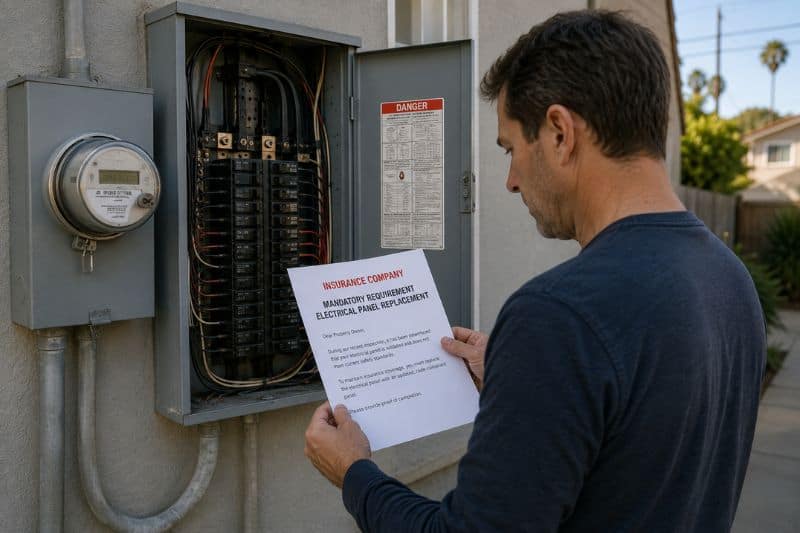
If you have received a notice from your insurance carrier requiring an electrical panel replacement, you are not in trouble yet. What you have is a deadline and a clear directive. RG Electric, a licensed C10 electrical contractor serving Los Angeles under License #910807, works with property managers and homeowners through this exact situation regularly. The process is manageable when you move quickly and work with the right contractor. This post walks you through every step, from understanding what the notice means to getting your coverage reinstated.
Why Insurance Companies Are Sending These Notices Now
The volume of insurance-mandated panel replacement notices in Los Angeles has increased significantly over the past two years. The reason is a combination of factors that have converged at the same time, and understanding them helps explain why your carrier is taking this position even if your panel has been functioning without obvious problems.
California’s wildfire seasons have placed enormous financial pressure on insurance carriers. Carriers that have paid out billions in claims are re-underwriting their portfolios, looking for elevated-risk properties. Outdated electrical panels are one of the clearest risk signals a carrier can identify, because certain panel brands have documented histories of failure and fire hazard. When a carrier flags your panel, they are managing their own exposure based on decades of claims data.
California has also updated its electrical codes multiple times since most flagged panels were installed. Equipment that was code-compliant forty years ago may not meet current California Electrical Code requirements, and carriers are aligning their underwriting standards accordingly.
The result is a wave of notices going out across Los Angeles, Sherman Oaks, Encino, Van Nuys, Koreatown, and the San Fernando Valley. If you received one, the right response is to move forward.
Section conclusion: Insurance carriers are not flagging panels arbitrarily. The notices are driven by real claims data, updated code standards, and the financial reality of insuring properties in California. Act promptly.
What the Notice Actually Means and What Your Timeline Looks Like
An insurance notice requiring a panel replacement is a condition of coverage, not a suggestion. Your carrier is telling you that they will not renew your policy, or in some cases will cancel your existing policy, unless the specified work is completed and documented within the timeframe they have set.
Most notices give property owners between 30 and 90 days from the date of the letter. The specific deadline will be stated in the notice itself. Read it carefully and note the exact date. That date is the deadline by which your carrier expects to receive documentation that the work has been completed, not just that it has been scheduled.
The documentation your carrier will typically require includes proof that the work was performed by a licensed electrical contractor, a copy of the permit that was pulled for the job, and in many cases a copy of the final inspection approval from the Los Angeles Department of Building and Safety. Some carriers also request a certificate of insurance from the contractor who performed the work.
This is why the contractor you choose matters as much as the timeline. A contractor who does not pull permits or does not carry proper insurance cannot provide the documentation your carrier needs. The work may be done, but without the right paperwork, your carrier may still refuse to reinstate or renew your coverage.
If your deadline is less than 30 days away, contact a licensed C10 contractor immediately. Panel replacements in Los Angeles require permits, and the permit process takes time. Getting the estimate, pulling the permit, completing the work, and scheduling the inspection all need to happen within your window. The sooner you make the call, the more manageable your timeline becomes.
Section conclusion: An insurance notice is a hard deadline with documentation requirements. The clock starts the day the letter is dated, and missing the deadline puts your coverage at risk. Move immediately.
The Four Panels Insurance Companies Flag Most Often in Los Angeles
If your notice identifies a specific panel brand, it is almost certainly one of the four brands that insurance carriers in California flag consistently. Each one has a documented history that explains why carriers treat them as uninsurable without replacement.
Zinsco Panels
Zinsco panels were installed widely in California homes and apartment buildings from the 1950s through the 1970s. The fundamental problem with Zinsco panels is that the breakers are prone to bonding with the bus bar over time, which means they can fail to trip when a circuit is overloaded. A breaker that does not trip allows the overloaded circuit to continue drawing current, generating heat, and potentially igniting a fire. Insurance carriers treat Zinsco panels as a known fire hazard regardless of whether the panel appears to be functioning normally. The panel may look fine and even respond normally to basic tests while still carrying this failure risk internally.
Federal Pacific Electric (Stab-Lok) Panels
Federal Pacific Electric panels, sold under the Stab-Lok brand, were among the most widely installed panels in the United States from the 1950s through the 1980s. Independent testing has shown that Stab-Lok breakers fail to trip at rates that make them a documented fire hazard. California insurance carriers have been among the most aggressive in requiring Federal Pacific replacements, particularly following the Pacific Palisades fires and the broader reassessment of residential fire risk across the state.
Challenger Panels
Challenger panels were produced from the late 1970s through the early 1990s before being discontinued following concerns about breaker failure and overheating. Like Zinsco, the core problem is breakers that do not reliably interrupt current when a circuit is overloaded. Challenger panels are found throughout older buildings in Culver City, Inglewood, Torrance, and Burbank. Insurance carriers flag them for the same reason: a breaker that does not trip is a fire hazard.
Pushmatic Panels
Pushmatic panels use a push-button breaker design that requires regular lubrication to function correctly. In most cases that maintenance has not been performed in decades, leaving dried-out breakers that are prone to failing under overload conditions. Replacement parts are no longer manufactured, which makes servicing a Pushmatic panel impractical and reinforces why carriers require replacement rather than repair.
Section conclusion: All four of these panel brands share the same fundamental risk: breakers that fail to interrupt current under overload conditions. That failure mode is a direct fire hazard, and it is why insurance carriers treat these panels as conditions of coverage rather than items to monitor.
What Happens If You Ignore the Notice
Missing an insurance deadline for a required panel replacement has consequences that extend well beyond an inconvenient gap in coverage. Understanding the full consequence chain is important for property managers and building owners who may be tempted to push back on the notice or delay action while getting multiple bids.
The most immediate consequence is coverage lapse. When your policy expires or is cancelled and the required work has not been completed, you are operating a property without insurance. For a homeowner, this means personal financial exposure for any loss that occurs during the gap. For a property manager or building owner, it means the building itself is uninsured, along with all the liability exposure that comes with tenant occupancy.
The second consequence is claim denial. If a fire or other covered event occurs while your panel replacement is overdue, your carrier may deny the claim on the grounds that you had been notified of the hazard and failed to correct it. This is not a hypothetical scenario. Insurance carriers have denied claims precisely because the property owner was on notice about a specific hazard and did not act within the required timeframe.
For property managers, a coverage lapse may trigger obligations under tenant leases, mortgage agreements, or local housing regulations. Some lenders require continuous coverage as a loan condition, and a gap could technically trigger a default provision even if no loss occurred.
Getting coverage reinstated after a lapse is also significantly more expensive. Carriers that would have renewed your policy may decline to write a new one for a property with a lapse history, and when they do offer coverage the premium is typically higher.
Section conclusion: Ignoring an insurance notice does not make the requirement go away. It creates a chain of consequences, coverage lapse, claim denial risk, and reinstatement difficulty, that are significantly more expensive and disruptive than the panel replacement itself.
The Right Steps to Take Immediately After Receiving the Notice
Once you have received the notice and confirmed the deadline, here is the sequence of steps that moves you from the notice to reinstated coverage as efficiently as possible.
The first step is to read the notice in full and note exactly what the carrier is requiring. Some notices specify the panel brand by name. Some specify a minimum amperage requirement for the replacement panel. Some require GFCI upgrades or grounding corrections in addition to the panel replacement. Understanding the full scope of what the carrier is requiring before you call a contractor ensures that the work you authorize covers everything the carrier needs to see.
The second step is to contact a licensed C10 electrical contractor in Los Angeles, not a handyman or general contractor. Your carrier requires documentation of licensure and the permit process requires a licensed contractor. RG Electric holds California C10 License #910807 and handles the full process from estimate to final inspection, including all permit and inspection coordination through our electrical panel services in Los Angeles. Reach us at (323) 521-5131.
The third step is to schedule a site visit for the estimate. Panel replacement costs vary based on amperage, wiring condition, site access, and any additional corrections required. RG Electric provides free estimates for new work, and the site visit ensures there are no surprises once work begins.
The fourth step is to confirm your contractor will pull the permit and manage the inspection. Panel replacements in Los Angeles require an LADBS permit and a final inspection before the permit closes. Your carrier will typically want the closed permit as part of the documentation package. A contractor who says a permit is not necessary is either uninformed or cutting corners, and either outcome creates problems when you submit your documentation.
The fifth step is to notify your carrier that work is scheduled. Most carriers will acknowledge a confirmed work date, which demonstrates good faith and may provide flexibility if inspection scheduling creates a timing issue near your deadline.
Section conclusion: Read the full requirement, call a licensed C10 contractor, get a permit-ready estimate, confirm the permit and inspection process, and notify your carrier that work is scheduled.
What to Expect From the Panel Replacement Process in Los Angeles
One of the reasons property managers and homeowners delay after receiving an insurance notice is uncertainty about what the process actually involves. Understanding the timeline and sequence removes that uncertainty.
The estimate visit typically takes 30 to 60 minutes. The electrician assesses the existing panel, meter socket, wiring condition, available space, and any additional corrections the carrier or code requires. The estimate is reviewed with you before any work is authorized.
Once the estimate is approved, the permit is applied for through the Los Angeles Department of Building and Safety. Processing typically takes several business days to two weeks depending on LADBS workload. Your contractor should apply immediately after estimate approval to avoid compressing the timeline near your deadline.
The panel replacement itself is typically completed in one day. Power to the property will be off for several hours during the work. In multi-unit buildings, coordinate with tenants in advance and provide notice consistent with your lease obligations.
After the work is complete, the LADBS inspector visits to verify the installation meets current code. For properties across Los Angeles, Encino, Sherman Oaks, Pasadena, and Glendale, inspection scheduling typically takes several days to a week. Once the inspection passes, the permit is closed and the documentation package is ready for your carrier.
In older buildings, inspectors sometimes identify additional issues when they review the installation. At RG Electric, we have worked through situations where an inspector found code violations in parts of the building we did not touch, including double-tapped breakers and missing grounding in adjacent panels. These situations add time and scope, which is why starting the process as early as possible after receiving the notice is always the right approach.
Section conclusion: From estimate to closed permit, the process typically runs two to four weeks. The earlier you start, the more buffer you have for permit processing, inspection scheduling, and any corrections the inspector identifies.
Why the Contractor You Choose Matters for Insurance Compliance
For a standard home repair, the difference between a licensed contractor and an unlicensed one is primarily about quality and code compliance. For an insurance-mandated panel replacement, the difference is also about whether the work actually satisfies the carrier’s requirements.
A licensed C10 electrical contractor is authorized to pull permits for electrical work, and pulling a permit is not optional for a panel replacement in Los Angeles. The permit creates an official record, triggers the LADBS inspection, and produces the closed permit document your carrier requires. Without it, many carriers will not accept the work as satisfying the condition of coverage.
A licensed contractor also carries the liability insurance and workers’ compensation coverage that protect you as the property owner during the job. If an unlicensed worker is injured on your property while performing electrical work, the liability exposure falls to you. A licensed, bonded, and insured contractor transfers that exposure appropriately.
For commercial clients and property managers, the certificate of insurance is an additional requirement. Your carrier and in some cases your mortgage lender will want to see that the contractor carries current general liability coverage. RG Electric can provide a certificate of insurance for any project through our commercial electrical services in Los Angeles.
Finally, a contractor with experience in Los Angeles panel replacements understands the LADBS permit process, the inspection requirements, and the documentation package your carrier needs. That experience reduces the risk of delays, failed inspections, or incomplete paperwork that could push your completion past your insurance deadline.
Section conclusion: For an insurance-mandated panel replacement, the contractor must be licensed, bonded, insured, and capable of pulling a permit and managing the LADBS inspection. These are what make the work count toward satisfying your carrier’s requirement.
Moving Forward After the Panel Is Replaced
Once the panel replacement is complete and the LADBS inspection has passed, your contractor will provide you with the documentation you need to submit to your carrier. This typically includes a copy of the closed permit, which confirms the inspection passed, and the contractor’s invoice showing the scope of work performed.
Submit this documentation to your carrier promptly and request written confirmation that the condition of coverage has been satisfied. Keep a copy of everything in your property records. For property managers, this documentation should be filed with your building’s maintenance records and referenced in your insurance file.
In many cases, completing a panel replacement with a licensed contractor and documented inspection results in a more favorable insurance conversation going forward. Carriers who have flagged a property for a hazard and seen it corrected professionally are generally more cooperative on renewals than carriers dealing with property owners who resisted or delayed the correction.
If your building has additional older panels that were not part of the current notice, this is a good time to have them evaluated. RG Electric has worked with property managers on multi-unit buildings where one panel replacement led to the identification of additional panels that needed attention. Addressing those proactively, before the next insurance cycle, is significantly less stressful than receiving another notice with a 60-day deadline.
For immediate assistance or to schedule a professional evaluation, call RG Electric directly at (323) 521-5131.