
 Call (323) 5215131
What documents should a Los Angeles commercial electrician provide before starting work?
Updated August 2026
A licensed commercial electrician working in Los Angeles should be able to provide a current certificate of insurance, proof of an active C10 license in good standing, workers compensation coverage documentation, and a signed permit when the scope of work requires one, before any work begins. RG Electric is a licensed C10 #910807 electrical contractor serving apartment buildings, commercial properties, and multi-unit owners throughout Los Angeles, and this is consistently the first question property managers and building owners ask before they will even schedule a site visit. That instinct is correct. The documents a contractor can or cannot produce tell you almost everything about whether hiring them protects your building or exposes it.
Why property managers ask for this before anything else
Property managers and building owners carry liability the moment a contractor sets foot on their property, and that liability does not disappear just because the contractor seemed competent or came recommended. If a worker is injured on site and the contractor has no workers compensation coverage, the building owner can become financially responsible for that injury. If the electrical work damages the building or causes a fire and the contractor has no general liability insurance, the building’s own insurance policy may be the only thing standing between the owner and a six or seven figure loss. Asking for documentation before work begins is not bureaucratic caution. It is the mechanism that determines who actually bears the risk if something goes wrong.
The practical effect of skipping this step is that the building owner has unknowingly assumed all of the risk a properly insured contractor would otherwise carry. This is why experienced property managers in Los Angeles will not schedule a walkthrough, let alone approve work, until these documents are in hand.
The certificate of insurance and what it actually needs to show
A certificate of insurance, often shortened to COI, is a document from the contractor’s insurance carrier confirming active coverage. For commercial electrical work, the two coverages that matter most are general liability, which covers property damage and third party injury caused by the work, and workers compensation, which covers injury to the contractor’s own employees while on site. A COI should list current policy dates that will remain active through the expected duration of the project, and for larger jobs, many property managers request to be added as an additional insured on the policy, which extends a layer of the contractor’s coverage to protect the building owner directly.
A contractor who cannot produce a COI on request, or who provides one with lapsed dates, is not simply disorganized. It usually means the coverage does not currently exist, and proceeding with that contractor means the building absorbs the liability that insurance was supposed to cover. We provide a current COI for every commercial project without exception, and for larger multi-unit and apartment complex work, we can add the property owner as an additional insured when requested.
Verifying the C10 license itself
California requires electrical contractors to hold a C10 license issued by the Contractors State License Board, and this license status is public information that any property manager can verify directly on the CSLB website using the license number the contractor provides. A verification search shows whether the license is active, whether it has any disciplinary history, and whether the contractor’s bond is current. This takes a few minutes and removes any need to simply take a contractor’s word for their qualifications.
Unlicensed electrical work is more common in Los Angeles than most property owners realize, particularly among handymen and general contractors who perform electrical work without holding the specific C10 classification required for it. Work performed by an unlicensed individual is not covered by a C10 bond, is unlikely to pass inspection if permits are later required, and can create disclosure problems during a future sale or insurance renewal. Verifying license status before work begins prevents a building from ending up with electrical work that has to be redone by a licensed contractor later, at additional cost and with the original problem still needing correction.
Permits, and why the answer is not always yes or no
Whether a specific electrical project requires a permit depends on the scope of work rather than the size of the building. A like-for-like device replacement, such as swapping a failed outlet for the same type in the same location, typically does not require a permit. Panel replacements, new circuits, subpanel installations, and any work that involves opening walls or adding new electrical infrastructure almost always do. A licensed contractor should be able to tell a property manager which category a given project falls into and should handle the permit application and inspection scheduling directly, rather than leaving that step to the building owner.
Los Angeles County adds a layer of complexity here that surprises many property managers who oversee buildings in more than one city. Properties within the City of Los Angeles go through the Los Angeles Department of Building and Safety, but cities such as Beverly Hills, Culver City, Pasadena, Glendale, and Long Beach each operate their own building and safety departments with separate permit systems and separate inspection scheduling. A contractor experienced in Los Angeles commercial work should already know which jurisdiction a given property falls under and how that city’s process differs, rather than treating every project as though it follows the same city process. Getting this wrong is a common source of delay, since a permit application submitted to the wrong jurisdiction or missing that city’s specific requirements has to be resubmitted, adding days or weeks to a project timeline.
The consequence of skipping a required permit is not limited to the immediate project. Unpermitted electrical work becomes a disclosure issue during a future sale, can be flagged during an insurance renewal inspection, and in some cases can result in the work needing to be exposed and reinspected after the fact, which is far more disruptive and costly than pulling the permit correctly the first time.
What happens when a contractor cannot produce these documents
When a contractor hesitates, provides expired paperwork, or offers to do the work faster and cheaper without pulling a permit, that is a signal worth taking seriously rather than a convenience worth accepting. Property managers we work with have described prior experiences with contractors who collected a deposit, performed the work without a permit or valid insurance, and then became unreachable when a problem surfaced afterward. In those situations, the building owner is left covering the cost of correcting the original work, obtaining the permit retroactively where possible, and in some cases addressing damage or injury that occurred during the original job with no insurance to draw on.
The pattern is consistent enough that it is worth stating plainly. A contractor unwilling or unable to produce a COI, a verifiable C10 license, and a permit when one is required is transferring risk onto the building rather than absorbing it themselves, whether or not that is how the arrangement is presented.
Utility coordination on larger commercial projects
Larger commercial and multi-unit projects, particularly panel upgrades and service changes, often require coordination with the local utility, and which utility applies depends on the property’s specific location. Most of the City of Los Angeles is served by the Los Angeles Department of Water and Power, while many surrounding cities and unincorporated areas fall under Southern California Edison. Scheduling a service disconnect and reconnect looks different depending on which utility serves the property, and a contractor who has coordinated both regularly will set expectations accurately from the start rather than discovering the difference mid-project. This is a detail property managers overseeing buildings across multiple Los Angeles County cities encounter often, and it is worth confirming with any contractor before a project timeline is finalized.
Questions worth asking before a contract is signed
A short set of direct questions, asked before any work is scheduled, resolves most of what has been described here. Asking for the C10 license number and confirming it independently through the CSLB website removes any need to rely on a business card or a website claim. Requesting a current COI, with the property owner named as an additional insured for larger projects, confirms the insurance is both active and structured to protect the building specifically. Asking directly whether the scope of work requires a permit, and if so, which department will issue it, tells a property manager whether the contractor already understands the jurisdiction their building falls under or is guessing along with them. None of these questions are unusual or excessive to ask of a licensed contractor. A contractor doing this work correctly answers them without hesitation, because the answers already exist as a normal part of how the business operates.
It is worth putting these questions in writing, even in something as simple as a follow-up email after an initial call, rather than relying on a verbal answer alone. A written response creates a record of what was represented before the work began, which matters if a dispute over scope, cost, or documentation ever comes up later. Most property managers who have been burned by an undocumented contractor in the past adopt this habit permanently, and it costs nothing beyond a few extra minutes before a project is approved.
Bonding, and what it covers that insurance does not
Separate from insurance, California requires C10 contractors to carry a contractor’s bond, currently set at fifteen thousand dollars, as a condition of holding an active license. The bond exists to compensate a property owner in cases of fraud, contract violations, or work that was never completed as agreed, which is a different protection than what a general liability policy covers. Insurance protects against accidental damage or injury during the work itself. The bond protects the building owner if the contractor simply does not deliver what was promised, disappears mid-project, or violates licensing law in the course of the work. A property manager verifying a contractor’s CSLB status can see whether the bond is current in the same lookup used to confirm the license itself, which makes this an easy check to run alongside the license verification already described above.
This distinction matters because a contractor can, in principle, carry valid insurance while still lacking a current bond, or the reverse, and a building owner who checks only one of the two has an incomplete picture of their actual protection. Confirming both before work begins closes that gap.
What a documented project file should include when the work is finished
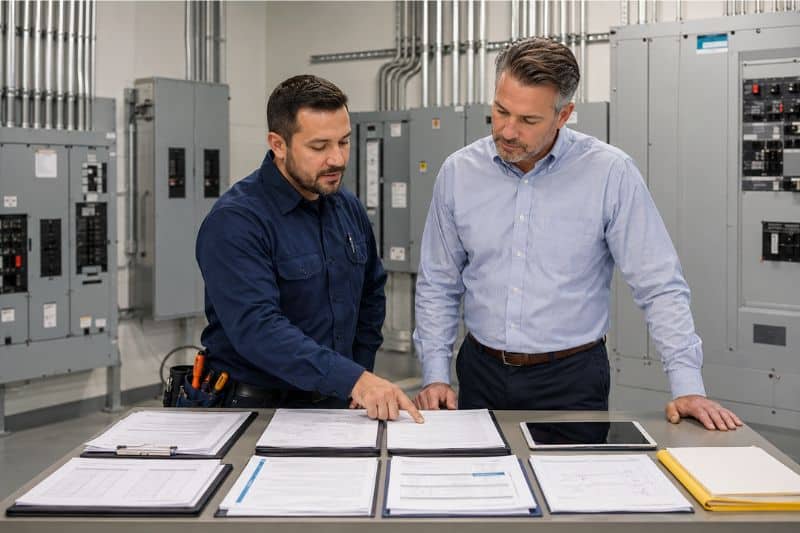
Documentation does not end when the work is complete. For commercial and multi-unit projects, a proper closeout file should include the final permit sign-off from the relevant building department, a copy of the COI that was active during the work, an itemized invoice describing exactly what was done and to which units or areas of the building, and dated photos of the completed work where applicable, particularly for panel replacements and any work that will be concealed behind walls or covers once finished. This file becomes part of the building’s permanent maintenance and insurance record, and it is what future contractors, inspectors, insurance adjusters, and potential buyers will reference if a question about that electrical work ever comes up again.
Property managers who receive only a paid invoice with no permit confirmation or photos are left without the documentation that actually protects the building later. A gap in this file does not cause a problem immediately, but it surfaces at the worst possible time, typically during a sale, an insurance renewal, or a future inspection when the original contractor is no longer available to fill in the missing pieces.
This is particularly important for buildings that change property management companies over the years, which happens often across Los Angeles apartment portfolios. An incoming management company inherits whatever documentation the prior manager kept, and a complete file makes it possible to answer a question about a five-year-old panel replacement in minutes rather than having to track down a contractor who may no longer be in business or reconstruct the history from memory. Buildings with consistently thorough documentation also tend to move through insurance renewals faster, since a carrier reviewing electrical history can see a pattern of licensed, permitted work rather than a series of unexplained gaps.
How RG Electric documents commercial and multi-unit projects
We provide a current certificate of insurance for every commercial engagement, verify and disclose our C10 license status directly, and handle permit applications and inspection scheduling as a standard part of the project rather than an optional add-on. For property managers overseeing buildings in multiple Los Angeles County cities, we confirm the correct jurisdiction and utility territory before finalizing a project timeline, so the schedule we provide reflects that specific city’s process rather than a generic estimate. Photos, permit confirmations, and completion documentation are provided for the building’s maintenance records and insurance file at the close of every project.
Our commercial electrical services in Los Angeles are built around this documentation standard for apartment buildings, multi-unit properties, and commercial clients. When a project involves correcting prior unpermitted or unlicensed work, that assessment and correction is handled through our electrical repair services in Los Angeles.
Electrical work is hazardous. Consult a licensed electrician like RG Electric for inspections, permits, and code-compliant installations.
For immediate assistance or to schedule a professional evaluation, call RG Electric directly at (323) 521-5131.