
 Call (323) 5215131
Why Your Circuit Breaker Keeps Tripping in Older Los Angeles Homes
Updated June 2026
A circuit breaker that keeps tripping is one of the most common electrical complaints RG Electric (License C10 #910807) receives from homeowners across Los Angeles. You reset it, power comes back, and everything seems fine until it trips again, sometimes within minutes, sometimes after a few days. It is tempting to treat repeated tripping as a quirk of an older home and move on. The problem with that approach is that a circuit breaker is a safety device, and when it trips, it is reporting something. Understanding what it is reporting, and whether that something is urgent, is the first step toward fixing the right problem.
What a Circuit Breaker Is Actually Doing When It Trips
A circuit breaker monitors the amount of current flowing through a circuit. When that current exceeds the breaker’s rated capacity, or when the breaker detects a fault condition, it interrupts the circuit automatically. This cuts power before the wiring can overheat and before a fault can cause arcing or fire.
The breaker is not malfunctioning when it trips. It is doing exactly what it was designed to do. The issue is identifying why it needed to trip, because the cause determines whether the situation is manageable, serious, or urgent.
There are three distinct categories of breaker trips, and each points to a different part of the electrical system. Overload trips occur when a circuit is asked to carry more current than it was designed for. Fault trips occur when electricity takes an unintended path, as in a short circuit or ground fault. Mechanical trips occur when the breaker device itself has aged to the point where its internal components no longer function reliably. Each category has different causes and different solutions.
Why Older Los Angeles Homes Trip Breakers More Often
Los Angeles has a significant concentration of housing built before 1980, and many of those homes have electrical systems that were designed for a fraction of the electrical demand they now carry. A home wired in 1965 was designed for a household with a few kitchen appliances, incandescent lighting, and no central air conditioning, no home office equipment, no EV charger, and no modern entertainment systems.
Over the decades, appliances were added, kitchens were updated, and room functions changed, but the circuits feeding those spaces often did not change with them. A single circuit that originally served a bedroom with a lamp and an alarm clock may now be powering a standing desk, two monitors, a charging station, a space heater, and a window AC unit. The breaker trips because the circuit is carrying exactly the load the breaker is protecting against.
The problem is compounded by the way older homes were upgraded incrementally over time. Rather than comprehensive electrical updates, most properties received piecemeal additions, new outlets here, a subpanel there, appliances upgraded without expanding the circuits that feed them. The result is a system that technically functions but operates close to its limits, where a shift in seasonal demand or a new appliance can push a circuit past its threshold.
Overloaded Circuits: The Most Common Cause
An overloaded circuit is the most frequent cause of repeated breaker trips in older Los Angeles homes. The circuit is being asked to supply more current than the wiring and breaker were rated for, and the breaker trips to prevent the wiring from overheating.
The clearest sign of an overloaded circuit is a breaker that trips when multiple high-draw appliances are running at the same time, particularly in kitchens, laundry rooms, and home offices. A breaker that holds overnight but trips when the microwave and coffee maker run simultaneously, or when the space heater and hair dryer are on the same bathroom circuit, is responding to a load condition rather than a wiring fault.
Temporary relief comes from redistributing load, plugging devices into different circuits or avoiding running high-draw appliances simultaneously. But this is management, not a solution. The circuit’s capacity has not changed, and the conditions that caused the trip will recur. The correct solution is either adding a dedicated circuit for the high-draw appliance or increasing the capacity of the existing circuit, both of which require a licensed electrician and, in most cases, a permit.
In older Los Angeles homes, kitchen circuits are the most frequent location for overload trips. Modern kitchens require dedicated circuits for the refrigerator, microwave, dishwasher, and countertop appliances. Homes that were wired before those requirements existed often have a single general-purpose circuit serving all of those loads, which is a recipe for repeated tripping.
Short Circuits and Ground Faults: The More Serious Causes
When a breaker trips immediately after being reset, or when it trips under minimal load, the cause is more likely a fault condition than a simple overload. Short circuits and ground faults represent different failure modes, but both result in current flowing where it should not, and both require professional diagnosis.
A short circuit occurs when a hot conductor comes into direct contact with a neutral conductor or with another hot conductor, creating a path of very low resistance. Current flows rapidly through that path, the breaker detects the surge, and trips immediately. Short circuits are caused by damaged wiring insulation, loose connections that allow conductors to touch, or failed devices. In older homes, brittle or deteriorated insulation is a frequent source. Wiring that has been subjected to decades of thermal cycling, rodent activity, or improper repairs can develop points where the insulation has failed and conductors are exposed.
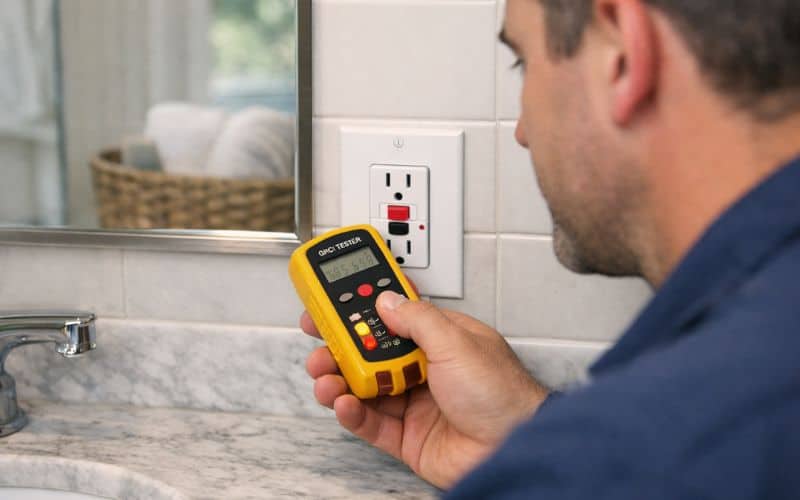
A ground fault occurs when a hot conductor contacts a grounded surface, such as a metal outlet box, a metal conduit, or the ground wire itself. The current takes an unintended path to ground, the breaker detects the imbalance, and trips. Ground faults are the condition that GFCI outlets are specifically designed to detect at a more sensitive level than a standard breaker, which is why GFCI protection is required near water sources where ground fault risk is elevated.
Both conditions can develop gradually in older wiring and may start as intermittent trips before becoming consistent. A breaker that trips every few days under similar conditions, rather than immediately on reset, may be detecting a fault that is only present when specific temperature or load conditions exist. This intermittent behavior makes diagnosis more involved but does not make the underlying fault less real.
Aging Breakers: When the Device Itself Is the Problem
Circuit breakers have a finite service life. The internal components that detect overloads and faults are mechanical and electronic, and they degrade over time. A breaker that has been in service for 30 or 40 years in an older Los Angeles home may no longer trip accurately. Some aging breakers become oversensitive and trip at loads well below their rating. Others fail in the opposite direction, not tripping when they should, which is the more dangerous failure mode.
Breakers in panels that have been exposed to moisture, that have experienced repeated overload trips, or that are in one of the four recalled panel brands (Zinsco, Federal Pacific Electric, Challenger, and Pushmatic) are at higher risk of mechanical failure. These four brands have documented histories of breaker performance problems, including breakers that fail to trip under fault conditions, and they are the panels that insurers and inspectors consistently flag in Los Angeles properties.
An aging breaker that trips nuisance trips, meaning it trips without a corresponding load or fault condition, is not a problem that resolves with a different usage pattern. The breaker needs to be evaluated and likely replaced. This evaluation also includes assessing the panel itself, because a panel that has produced multiple aging breaker issues may have broader reliability concerns.
Warning Signs That Require Immediate Attention
Most repeated breaker trips warrant a diagnostic service call rather than a DIY investigation. But certain symptoms indicate conditions that should not wait for a scheduled appointment.
A breaker that will not hold in the on position at all, even with nothing connected to the circuit, has either failed internally or is detecting a persistent fault in the wiring. Either condition requires professional assessment before the circuit is used again.
A burning smell near the panel or near a specific outlet or switch on the tripping circuit indicates that heat is already present at a level that is affecting insulation or connection materials. This is not a situation where waiting to see if the smell goes away is appropriate. It is a situation where a licensed electrician should be called the same day.
A panel face or breaker that is warm to the touch, or that has any visible discoloration or scorch marks, indicates heat buildup inside the panel. This is particularly concerning in panels that have known reliability issues. Warmth that cannot be explained by normal electrical activity should be treated as an urgent finding.
Buzzing, crackling, or popping sounds from the panel or from a wall outlet are signs of arcing, which is current jumping across a gap rather than flowing through a conductor. Arcing is a fire risk and is never a normal operating sound from an electrical system.
Why Resetting the Breaker Is Not a Solution
The reflex to reset a tripping breaker and continue using the circuit is understandable, but it addresses the symptom rather than the cause. Each time the breaker trips and is reset without diagnosing why it tripped, the underlying condition that caused the trip continues. In the case of an overloaded circuit, the wiring continues to carry the load that caused the trip. In the case of a fault, the fault condition continues to develop.
Wiring insulation that is stressed by repeated overload events degrades faster than insulation under normal conditions. Connection points that are loose enough to cause intermittent faults do not tighten themselves. A panel that has recurring breaker issues does not improve with use. The practical consequence of treating repeated trips as a nuisance is that the underlying problem reaches a more serious stage before it is addressed, and more serious stages cost more to correct and carry higher safety exposure in the interim.
A breaker that trips repeatedly is reporting a condition. The appropriate response is to identify what that condition is, not to restore power and wait for the next trip.
What the Diagnostic Process Looks Like
When RG Electric responds to a repeated breaker tripping complaint, the diagnostic process starts with the panel and works outward. A technician examines the panel condition, tests the tripping breaker, assesses the load on the circuit, and traces the circuit to identify any fault conditions in the wiring or connected devices.
Findings are documented and reported to Roy, the owner and master electrician, who reviews them and builds a written estimate that identifies the cause, the recommended correction, and any related conditions that were observed during the assessment. The estimate distinguishes between what is required to resolve the tripping issue and what additional work may be recommended based on the overall condition of the circuit and panel.
Nothing proceeds without the property owner’s approval, and the estimate covers everything before any work begins. There are no surprise charges at the end of the job.
RG Electric’s circuit breaker services in Los Angeles cover the full diagnostic and repair process, from individual breaker replacement to panel evaluation and upgrade. All work is performed under the C10 license, permitted where required, and backed by the 12-month workmanship guarantee.
When the Breaker Is Not the Real Problem
In many cases, the breaker that is tripping is not where the actual problem is located. The breaker is responding to a condition elsewhere in the circuit, and replacing or resetting the breaker without addressing that condition leaves the root cause in place.
A breaker that trips because of an overloaded circuit needs additional circuit capacity, not a new breaker. A breaker that trips because of a ground fault in a downstream outlet needs that outlet and its wiring evaluated, not just the breaker reset. A panel where multiple breakers are tripping under normal loads may need a load assessment and capacity upgrade rather than individual breaker replacements.
This is the reason a diagnostic approach produces better outcomes than a replacement approach. Identifying the actual cause of the trip points to the right correction rather than the most visible one. RG Electric’s electrical panel services in Los Angeles include load assessments and panel evaluations for properties where the pattern of breaker trips suggests a broader capacity or reliability issue rather than an isolated circuit problem.
The Connection Between Breaker Issues and Insurance
In Los Angeles, where insurers are increasingly scrutinizing the electrical systems of older properties, a pattern of breaker trips can have implications beyond the inconvenience of lost power. A home with recurring electrical issues that are not professionally diagnosed and corrected is a home with undocumented electrical conditions. When an insurer reviews coverage or investigates a claim, undocumented electrical problems are a liability for the property owner rather than a neutral fact.
Conversely, a property owner who has had repeated breaker trips professionally diagnosed, had the underlying cause corrected by a licensed electrician, and has documentation of that correction is in a stronger position. The work was done correctly, it was done under license, and there is a record of it. That documentation matters at renewal time, at sale time, and in the event of a claim.
For property managers overseeing apartment buildings and multi-unit properties in Los Angeles, this connection is particularly important. Tenant complaints about power outages caused by repeated breaker trips create liability exposure that goes beyond the electrical system itself. Addressing the underlying electrical condition through licensed, permitted work is the response that closes that exposure rather than leaving it open.
For immediate assistance or to schedule a professional evaluation, call RG Electric directly at (323) 521-5131.