
 Call (323) 5215131
What does a failed electrical inspection mean when selling a home in Los Angeles?
Updated August 2026
A failed electrical inspection during a home sale in Los Angeles means the buyer’s inspector, the lender’s inspector, or the city has identified an electrical condition that does not meet current code, and closing cannot proceed until it is corrected or resolved through negotiation. RG Electric is a licensed C10 #910807 electrical contractor serving homeowners and property managers throughout Los Angeles, and we are frequently called into a transaction at exactly this point, when a deal that was on track suddenly has a deadline attached to an electrical problem nobody planned for. Understanding what triggers a failed inspection, what happens next, and what it actually costs in time and money helps sellers and their agents respond correctly instead of losing the sale to something that is usually fixable.
What causes an electrical inspection to fail during a sale
Most failed electrical inspections in Los Angeles home sales trace back to a small set of recurring conditions. An outdated or recalled panel, such as Zinsco, Federal Pacific, Challenger, or Pushmatic, is one of the most common triggers, since these panels are widely recognized as fire hazards even when they are still technically functioning. Missing GFCI protection at kitchen counters, bathrooms, outdoor outlets, and garages is another frequent finding, particularly in homes that have had partial renovations over the years without full code updates. Ungrounded outlets, reversed polarity from earlier handyman work, double-tapped breakers, and unpermitted additions such as a converted garage or an added bedroom with wiring that was never inspected all show up regularly as well.
The inspector conducting this review is usually one of three people: a general home inspector hired by the buyer, who will flag electrical concerns for a specialist to confirm, a city inspector if the sale triggers a point-of-sale inspection requirement in certain Los Angeles jurisdictions, or an insurance company inspector if the buyer’s lender requires proof of insurable condition before funding the loan. Each of these has a different threshold for what counts as a failure, but panels, grounding, and GFCI protection are the three areas that appear across all of them. When any of these conditions are present, the practical effect is the same regardless of which inspector found it: the transaction now has an open item that has to close before the deal can.
Why one hidden issue can delay an entire closing
A seller in Sherman Oaks recently prepared their home for sale by updating the kitchen and adding two outdoor outlets, work performed by a general handyman rather than a licensed electrician. The buyer’s inspector flagged the outdoor outlets for missing GFCI protection, a straightforward correction. But once RG Electric was called in to fix the flagged items, the panel itself turned out to be an original 1962 Zinsco unit that had never been touched. The buyer’s lender would not fund the loan without either a full panel replacement or a signed disclosure and price adjustment, neither of which had been part of anyone’s plan a week earlier. This is a common pattern. The item that failed the inspection is rarely the whole story, and a licensed electrician evaluating the flagged issue often finds a second, larger condition sitting behind it that the original inspector was not specifically looking for.
The consequence of this pattern is that sellers who treat a failed inspection as a single line-item fix sometimes discover a second round of findings after the first repair is already scheduled, which compresses an already tight closing timeline even further. Having a licensed electrician evaluate the full panel and circuit condition at the first visit, rather than only the specific item flagged, prevents a second surprise from surfacing days before closing.
What happens to the timeline once an inspection fails
Once an electrical condition is flagged, escrow typically does not close until one of three things happens: the seller completes the repair and provides documentation, the buyer accepts a credit or price reduction in lieu of repair, or the buyer walks away from the transaction entirely. Every day spent deciding which path to take is a day added to the closing timeline, and in a competitive Los Angeles market, a delayed closing can affect financing rate locks, moving logistics on both sides, and in some cases the buyer’s willingness to stay in the deal at all.
The fastest path through this is usually a direct repair rather than a negotiated credit, because a credit still requires the buyer’s lender to be comfortable funding a home with a known electrical hazard, which they frequently are not. A same-day or next-day diagnostic visit from a licensed electrician, followed by a written estimate and a realistic repair timeline, gives the seller’s agent something concrete to bring back to the buyer immediately rather than an open-ended promise to look into it. The consequence of moving quickly here is straightforward: transactions that get a firm repair timeline within 48 hours of a failed inspection close on schedule far more often than ones where the electrical question sits unresolved for a week or more.
The insurance dimension sellers often miss
A failed electrical inspection is not only a buyer issue. California insurance carriers have become significantly stricter about panel condition in the past year, particularly following major wildfire events that increased scrutiny on fire risk across the state. A buyer’s lender typically requires proof of insurability before funding a loan, and an insurance company that sees a Zinsco, Federal Pacific, Challenger, or Pushmatic panel on a pre-inspection report may decline to bind a policy at all until it is replaced. This means the electrical condition can block the transaction even if the buyer personally would have been willing to accept it, because the lender’s insurance requirement sits outside the buyer’s control.
For sellers, this makes proactive panel evaluation before listing a genuinely useful step rather than an optional one. A seller who replaces an outdated panel before listing removes the insurance question from the transaction entirely, rather than discovering it during the exact week the deal is supposed to close. The practical effect is fewer surprises for everyone and a cleaner path to a funded loan.
What documentation resolves a failed inspection
Completing a repair is only half of what closes out a failed electrical inspection. Buyers, lenders, and title companies generally want to see a permit pulled for any panel replacement or significant electrical correction, a final sign-off from city inspection where required, and a written invoice or completion letter from a licensed C10 contractor confirming what was done. Repairs performed without permits, even if done correctly, can create the same problem again during a future sale, since the lack of permit history itself becomes a disclosure item. This is one of the more common mistakes we see: a prior owner corrected an electrical issue years earlier, but because no permit was pulled, the current sale’s inspection flags it as unresolved even though the physical work was done properly.
The consequence of skipping documentation is that the same electrical condition can resurface as an obstacle in a future transaction even after it has technically been fixed. Proper permits and a paper trail are what actually close the issue out for good, not just the physical repair itself.
What a pre-closing repair actually involves
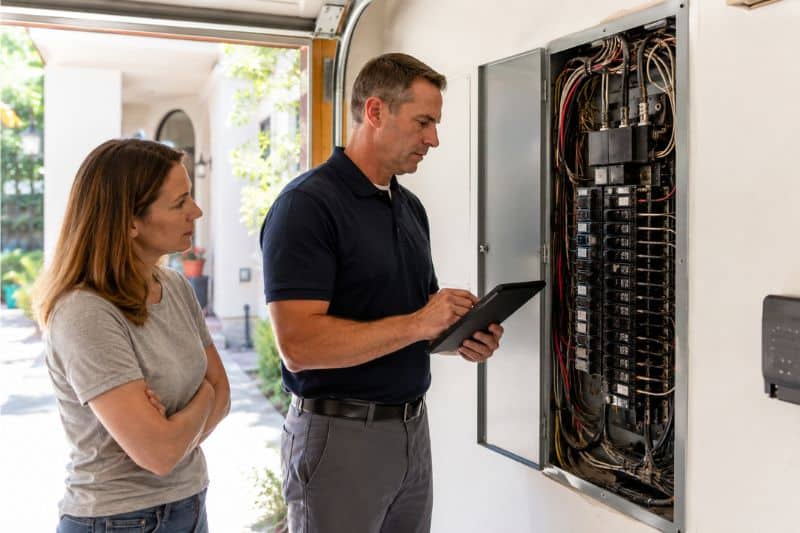
The scope of a pre-closing electrical repair depends entirely on what the inspection flagged, but a few patterns are common enough to describe here. A GFCI compliance correction, where outdated or missing GFCI protection is added at kitchen, bathroom, garage, and outdoor outlets, is usually completed in a single visit and does not typically require a permit if it is a like-for-like device swap. A full panel replacement, by contrast, requires a permit, a city inspection, and coordination with the utility for any service disconnect and reconnect, which adds days rather than hours to the timeline even when the physical installation itself is quick. Grounding corrections, double-tapped breaker fixes, and reversed polarity repairs generally fall in between, often completed same-day but sometimes uncovering a second issue once the panel cover is off, which is why a full evaluation at the first visit matters more than a narrow fix aimed only at the single item the inspector flagged.
Cost is the question every seller asks first, and the honest answer is that it depends heavily on scope. A GFCI correction is typically the least expensive item on this list, while a full panel replacement, particularly on an older Zinsco or Federal Pacific installation with limited working clearance, sits at the higher end. What matters more than a specific number is getting a written estimate quickly, since the estimate itself is what the seller’s agent uses to negotiate with the buyer, whether that means proceeding with the repair or presenting a credit amount backed by a real number rather than a guess. A vague verbal estimate slows negotiations down. A specific written one from a licensed contractor moves them forward.
What a pre-listing evaluation catches before a buyer ever sees the home
A pre-listing electrical evaluation is a short diagnostic visit, typically covering the panel’s age and brand, the presence of GFCI protection in required locations, visible grounding condition, and any signs of prior unpermitted work such as mismatched outlet types or wiring that does not match the rest of the home. This is not a substitute for the buyer’s own inspection, but it tells the seller in advance whether their home is likely to trigger a finding, and it gives them the option to correct it on their own schedule, months before a closing deadline exists, rather than in the middle of one.
Sellers in older Los Angeles neighborhoods including Encino, Van Nuys, Culver City, and the broader San Fernando Valley benefit from this the most, since those areas carry a higher concentration of homes built before current GFCI and grounding requirements existed. A pre-listing evaluation in these cases is less about whether an issue exists and more about identifying it early enough that fixing it does not become the thing standing between an accepted offer and a closed sale.
Multi-unit and investment property sales carry an added layer
Property managers and investors selling multi-unit buildings in Los Angeles face a version of this same problem at larger scale. A failed inspection on one unit’s panel often prompts the buyer’s inspector to request a review of every unit in the building, since a shared building history typically means shared electrical conditions. We have found double-tapped breakers, missing grounding, and outdated subpanels in units the original inspection never touched, simply because the building’s electrical work was performed in batches over multiple years by different contractors. In one recent case, an inspector clearing three newly upgraded panels in a multi-unit building went on to open a fourth panel that had not been part of the project at all, and found a double-tapped breaker that delayed the sale until it was corrected, even though the seller had already completed the upgrades everyone assumed were the only issue.
For a seller of a multi-unit property, budgeting time and cost for a building-wide electrical review, rather than assuming the flagged unit is an isolated case, prevents the transaction from stalling out unit by unit as each new finding surfaces. This is especially true for buildings where units were renovated at different times by different owners, since that history rarely appears anywhere in the listing paperwork and only becomes visible once an electrician is actually inside the panels.
How RG Electric handles a pre-closing electrical repair
When a seller, buyer, or agent calls us with a failed inspection report in hand, we schedule a diagnostic visit that evaluates the specific flagged item along with the panel and circuit condition as a whole, so the seller gets the full picture on the first visit rather than in stages. We provide a written estimate the same day in most cases, explain what is required by code versus what is optional, and handle permit paperwork and inspection scheduling directly so the seller and their agent are not managing that process themselves during an already stressful closing window. If the finding involves a recalled panel, we can typically complete a straightforward panel replacement quickly enough to meet standard escrow timelines when we are brought in promptly after the inspection fails.
We also work directly with real estate agents and escrow officers who need documentation in a specific format for the file, and we provide the completion letter and permit confirmation that lenders and title companies typically require to close out the condition. For sellers who want to avoid this scenario entirely, a pre-listing electrical evaluation identifies panel age, grounding condition, and GFCI compliance before the home ever goes on the market, which turns a potential closing crisis into a planned repair on the seller’s own timeline instead of the buyer’s.
Our electrical repair services in Los Angeles cover the diagnostic and correction work involved in resolving a failed inspection finding, from a single GFCI upgrade to a full circuit correction. When the finding involves the panel itself, that work is handled through our electrical panel services in Los Angeles, including replacement of Zinsco, Federal Pacific, Challenger, and Pushmatic panels.
Electrical work is hazardous. Consult a licensed electrician like RG Electric before working on panels, wiring, or any condition identified in a home inspection report.
For immediate assistance or to schedule a professional evaluation, call RG Electric directly at (323) 521-5131.