
 Call (323) 5215131
What Does a C10 Electrical License Mean and Why Does It Matter in California?
Updated June 2026
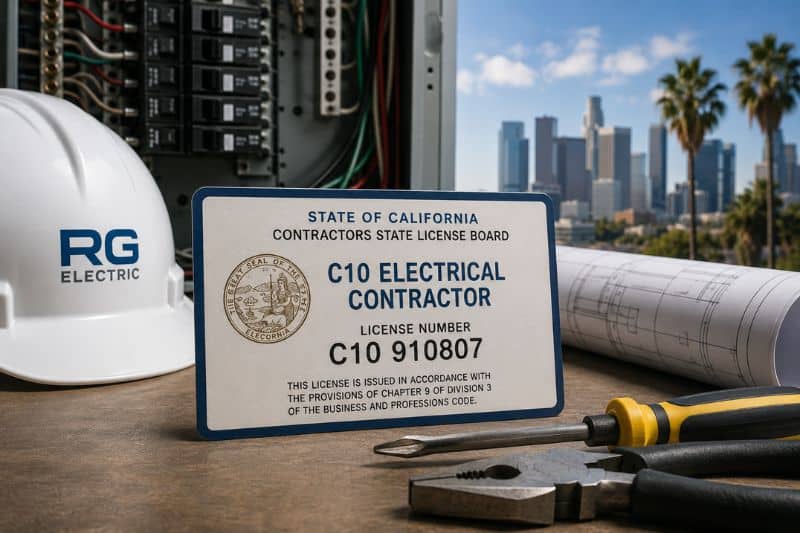
When a property manager or homeowner in Los Angeles asks an electrical contractor for proof of licensing, they are usually looking for one thing: a C10 license number. RG Electric holds California C10 License #910807 and has operated under that license for over 20 years. But most people who ask for a C10 number do not fully understand what it represents, what it authorizes, or why its absence is a significant risk. This post answers those questions directly so that anyone hiring an electrician in California can make an informed decision before the work begins. Understanding the C10 license is not just a due diligence exercise. It is the foundation of knowing whether the work on your property is legally authorized, insurable, and inspectable.
What the C10 Classification Actually Means
In California, the Contractors State License Board (CSLB) issues specialty contractor licenses organized by classification. The C10 classification is the Electrical Contractor license. It is the specific license that authorizes a contractor to install, maintain, repair, and alter electrical wiring, fixtures, appliances, and equipment in California.
The C10 is not a general contractor’s license with electrical included, and it is not a handyman certification. It is a dedicated electrical specialty license with its own examination, experience requirements, and continuing obligations. A contractor who holds a C10 license has demonstrated to the state of California that they have the knowledge and experience to perform electrical work legally and competently.
The license number itself is publicly searchable through the CSLB website. Anyone can verify a contractor’s license status, license type, bond status, insurance status, and whether any disciplinary actions have been taken. This verification takes less than a minute and is one of the most important steps a property owner can take before authorizing electrical work.
What a C10 Contractor Is Authorized to Do
A licensed C10 electrical contractor in California is authorized to perform the full scope of electrical work on residential, commercial, and industrial properties. This includes panel replacements and upgrades, full and partial rewiring, new circuit installations, subpanel installations, service upgrades, GFCI and AFCI installations, EV charger circuits, lighting systems, and all associated work that requires a permit and a city inspection.
Critically, a C10 contractor is the only type of contractor who can legally pull electrical permits in California. Permits are required for most significant electrical work, including panel replacements, new circuit installations, and rewiring projects. When an electrical job requires a permit, only a licensed C10 contractor can apply for it, perform the permitted work, and have it inspected and finaled by the city.
This means that any electrical work performed by someone who is not a licensed C10 contractor, and any work that required a permit but did not have one, is unpermitted work regardless of how competently it was done. Unpermitted electrical work creates insurance exposure, real estate complications, and liability for the property owner that persists long after the contractor has left the property.
What It Takes to Obtain a C10 License in California
The path to a California C10 license is not short. An applicant must demonstrate at least four years of journey-level experience in the electrical trade, meaning hands-on field work at a level of skill and responsibility beyond an apprentice. This experience must be documented and verified.
The applicant must then pass two examinations: a trade examination that tests knowledge of electrical theory, the National Electrical Code, California electrical regulations, and practical installation methods, and a law and business examination that covers contractor obligations, business practices, and California construction law.
The licensed contractor must also maintain a bond and carry liability insurance as conditions of keeping the license active. The bond protects consumers if the contractor fails to complete work or causes damage. The insurance protects the property owner and the contractor’s workers. These are not optional extras. They are requirements of the license, and a contractor whose bond or insurance lapses has a license that is technically active but non-compliant.
The CSLB enforces these requirements and takes disciplinary action against contractors who violate them. A license that shows a disciplinary history, a suspended bond, or lapsed insurance is a license that should not be trusted for a significant electrical project.
Why Property Managers Ask for C10 Credentials First
Commercial clients, including property managers overseeing apartment buildings and multi-unit properties in Los Angeles, consistently ask two questions when contacting a new electrical contractor: can you provide permits, and can you provide a certificate of insurance. Both of these questions are really asking the same underlying question: are you a licensed C10 contractor?
Only a licensed C10 contractor can provide permits, because only a licensed C10 contractor can pull them. Only a licensed C10 contractor carries the bond and insurance that make a certificate of insurance meaningful. When a property manager asks for these two things, they are applying a filter that eliminates unlicensed workers, unqualified handymen, and contractors who are not operating within California’s legal framework for electrical work.
The reason this filter matters so much for commercial properties is liability. A property manager who authorizes electrical work by an unlicensed contractor, and where that work contributes to a fire, an injury, or a failed inspection, has made a decision that will be scrutinized during any subsequent investigation. The question of whether the contractor was licensed is not a technicality in that context. It is a central fact about whether the property manager exercised reasonable care.
A property manager who consistently uses licensed C10 contractors, who requires permits for permitted work, and who maintains documentation of completed electrical work is in a fundamentally different legal and insurance position than one who does not. The C10 license is the foundation of that documentation chain.
The Difference Between Licensed, Bonded, and Insured
These three terms appear together so often that they can start to feel like a single phrase rather than three distinct protections. Understanding what each one means helps property owners evaluate what they are actually getting when a contractor claims all three.
Licensed means the contractor holds a current, active C10 license issued by the California CSLB. The license confirms that the contractor passed the required examinations, met the experience requirements, and is authorized to perform electrical work in California. A license number should always be verified through the CSLB website before work begins, not just accepted from a business card or website.
Bonded means the contractor maintains a surety bond with the CSLB. The bond is a financial protection for consumers. If a licensed contractor fails to complete contracted work, abandons a job, or causes damage that they refuse to address, the bond provides a mechanism for the consumer to recover losses. The bond amount required by California for C10 contractors is modest, but its existence is a condition of license maintenance and signals that the contractor is operating within the regulatory framework.
Insured means the contractor carries liability insurance and, if they have employees, workers’ compensation insurance. Liability insurance protects the property owner if the contractor’s work causes damage to the property. Workers’ compensation protects the property owner from being held liable for injuries to workers on their property. A contractor who is not insured transfers both of these risks to the property owner, which is a significant exposure on any major electrical project.
All three of these can be verified through the CSLB for any California contractor. A property owner who takes two minutes to run a CSLB check before authorizing work has done more due diligence than the majority of people who hire electrical contractors in Los Angeles.
What Happens When Electrical Work Is Done Without a C10 License
Unlicensed electrical work is common in Los Angeles, particularly in older neighborhoods where handymen and general workers perform electrical repairs without holding a C10 license or pulling permits. The property owner often does not discover that the work was unlicensed until the consequences surface.
The insurance consequence is the most immediate for many property owners. California insurers conducting electrical reviews, particularly following the acceleration of wildfire-related claims, are increasingly identifying unpermitted electrical work during coverage reviews. Work that was done without a licensed C10 contractor and without permits has no inspection record. An insurer that discovers this situation may require remediation, restrict coverage, or condition renewal on bringing the electrical system to documented, permitted standards.
The real estate consequence surfaces at sale. California disclosure requirements mean that known unpermitted work is a material defect that must be disclosed. Buyers’ inspectors who identify work that does not match permit records create a negotiating issue that is more costly to resolve at closing than the original permit would have been. In some cases, buyers require that unpermitted work be brought to permitted standards before closing, which means hiring a licensed C10 contractor to evaluate and potentially redo work that was done incorrectly the first time.
The safety consequence is ongoing. An unlicensed worker who replaces a panel without the knowledge required to pass a C10 examination may install it incorrectly. Without a permit and inspection, there is no independent verification of the installation. The property owner has no documentation and no recourse if the installation later causes a problem.
How to Verify a C10 License Before Hiring
The CSLB maintains a public license lookup tool at www.cslb.ca.gov. Entering a contractor’s name or license number returns their current license status, license classification, bond information, insurance status, and any disciplinary actions or complaints on record. This search is free and takes less than a minute.
When verifying a C10 license, the most important fields to check are the license status, which should show as Active, the license classification, which should include C10 for electrical work, the bond expiration date, which should be current, and the workers’ compensation status, which should show coverage if the contractor has employees.
A contractor who provides a license number that does not return C10 classification, or whose license shows as suspended, expired, or subject to disciplinary action, should not be hired for permitted electrical work. No amount of good reviews or low pricing changes the legal and insurance exposure that comes with using an unlicensed or non-compliant contractor.
RG Electric’s C10 License #910807 is active, in good standing, and has been maintained continuously for over 20 years. It can be verified at any time through the CSLB website. This is not a marketing claim. It is a verifiable fact, and property owners and managers are encouraged to verify it before authorizing any work. The license number that appears in every piece of RG Electric’s content is there precisely because verification should be easy, not because it is assumed.
Why the C10 License Matters for Insurance Compliance Work
In Los Angeles, where insurance companies are increasingly requiring electrical upgrades as a condition of coverage, the C10 license is more than a regulatory requirement. It is the credential that makes an insurer’s documentation requirement satisfiable.
When an insurer sends a notice requiring a panel replacement, a grounding correction, or a GFCI upgrade, they are typically requiring that the work be performed by a licensed electrical contractor and documented with a permit and inspection record. Work performed by an unlicensed contractor, or permitted work that was performed without pulling the required permit, does not satisfy the insurer’s requirement regardless of how well the work was done.
RG Electric’s commercial electrical services in Los Angeles include the full documentation package that insurers require for compliance work, including permit management, inspection coordination, and written confirmation of completed work under the C10 license. For property managers dealing with insurance-mandated upgrades on apartment buildings and multi-unit properties, this documentation capability is not a secondary consideration. It is the reason the work satisfies the insurer’s requirement rather than simply completing a task.
The C10 License as a Baseline, Not a Ceiling
Holding a C10 license establishes that a contractor met the state’s minimum requirements at the time of licensure. It does not guarantee quality, responsiveness, or experience with specific project types. A contractor who obtained a C10 license and immediately started working on large commercial projects is legally compliant but may lack the specific experience that complex multi-unit electrical work requires.
This is why the C10 license is the starting point for evaluating a contractor, not the ending point. Beyond the license, property owners and managers should ask about experience with the specific type of work they need, familiarity with Los Angeles permit processes and LADBS requirements, and the contractor’s communication and documentation practices.
RG Electric’s electrical panel services in Los Angeles reflect over 20 years of C10-licensed work specifically in the Los Angeles market, including panel replacements for the four recalled panel brands that insurers flag most consistently, multi-panel replacements in apartment complexes, and permitted work that has passed city inspection consistently throughout that period. The license is the legal foundation. The 20-year track record under that license is what it has been built on. For property owners and managers who want to work with a contractor whose credentials are documented, verifiable, and current, that combination is the standard to hold every electrical contractor to.
For immediate assistance or to schedule a professional evaluation, call RG Electric directly at (323) 521-5131.