
 Call (323) 5215131
Why the GFCI Outlet in Your Los Angeles Kitchen or Bathroom Keeps Tripping and When It Is Not the Outlet
A GFCI outlet that keeps tripping is one of the most common electrical complaints RG Electric (License C10 #910807) receives from homeowners and property managers across Los Angeles. The frustration is understandable: you reset the outlet, it trips again within hours or days, and eventually you start wondering whether the outlet itself is faulty. Sometimes it is. More often, the outlet is doing exactly what it was designed to do, and the problem is somewhere else entirely. Understanding the difference between a failing GFCI and a GFCI responding to a real hazard is the first step toward fixing the right thing.
What a GFCI Outlet Actually Does
A ground fault circuit interrupter monitors the flow of electricity through a circuit and compares the current going out to the current returning. In a properly functioning circuit, those two values are equal. When they are not, it means current is taking an unintended path, which is typically through a person, a wet surface, or a damaged conductor. The GFCI detects this imbalance in a fraction of a second and cuts power before the difference can cause a serious shock or fire.
California code requires GFCI protection in any location where water and electricity could come into contact. This covers kitchen countertop outlets, bathroom outlets, garage outlets, outdoor outlets, and outlets near laundry areas and wet bars. In Los Angeles homes and apartment buildings built before these requirements were updated, GFCI protection is often missing entirely or was added later in ways that are not always correct.
The important point is this: when a GFCI trips, it is reporting that it detected something. The question is whether what it detected is a real fault in the circuit or a symptom of a problem with the device itself. Those two scenarios require different responses.
Reasons a GFCI Outlet Trips Repeatedly
There are several distinct causes for a GFCI that will not stay reset, and identifying the right one prevents the common mistake of replacing a functioning outlet only to have the new one trip for the same reason.
A connected appliance has a ground fault
This is the most common cause of a repeatedly tripping GFCI in a kitchen or bathroom. An appliance plugged into the circuit, or into a standard outlet downstream of the GFCI, has developed an internal fault that is leaking current. The GFCI is tripping correctly because it is detecting that fault.
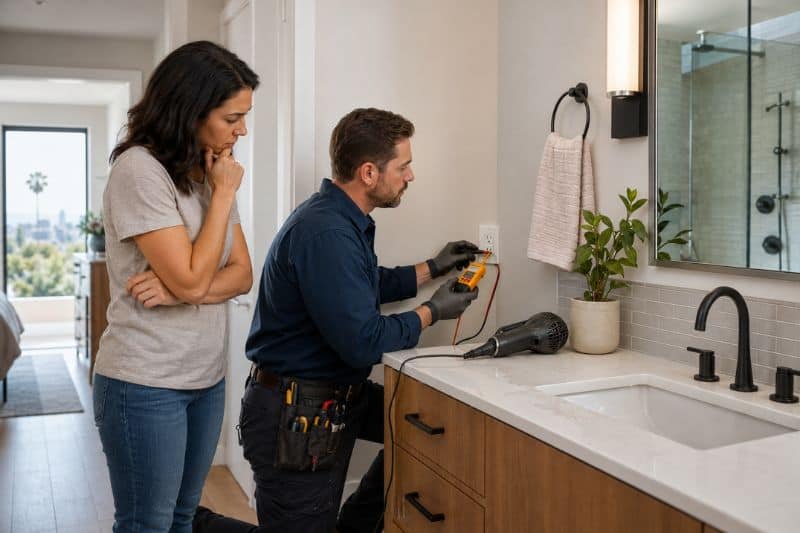
The test is straightforward: unplug everything connected to the circuit, reset the GFCI, and then plug appliances back in one at a time. If the GFCI holds until a specific appliance is plugged in and trips when that appliance is connected, the appliance is the source of the fault. A hair dryer with a damaged cord, a refrigerator with a failing motor, or a countertop appliance with moisture inside can all produce ground faults that trigger the GFCI.
In this scenario, the GFCI itself is working correctly. Replacing it will not solve the problem. The appliance needs to be repaired or replaced.
Moisture inside the outlet or on the circuit
Los Angeles is not a particularly humid climate, but moisture gets into outlet boxes in bathrooms and outdoor locations through condensation, plumbing leaks, and cleaning water. A GFCI outlet that is installed in a bathroom where steam accumulates, or an outdoor outlet that was exposed to rain or irrigation, may trip repeatedly because it is detecting moisture on the conductors inside the box.
This is more common in older Los Angeles homes where outlet boxes are not sealed adequately and where bathroom ventilation is insufficient to clear steam after showers. It also occurs in outdoor outlets that are installed without weatherproof covers or in locations where sprinkler systems direct water toward the outlet face.
The cause is real moisture creating a current path the GFCI is designed to interrupt. The effect is a GFCI that resets successfully but trips again once the moisture returns. The consequence is an outdoor or bathroom circuit that is intermittently unavailable and a property that has an underlying moisture management problem contributing to ongoing electrical issues.
Wiring errors in the circuit
A GFCI outlet that was installed by an unlicensed handyman, or that was wired during a renovation without proper attention to the line and load terminals, may trip repeatedly because the wiring configuration is incorrect. The most common error is connecting downstream outlets to the load terminals when they should be on the line side, or reversing the line and load connections entirely.
Incorrect wiring can also result from previous repairs where a standard outlet was replaced with a GFCI without accounting for how the downstream outlets on the same circuit were connected. In older Los Angeles homes, circuit configurations are sometimes unconventional, and a GFCI installed without understanding the full circuit can create tripping behavior that appears random but is actually the result of a consistent wiring error.
This is one of the most common findings when RG Electric is called to diagnose a GFCI that a homeowner or a previous handyman has already replaced once or twice without success. The device keeps tripping not because the device is faulty but because the circuit was never wired correctly in the first place.
The GFCI is protecting a larger circuit than expected
A single GFCI outlet can be wired to protect all of the standard outlets downstream of it on the same circuit. In many older Los Angeles homes, one GFCI outlet in a bathroom protects several other outlets in adjacent bathrooms or areas through the load terminals. When any outlet on that protected circuit develops a fault, or when any appliance connected to any of those outlets causes a ground fault, the upstream GFCI trips.
This creates a confusing situation where the GFCI that is tripping is not physically near the source of the fault. A GFCI in the master bathroom may be tripping because of a problem with an outlet in the hallway bathroom that is on the same protected circuit. A homeowner who focuses only on the tripping outlet and does not understand how the circuit is configured will not find the source of the fault.
Diagnosing this correctly requires tracing the circuit and understanding which outlets are downstream of which GFCI devices. This is not a task that can be reliably accomplished without electrical knowledge and testing equipment.
The GFCI device itself has failed
GFCI outlets have a finite lifespan. They contain electronic components that degrade over time, particularly in environments where they are exposed to temperature cycling, humidity, or repeated tripping events. A GFCI outlet that has been in service for ten or more years in a bathroom or outdoor location may begin to trip nuisance trips, meaning it is triggering its protection mechanism without detecting an actual fault.
The way to distinguish a failing GFCI from a GFCI responding to a real fault is to disconnect all downstream outlets and all appliances from the circuit, then test the GFCI in isolation. If it trips without any load connected, the device itself has failed and needs to be replaced. If it holds in isolation but trips when load is reintroduced, the problem is in the circuit or the connected equipment.
A GFCI that has failed in the tripping direction is still protecting the circuit, but it is no longer reliable as a working outlet. It should be replaced by a licensed electrician who can also verify that the replacement is wired correctly and that the downstream circuit is in good condition.
When the Problem Is Not the Outlet at All
Some of the most important GFCI tripping scenarios in Los Angeles properties are ones where the outlet is functioning correctly and the real problem is deeper in the electrical system.
A GFCI that trips repeatedly in a kitchen may be detecting a fault in the wiring inside the wall rather than in any connected appliance. Old wiring with degraded insulation, particularly in homes built before 1970, can develop faults where the conductor insulation has cracked or deteriorated to the point where current leaks to adjacent conductors or to the metal conduit. These faults are intermittent, they worsen over time, and they are not visible without opening the wall or performing conductor insulation testing.
A GFCI that trips in a bathroom and is connected to a circuit that also serves a light fixture or an exhaust fan may be detecting a fault in that fixture rather than in the outlet itself. Bathroom exhaust fans are often overlooked as a source of ground faults because they are not thought of as part of the outlet circuit, but if they share the circuit with a GFCI-protected outlet and develop an internal fault, the GFCI will respond.
In multi-unit buildings in Los Angeles, GFCI tripping in individual units can sometimes trace back to shared wiring in common areas or to wiring that was modified improperly during a previous renovation. When a property manager receives multiple tenant complaints about GFCI outlets tripping in different units, the cause is rarely the outlets themselves. It is more likely a circuit configuration issue or a wiring fault that is affecting multiple units through a shared path.
What a Diagnostic Service Call Covers
When RG Electric responds to a GFCI tripping complaint, the diagnostic process does not begin and end with the outlet. A technician will test the GFCI device itself, trace the circuit to identify all outlets and fixtures on the protected circuit, test for ground faults in the wiring and connected equipment, and assess the overall condition of the outlet box and wiring connections.
Findings are reported to Roy, the owner and master electrician, who reviews them and builds an estimate for whatever correction is needed. That estimate distinguishes between what is required to resolve the immediate tripping issue and what additional work may be recommended based on the overall condition of the circuit. Nothing proceeds without the property owner’s approval.
RG Electric’s electrical outlet and switch services in Los Angeles cover the full range of GFCI-related work, from replacing a single failed device to rewiring a circuit that was never correctly configured. The 12-month workmanship guarantee applies to all completed work, which means that if an issue connected to the repair surfaces within that window, there is no additional service call charge.
GFCI Requirements in Los Angeles Homes and Apartment Buildings
One reason GFCI issues are so common in older Los Angeles properties is that the code requirements for GFCI protection have been updated repeatedly since the protection was first required in the 1970s. Properties that were built to code in 1975 do not have GFCI protection in the same locations that are now required for new construction and major renovations.
Current California code requires GFCI protection for all kitchen countertop outlets within six feet of a sink, all bathroom outlets, all garage outlets, all outdoor outlets, all outlets in unfinished basements and crawlspaces, all outlets near swimming pools, hot tubs, and fountains, and all outlets in boathouses. For properties in Los Angeles where a rewire or panel replacement has been performed under permit, the inspector will require that all newly installed or disturbed outlets in these locations meet current GFCI requirements.
In apartment buildings and multi-unit properties, this requirement applies to each unit individually. A property manager who is having electrical work done in common areas or in individual units should expect that any outlet in a GFCI-required location that does not currently have protection will be flagged during inspection. Addressing these proactively rather than waiting for a code correction notice is both faster and less disruptive to tenants.
Properties where a handyman installed standard outlets in bathroom or kitchen locations that should have GFCI protection are particularly common in Los Angeles. This is one of the most frequent corrections RG Electric makes when called to a property for a different reason, and it represents a genuine safety exposure rather than a technicality. An unprotected outlet near a bathroom sink or a kitchen countertop is a shock hazard, and it is also a code violation that can create issues at insurance renewal or sale.
Why Repeatedly Resetting a Tripping GFCI Is Not a Solution
The impulse to reset a tripping GFCI and move on is understandable, particularly when the outlet resets successfully and works for a few days before tripping again. But this pattern is the GFCI communicating that it is detecting something on a recurring basis, and that something does not resolve itself between trips.
A GFCI that is tripping because of a wiring fault in the wall is detecting a fault that is present every time current flows through that section of wire. The fault does not disappear between trips. It is simply not active at the moment the outlet is reset. As the underlying wiring continues to degrade, the fault will become more frequent and eventually permanent.
A GFCI that is tripping because of moisture in the outlet box is detecting moisture that is present on a recurring basis. The moisture does not disappear between trips any more than the source of the moisture does. Each time the GFCI resets and trips again, it is confirming that the condition it detected the first time is still present.
The consequence of treating repeated GFCI tripping as a nuisance rather than a diagnostic signal is that the underlying problem continues to develop unaddressed. Wiring faults that start as intermittent ground faults can progress to short circuits. Moisture in outlet boxes can accelerate the corrosion of connections and conductors. A GFCI that is protecting a circuit with a real fault is doing its job correctly, but it cannot correct the fault. Only a licensed electrician can do that.
Working With a Licensed Electrician on GFCI Issues
The right approach to a GFCI that keeps tripping is to treat it as a diagnostic call rather than a replacement job. A licensed electrician will test the device, trace the circuit, check for downstream faults, and identify whether the problem is the outlet, the wiring, the connected equipment, or a combination. That diagnostic process takes time and requires equipment, which is why RG Electric charges a service fee for diagnostic calls rather than offering free estimates for repair work.
For homeowners and property managers in Sherman Oaks, Encino, Van Nuys, Koreatown, Culver City, Torrance, and across greater Los Angeles, that service fee is the cost of knowing what the problem actually is before any repair work begins. The alternative, replacing the GFCI device without diagnosing the circuit, is a common pattern that results in the new outlet tripping for exactly the same reason the old one did.
RG Electric’s electrical repair services in Los Angeles follow the same workflow for every diagnostic call: technician assesses and reports findings to Roy, Roy builds a written estimate, the customer reviews and approves before any work begins. There are no surprise charges and no pressure to approve additional work beyond what was found. The goal is to resolve the actual problem on the first visit, not to replace components until the tripping stops.
For immediate assistance or to schedule a professional evaluation, call RG Electric directly at (323) 521-5131.