
 Call (323) 5215131
If you own or manage a rental property in Los Angeles, the question of whether smoke detectors are required by code is not a gray area, and the answer is yes. California law treats working smoke alarms as a baseline condition of habitability, and the obligation to install, maintain, and test them in a rented unit falls on the owner, not the tenant. RG Electric, a licensed C10 electrical contractor in Los Angeles, License #910807, handles smoke detector evaluation, replacement, and hardwired installation across the city, and the most common reason owners call is that an inspection, a renovation, or an insurance review has suddenly turned a device they never thought about into a compliance problem with a deadline attached.
The short answer, and what it means for a Los Angeles rental
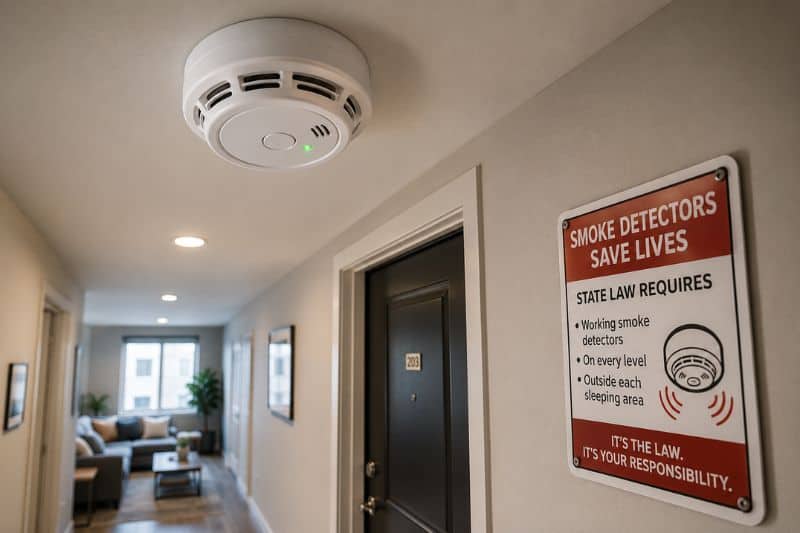
Smoke alarms are mandatory in every dwelling unit intended for human occupancy in California, and that includes single-family homes, condominiums, and apartment units that are rented or leased. The requirement is not optional, it does not phase out for older buildings, and it is not satisfied by a single hallway unit in a multi-bedroom apartment. Under the California Residential Code and the California Building Code, alarms must be present in each room used for sleeping, outside each separate sleeping area in the immediate vicinity of the bedrooms, and on every level of the unit, including basements.
For a property owner, the practical consequence is that a rental either meets this standard right now or it does not, and there is rarely a middle ground that an inspector will accept. A unit that passed years ago under an older device standard can fail today if the alarms are missing, expired, or improperly located. The conclusion for any Los Angeles landlord is straightforward, the smoke detector requirement is active, enforceable, and tied to the owner, so the only real question is whether the current devices would survive an inspection.
Where California requires smoke alarms inside a rental unit
The placement rules are specific, and they are the first thing an inspector checks. A required alarm must be installed inside each bedroom or room used for sleeping, on the ceiling or wall outside of each separate sleeping area in the immediate vicinity of those bedrooms, and on each story of the dwelling. In a two-story townhome rental in Sherman Oaks, that means alarms upstairs near the bedrooms, an alarm covering the sleeping area, and coverage on the lower level as well. A studio in Koreatown still needs an alarm in the sleeping area and proper coverage for its single level.
The reasoning behind the placement is not arbitrary. Most fatal residential fires happen at night, and the seconds between detection and escape depend on an alarm being close enough to the sleeping occupant to wake them. A device mounted only in a central hallway, with bedroom doors closed, may not sound loudly enough or early enough to matter. California recognized this gap decades ago, which is why bedroom-level coverage has been required since the early 1990s. The conclusion here is that coverage is measured room by room and level by level, so a rental that has alarms but not in the right places is still out of compliance, and a quick walkthrough is usually enough to reveal the gaps.
When smoke alarms must be hardwired and interconnected
This is where smoke detector compliance stops being a hardware-store errand and becomes electrical work, and it is the part most owners do not see coming. For new construction, alarms must be hardwired into the building’s electrical system and interconnected, meaning that when one alarm senses smoke, every alarm in the unit sounds. The same elevated standard is triggered by renovation work. When a permit is required for alterations, additions, or repairs that exceed $1,000 in value, the unit’s smoke alarms must be brought up to the current location and performance standard as part of that work.
There is an important practical limit on the hardwiring requirement, and it is the detail that separates an informed contractor from a guess. Alarms generally do not need to be hardwired and interconnected during a permitted project unless the wall or ceiling finishes are already being removed as part of that work. If a rewire, a panel relocation, or a remodel in a Van Nuys duplex opens the walls, the access exists and the code expects hardwired, interconnected alarms to go in while the cavity is open. If the work does not disturb those finishes, battery devices that meet the current standard can usually satisfy the requirement. This is exactly why smoke detector upgrades so often ride along with larger jobs, and why a licensed electrician should be the one scoping it. Professional smoke detector installation in Los Angeles means the interconnection, the circuit, and the device listing are handled correctly the first time, rather than discovered as a problem at inspection.
Interconnection itself is a code requirement in its own right. Where more than one alarm is required in a unit, those alarms must be interconnected so that activation of any one of them activates all of them. The conclusion for an owner planning any permitted electrical or remodeling work is that the smoke alarm scope is not a separate afterthought, it is part of the job, and opening walls changes what the law requires of you.
The ten-year sealed battery rule and why old devices fail
Even where hardwiring is not triggered, the devices themselves have to meet a current standard, and this trips up owners who assume any working alarm from a hardware store counts. A battery-operated smoke alarm installed today must contain a non-replaceable, non-removable battery capable of powering the device for at least ten years. The intent of the rule is to eliminate the most common failure mode in rental housing, the alarm that goes silent because someone pulled the nine-volt battery for another use and never replaced it. A new alarm with a removable, replaceable battery, the kind still sold on many shelves, can actually place a rental out of compliance.
There are sensible exceptions. Older units that are already hardwired with a battery backup are generally not held to the ten-year sealed battery standard, because they draw their primary power from the building. But a device’s age still matters. Smoke alarms have a service life, typically around ten years from the date of manufacture, after which the sensor degrades and the unit should be replaced regardless of whether it still chirps. The conclusion is that compliance is about more than the presence of an alarm, it depends on the device type, its battery standard, and its age, and a box of new alarms from the wrong shelf can leave a Downtown LA rental no better off in the eyes of an inspector.
Carbon monoxide alarms belong in the same compliance check
Smoke alarms rarely travel alone in a compliance review, because California pairs them with a separate carbon monoxide requirement that catches many of the same rentals. Under Health and Safety Code Section 17926, the owner of any dwelling unit that has a fossil fuel burning appliance, a fireplace, or an attached garage must install a carbon monoxide alarm approved by the State Fire Marshal. That sweeps in a large share of Los Angeles housing stock, gas ranges, gas water heaters, gas wall furnaces, and the attached garages common in Valley duplexes and older homes around Tarzana and Woodland Hills all trigger the rule. A fully electric unit with no fireplace and only a detached garage may fall outside it, but most rentals do not.
Placement mirrors the smoke alarm logic, devices go outside each sleeping area in the immediate vicinity of the bedrooms and on every level, and combination smoke and carbon monoxide alarms are permitted in place of separate units when they are properly listed. As with smoke alarms, the owner carries the duty to install and maintain, and the device must be functioning when the tenant takes possession. The conclusion is that an owner verifying smoke alarm compliance should confirm carbon monoxide coverage in the same visit, because the two requirements share the same triggering buildings, the same placement zones, and the same owner responsibility, and an inspector will look at both.
How missing or misplaced detectors surface during an inspection
Smoke detector violations rarely announce themselves on a calm day. They surface when an inspector is already in the unit for another reason, and that timing is what makes them costly. When a permit requires a city inspector to enter a residential structure, that inspector is expected to verify that smoke and carbon monoxide alarms are installed in the required locations before signing off. So an owner who pulls a permit for a panel upgrade or a kitchen remodel can find the entire approval held up by an alarm problem that had nothing to do with the original scope of work.
This is the same dynamic that plays out with older buildings across the San Fernando Valley, where an inspector opens the door to one issue and finds three more. A property owner expects to close out a straightforward job, and instead receives a correction notice because the bedrooms lack alarms or the existing devices are long expired. Fire marshals and code enforcement officers also have independent authority to inspect dwellings and issue citations, and a tenant complaint about an inoperable alarm can be enough to start that process. The conclusion is that the cost of a smoke detector deficiency is almost never just the price of the device, it is the delayed permit, the failed inspection, the return visit, and the citation, all of which are avoidable by getting ahead of the requirement rather than meeting it under pressure.
What this means for landlords and multi-unit owners in Los Angeles
For owners of apartment buildings and other multiple-dwelling properties, the responsibility is explicit. State law makes the owner of a rented or leased unit responsible for installing, testing, and maintaining the required smoke alarms, and since 2014 that obligation extends to owners of rented single-family homes as well. The tenant’s only duty is to notify the owner when an alarm is inoperable. That allocation of responsibility matters because it means a landlord cannot shift the compliance burden onto residents, and a building with dead or missing alarms is the owner’s liability exposure, not the tenant’s.
Documentation is the quiet half of that responsibility. The same records that prove a unit was compliant at move-in are what protect an owner during a dispute, a turnover, or an insurance review, dates of installation, device types, locations, and confirmation that each alarm was tested and functioning when the tenant took possession. Carriers reviewing a building’s risk increasingly want to see that life-safety devices are current and accounted for, and an owner who can produce that record is in a far stronger position than one reconstructing it after a claim. The conclusion is that compliance and proof of compliance are not the same thing, and a Los Angeles owner benefits from treating documentation as part of the job rather than an afterthought.
In multi-unit buildings the technical picture is also more demanding. Many apartment properties in Encino and across the city use hardwired alarm systems, and per-unit interconnection means a failure in one device can affect how the whole unit’s alarms behave. Maintaining those systems across dozens of units, documenting that each one functions, and ensuring that turnover units are brought current before a new tenant moves in is an ongoing operational task, not a one-time install. For owners juggling this across a portfolio, coordinated commercial electrical services for Los Angeles multi-unit buildings can bring an entire property to a consistent standard rather than chasing violations unit by unit. The conclusion for a landlord or property manager is that smoke alarm compliance is a documented, owner-owned obligation that grows more complex with the size of the building, and treating it as a managed system protects both the tenants and the owner’s legal position.
The proactive move before your next inspection or insurance review
The owners who avoid the scramble are the ones who treat smoke detector compliance as something to verify on their own schedule, not on an inspector’s. A licensed evaluation answers the questions that actually determine compliance, whether every required location is covered, whether the devices meet the current battery or hardwired standard, whether interconnection is present where it is required, and whether the age of the existing alarms means they are due for replacement regardless of function. Doing that before a permit is pulled, before a unit turns over, or before an insurance carrier sends an inspector means the work happens calmly and on budget, instead of as an emergency correction that delays everything else.
This is the same principle that applies to recalled panels and aging wiring across Los Angeles, the deficiency is far cheaper to fix on your own timeline than under a deadline imposed by someone else. A licensed C10 contractor can assess the whole unit or building, identify exactly where the gaps are, and bring the property to current code with proper devices, correct placement, and compliant interconnection. The conclusion is the simplest one in this entire discussion, smoke alarms are required, the owner is responsible, and the cost of confirming compliance early is always lower than the cost of being caught short.
For immediate assistance or to schedule a professional evaluation, call RG Electric directly at (323) 521-5131.