
 Call (323) 5215131
Rewiring Older LA Buildings: Aluminum Branch Circuits, Cloth Insulation, and Safe Upgrades
Updated April 2026
Los Angeles has one of the most varied building inventories of any major American city. Craftsman bungalows in Highland Park, mid-century apartment complexes in Koreatown, post-war single-family homes throughout the San Fernando Valley, and 1960s commercial buildings in Culver City and West LA all share a common condition: the electrical systems inside them were designed for a world that no longer exists. RG Electric, licensed C-10 #910807, rewires older residential and commercial properties throughout Los Angeles, and the same patterns appear repeatedly regardless of neighborhood or building type. Wiring that was installed correctly for its era is now operating under loads it was never designed to carry, with insulation that has degraded past the point of safe service life. This post covers the specific wiring types that create the most risk in older LA buildings, how to identify them, and what a professional rewiring project actually involves.
Why Older Wiring Fails in Modern Buildings
The electrical systems in homes and apartment buildings built between the 1940s and 1980s were sized for the loads of that era. A typical mid-century household ran a refrigerator, a range, a few lights, and a television. The wiring, insulation, and panel capacity that served those loads were adequate at installation and remained adequate for decades. The buildings did not change. The loads did.
Today, those same circuits are expected to carry central HVAC systems, in-unit laundry, multiple large-screen televisions, desktop computers, phone chargers, and in increasing numbers, EV charging loads. In multi-unit buildings, the cumulative effect of that load increase across every unit puts sustained stress on distribution systems that were never designed for it. The consequence is not always a dramatic failure. It is more often a gradual degradation: wiring that runs warm, connections that loosen under thermal cycling, insulation that cracks and exposes bare conductors inside wall cavities where no one can see it.
Los Angeles’s climate accelerates this process. Attic temperatures in LA homes regularly exceed 130 degrees during summer. That sustained heat is harder on wiring insulation than the freeze-thaw cycles that define electrical aging in colder climates. Insulation that might last 60 years in a Minnesota home may have already exceeded its safe service life in a Reseda or Van Nuys property of the same age.
The Wiring Types Found in Older LA Properties
The specific wiring type in a building determines the nature and urgency of the risk. Most older LA properties contain one of four wiring systems, and some contain a mix of multiple types installed during different eras of renovation.
Knob-and-tube wiring
Knob-and-tube is the oldest system still found in active use in Los Angeles homes, primarily in properties built before 1940. It routes individual copper conductors through ceramic knobs mounted to framing and ceramic tubes where the wire passes through structural members. The conductors themselves are often still functional, but the system has two fundamental problems that make it incompatible with modern use.
First, knob-and-tube has no ground conductor. Every circuit is two-wire only, which means there is no safe path for fault current to dissipate. Every three-prong outlet on a knob-and-tube circuit is either ungrounded or has been adapted in a way that provides no actual ground protection. Second, knob-and-tube was designed to dissipate heat into open air. When insulation is added to walls and attics around it, the heat that the system was designed to shed has nowhere to go, and the wiring runs progressively hotter under load. Covering knob-and-tube with insulation is itself a code violation in California. Most insurance carriers will not write policies on properties with active knob-and-tube wiring.
Cloth-insulated copper wiring
Properties built between roughly 1940 and the early 1960s commonly have cloth-insulated copper wiring. The conductors are copper, which is still a reliable material, but the insulation surrounding them is a woven cotton or rayon jacket impregnated with rubber. After six or more decades in a Los Angeles attic or wall cavity, that rubber has typically hardened, cracked, and separated from the conductor in sections.
The failure mode of cloth wiring is not dramatic. It is insidious. The insulation crumbles gradually, and the bare copper it exposes makes contact with nearby materials, other conductors, wood framing, or the metal edges of junction boxes. Arcing can occur at those contact points without tripping a breaker, because the contact resistance may be high enough to limit current below the breaker’s trip threshold while still generating enough heat to ignite surrounding material over time. Cloth wiring that has not been evaluated in the past decade should be treated as a priority inspection item, particularly in any building where the wiring is visible in the attic or accessible junction boxes.
Aluminum branch circuit wiring
Aluminum branch wiring was installed in residential and multi-unit buildings extensively from the mid-1960s through the mid-1970s, when copper prices rose sharply and aluminum was adopted as a cost-effective alternative. The metal conducts electricity adequately, but its physical properties create problems that copper does not have.
Aluminum oxidizes when exposed to air, and aluminum oxide is a poor conductor. At every termination point, where the wire connects to an outlet, switch, breaker, or junction, the oxide layer increases resistance. Increased resistance means heat. Aluminum also expands and contracts significantly with temperature changes, more than copper does, and that thermal movement progressively loosens terminal screws over years of cycling. Loose connections mean arcing. The combination of oxidation and thermal movement at termination points is the mechanism behind the elevated fire risk that the U.S. Consumer Product Safety Commission documented in aluminum-wired homes beginning in the 1970s.
In Los Angeles apartment buildings, aluminum branch wiring is particularly common in properties constructed between 1965 and 1975. Property managers who are not certain whether their building contains aluminum branch circuits should have a licensed electrician check, because the visual identification requires opening outlets and inspecting the conductor material directly. Silver-colored wiring in a building from that era is aluminum. Devices marked AL-CU or CO/ALR were rated for aluminum connections. Standard devices rated only for copper are a code violation when connected to aluminum conductors.
Ungrounded circuits and two-wire systems
Many LA properties built before 1970 have circuits that were installed with only two conductors, a hot and a neutral, with no ground wire. This is true of both knob-and-tube and many early plastic-sheathed cable installations. Without a ground conductor, there is no safe path for fault current when a device develops an internal short, and there is no GFCI-compatible grounding reference for circuits near water. Three-prong outlets installed on ungrounded circuits provide a false sense of security and do not provide actual ground protection.
Bringing ungrounded circuits into compliance requires either running new cable with a ground conductor, installing a grounding electrode conductor where code allows, or replacing the outlets with GFCI devices and labeling them as ungrounded per the NEC exception. The appropriate solution depends on the circuit’s location, accessibility, and the overall condition of the wiring. We evaluate these options during the initial assessment and recommend the approach that provides genuine protection rather than a cosmetic fix.
How to Identify Whether Your Building Has Problem Wiring
Several signs visible during a routine property inspection suggest that the wiring system warrants a professional evaluation. None of these signs is definitive on its own, but any combination of them in a building from the relevant era should be treated as sufficient reason to have a licensed electrician open panels and access points and assess what is actually present.
Outlets and switch covers that are warm to the touch, particularly when no device is plugged in or the switch is off, indicate resistance heating at the connection point. Lights that flicker or dim when appliances run on the same circuit suggest a loose or high-resistance connection. Breakers that trip frequently without an obvious load cause may be responding to intermittent arcing downstream. A burning or warm plastic smell near outlets, switches, or the panel requires immediate attention and should not be deferred. Visible wiring in attics, basements, or utility rooms that shows cracked, flaking, or discolored insulation is a direct visual indicator of end-of-life insulation.
For property managers, tenant electrical complaints that repeat across multiple units or that cannot be resolved by replacing individual devices are often a sign of a distribution-level wiring problem rather than a unit-level issue. A complaint pattern that maps to a specific feeder or panel zone is worth investigating at the wiring level before spending additional time and money on device replacements that do not address the actual cause.
What the Rewiring Process Involves
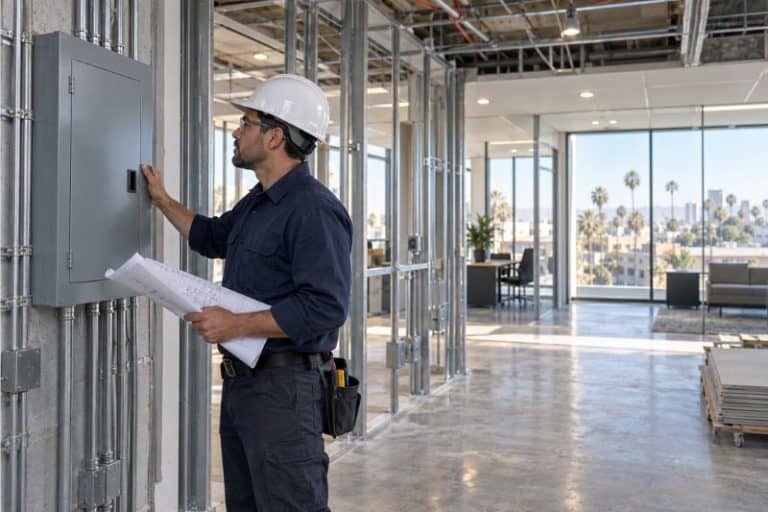
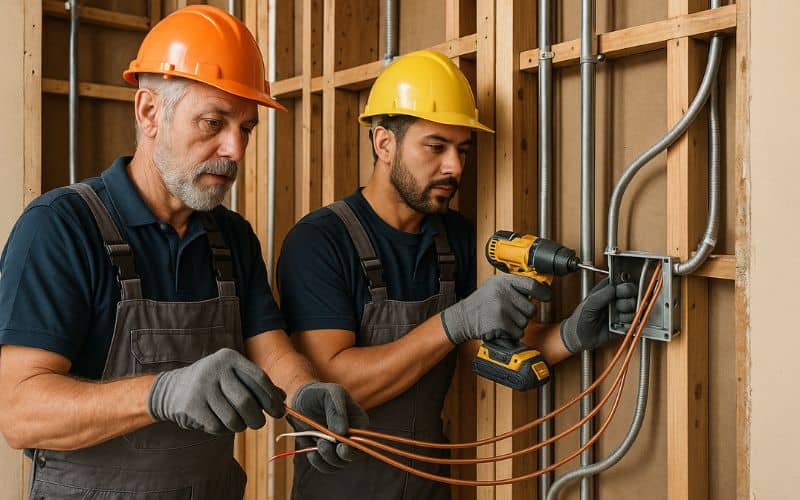
A full rewiring project replaces the building’s branch circuit wiring from the panel to the devices. The process is more involved than most other electrical work because it requires accessing wall and ceiling cavities throughout the building, but it does not require demolishing all finished surfaces if the work is planned carefully.
Assessment and load calculation
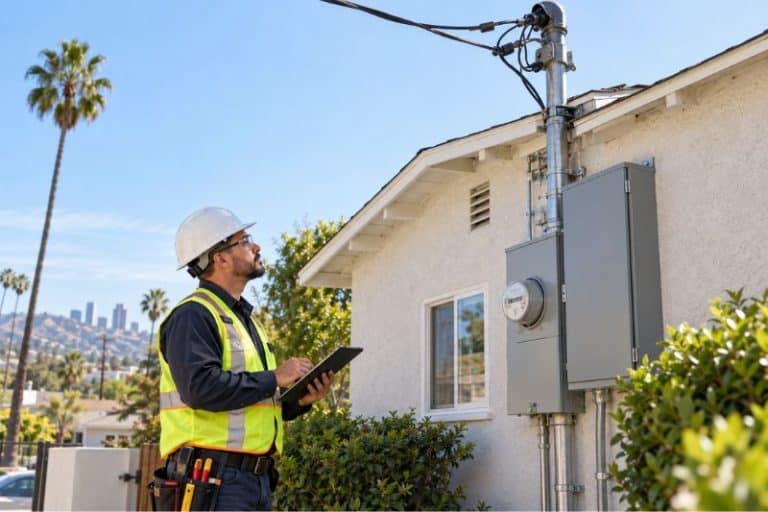
The process starts with a thorough assessment of the existing system. We identify all wiring types present, map the circuit distribution, evaluate the panel capacity relative to the building’s current and anticipated load, and note any existing code violations that will need to be addressed before the new wiring can pass inspection. The assessment also identifies access conditions, where attic access exists, where fishing wire through finished walls is practical versus where surface conduit or selective demolition may be required.
Load calculations are completed to confirm that the existing panel service size is adequate for the rewired system, or to identify where a service upgrade or subpanel addition needs to be part of the project scope. Adding new wiring to a panel that is already at capacity produces a compliant installation that performs no better than what it replaced.
Permitting and LADBS coordination
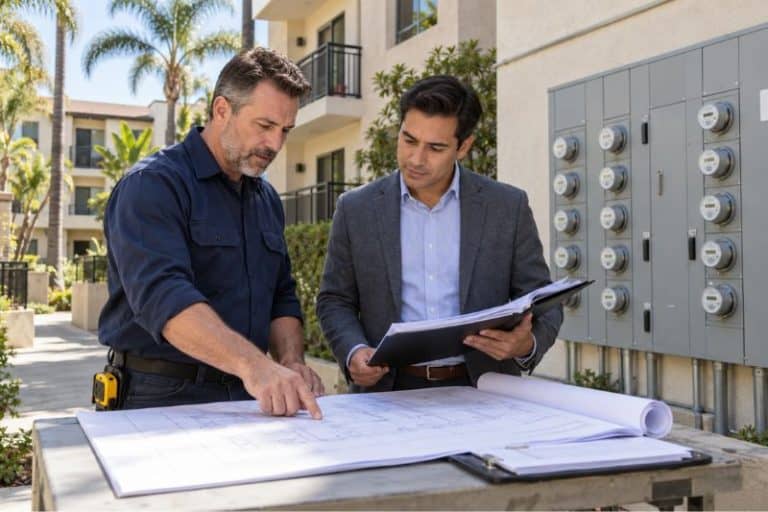
Rewiring projects in Los Angeles require a permit from LADBS. The permit application includes a description of the scope, load calculations, and a plan drawing for larger projects. We handle all permit submissions and inspector coordination. The inspection happens after rough-in, before walls are closed, so the inspector can verify that the new wiring is correctly installed, supported, and protected before it becomes inaccessible. Final inspection occurs after devices and covers are installed and the panel directory is complete and accurate.
Phased execution in occupied buildings
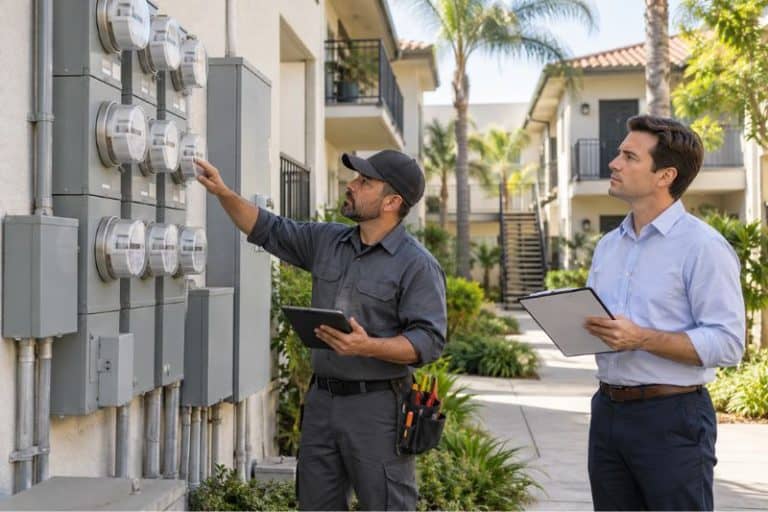
For occupied apartment buildings and commercial properties, we phase the work to minimize disruption. Typically this means completing one section, floor, or unit group at a time, restoring power to that area before moving to the next. Power interruptions to individual units are scheduled in advance with tenants, kept to the minimum duration required for the work, and coordinated around tenant schedules where practical. We do not shut down building-wide power for extended periods during occupied rewiring projects.
What goes in when the old wiring comes out
New branch circuit wiring uses copper conductors with thermoplastic insulation, THHN or THWN rated, run in conduit or as NM cable depending on the installation location and code requirements for the building type. All new circuits include a ground conductor. GFCI protection is installed at all required locations, including bathrooms, kitchens, laundry areas, garages, and outdoor circuits. AFCI protection is installed on bedroom circuits and other locations required by current code. All connections are made with listed connectors and torqued to manufacturer specifications. The panel directory is updated to accurately reflect every circuit.
At the end of the project, we test every circuit for voltage, continuity, and proper ground fault response, and the system is inspected by LADBS before we close out the permit. The documentation you receive at closeout includes the permit, inspection certificate, and a circuit schedule that accurately describes what every breaker in the panel serves.
Aluminum Wiring Remediation Options
Full rewiring is the most comprehensive solution for aluminum branch circuits, but it is not the only option available and may not be the right choice for every property. Two device-level remediation approaches are recognized by the CPSC and the NEC as alternatives to full rewiring for aluminum circuits.
COPALUM crimp connectors are a pigtailing method that joins an aluminum conductor to a short copper conductor using a specialized high-pressure crimping tool. The crimp forms a gas-tight connection between the two metals that does not loosen over time and does not create the oxidation and thermal movement problems that affect standard twist-on connectors on aluminum wire. The resulting copper pigtail terminates at the device using standard copper-rated hardware. COPALUM pigtailing is installed at every outlet, switch, and junction box on the affected circuits and requires a tool that most electrical contractors do not own, so it must be performed by a contractor with that specific equipment.
AlumiConn connectors are a lever-lock device that connects aluminum to copper at the device termination point without requiring a specialized crimping tool. They are CPSC-recognized for aluminum wiring remediation and are a practical option when COPALUM equipment is not available or when the project scope makes pigtailing cost-prohibitive. AlumiConn connectors are installed at every termination point on each aluminum circuit being remediated.
For property managers weighing options, full rewiring is the definitive long-term solution and the one that produces a system with no remaining aluminum in the branch circuits. Pigtailing is appropriate where full rewiring is not practical due to cost, building construction, or occupancy constraints, and it significantly reduces the risk profile of the aluminum circuits when performed correctly and completely. Partial remediation, where only some termination points are addressed, does not provide meaningful risk reduction and is not an approach we recommend.
Insurance and Property Sale Implications
Insurance carriers in California have increased scrutiny of older wiring systems substantially over the past several years. Properties with active knob-and-tube wiring, unremmediated aluminum branch circuits, or documented cloth wiring in poor condition are frequently flagged during underwriting reviews. The outcome ranges from increased premiums to coverage denial to a required remediation deadline as a condition of renewal. Post-fire-season insurance market pressure in Los Angeles has accelerated this trend, and property managers who have not received an underwriting inquiry about their electrical systems yet should treat that as a matter of timing rather than absence of risk.
At the point of sale, buyers’ inspectors routinely identify aluminum wiring, knob-and-tube, and cloth insulation in older LA properties, and those findings appear in inspection reports that buyers use to negotiate credits or require corrections before close. Having a completed rewiring project with permit documentation and inspection sign-off available at the time of sale removes that negotiating lever from the transaction and supports the property’s value rather than creating a deduction.
For properties managed on behalf of owners, the documentation from a completed rewiring project is also useful in demonstrating to the owner that the property’s electrical infrastructure has been addressed and that the associated liability and insurance risk has been reduced. That documentation is worth having in the property file regardless of whether a sale or policy renewal is imminent.
Planning a Rewiring Project for Your Los Angeles Property
The properties that handle rewiring projects most successfully are the ones where the planning started before the pressure did. A property manager who schedules a wiring assessment before receiving an insurance inquiry has time to evaluate options, get competitive estimates, plan around tenant schedules, and phase the work over a timeline that fits the operating budget. A property manager who receives a 60-day insurer deadline and initiates the project on day 30 is making every decision under pressure, with fewer options and less time to execute them well.
The first step is knowing what you have. If the building’s wiring type is not documented, or if the last electrical inspection was more than five years ago, a professional assessment is the right starting point. That assessment confirms which wiring types are present, identifies the highest-risk conditions, evaluates panel adequacy, and produces a written report that can be shared with an insurance carrier or used as the basis for a rewiring scope and estimate.
Our wiring services cover assessment, remediation, and full rewiring for residential and commercial properties throughout Los Angeles. For multi-unit buildings where the project scope spans multiple panels, multiple floors, or multiple buildings on a portfolio, our commercial electrical services team handles the planning, permitting, phasing, and tenant coordination so the project proceeds without extended disruption to operations.
For immediate assistance or to schedule a professional evaluation, call RG Electric directly at (323) 521-5131.
Electrical work is hazardous. Consult a licensed electrician like RG Electric for inspections, permits, and code-compliant wiring installations throughout Los Angeles.