
 Call (323) 5215131

What Electrical Work Is Required to Repair or Rebuild a Fire-Damaged Home in Los Angeles?
Updated October 2026
After a fire, the electrical system is one of the first things people worry about and one of the last things they can see. The wiring may look fine and still be compromised, the panel may be untouched and still be unsafe, and the rules about what must be done depend on how much of the house was damaged and which city or county office oversees your address. RG Electric is a licensed C10 #910807 electrical contractor serving homeowners across Los Angeles County, and this guide explains what electrical work fire damage usually requires, how repair differs from a full rebuild, who issues the permits, and what to expect along the way. It is written for people who are making decisions under pressure, so we have kept it plain.
Why the Permit Office Depends on Where Your Home Is
The first surprise for most homeowners is that there is no single Los Angeles process. The permit office, the inspector, and the electric utility change with the address.
The City of Los Angeles
Inside the City of Los Angeles, building and electrical permits come from the Los Angeles Department of Building and Safety, and the electric utility is the Los Angeles Department of Water and Power. After the Palisades fire, LADWP published its own process for restoring service to rebuilding properties, including a way to request temporary power for construction. That is a useful example of the pattern: the building department approves the work, and the utility separately approves and connects the service.
Unincorporated Los Angeles County
Communities outside any city, such as Altadena after the Eaton fire, are in unincorporated Los Angeles County. Permits there come from the County’s Public Works Building and Safety office, which set up One-Stop Permit Centers for fire survivors, and the electric utility is Southern California Edison. A homeowner in that situation deals with different offices, different forms, and a different utility than a homeowner in the City of Los Angeles, even though the two addresses can be a few miles apart.
Cities with their own departments and utilities
Many cities have their own building departments. Santa Monica, Beverly Hills, Culver City, Inglewood, and Torrance each run one. Several of the cities we serve, including Pasadena, Glendale, and Burbank, also run their own municipal electric utilities, so service requests go to the city utility and not to LADWP or Edison.
What this means for you
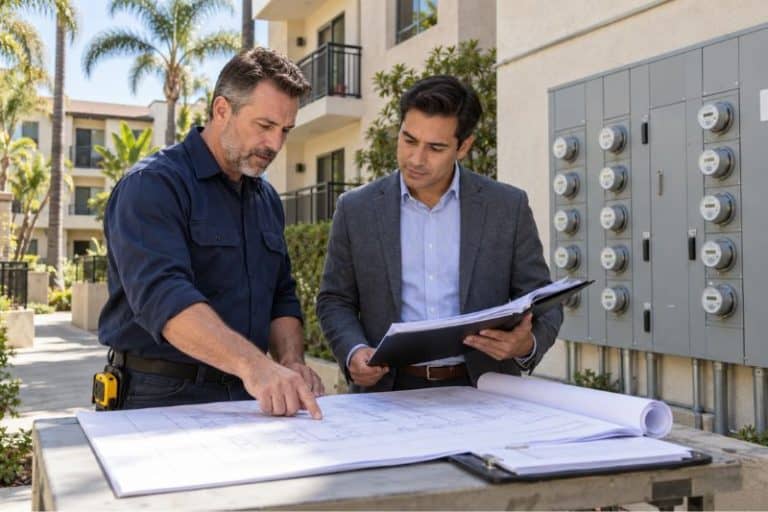
Before anything else, find out which building department and which utility cover your address, because every later step runs through them. We pull permits in the correct jurisdiction for the properties we work on, and we can tell you quickly which offices apply to yours.
What Electrical Work Fire Damage Usually Requires
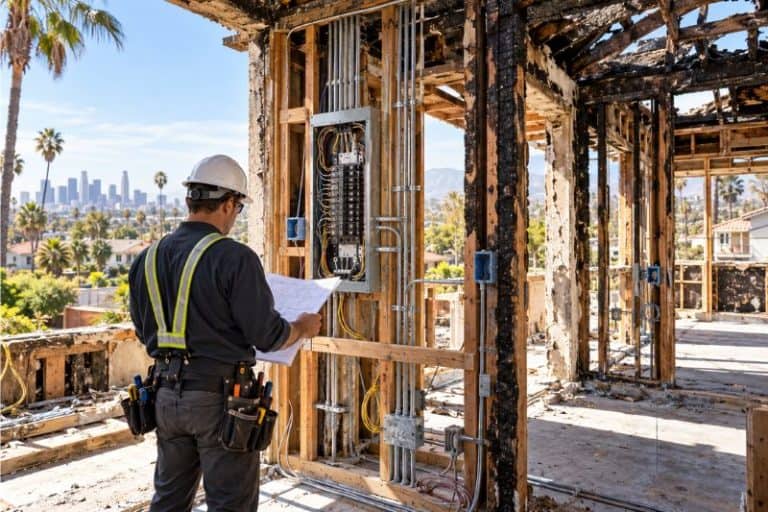
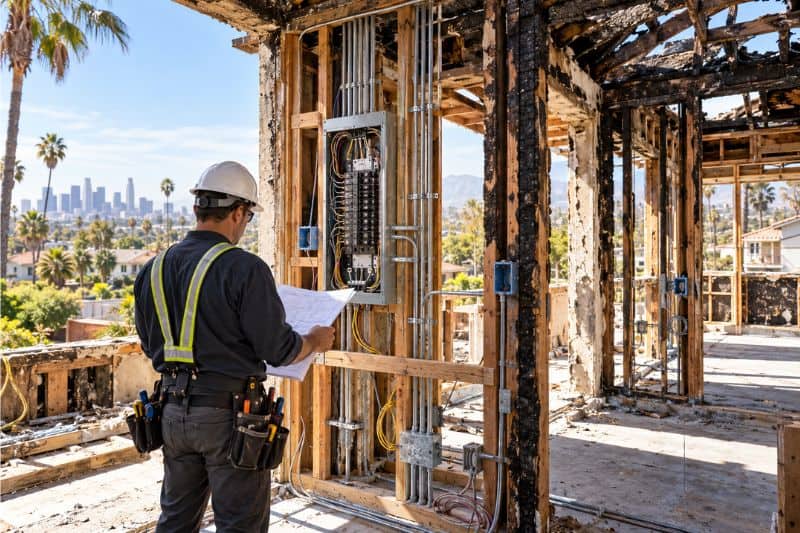
Fire affects electrical systems in ways that are not always visible. Heat softens and cracks wire insulation, smoke and soot leave residue that causes corrosion at connections, and the water used to fight a fire can reach panels, outlets, and junction boxes that never burned.
An evaluation before power is restored
The first step is an inspection by a licensed electrician before anyone re-energizes the building. Wiring, devices, and equipment that have been exposed to heat, smoke, or water may need to be replaced even when they look intact, and that call is made by testing and inspection, not by appearance. The building department or the utility may also require an approved inspection before power is turned back on, so confirm with them early.
Wiring and devices
Where insulation has been damaged, the affected circuits are usually replaced and not repaired in place. Outlets, switches, and fixtures in the damaged area are commonly replaced as well. Because the work involves new wiring, it brings today’s code requirements with it for those circuits. The 2025 California Electrical Code, based on the 2023 National Electrical Code, took effect statewide on January 1, 2026, and our wiring services cover tracing, replacing, and testing circuits after damage.
The panel and the service
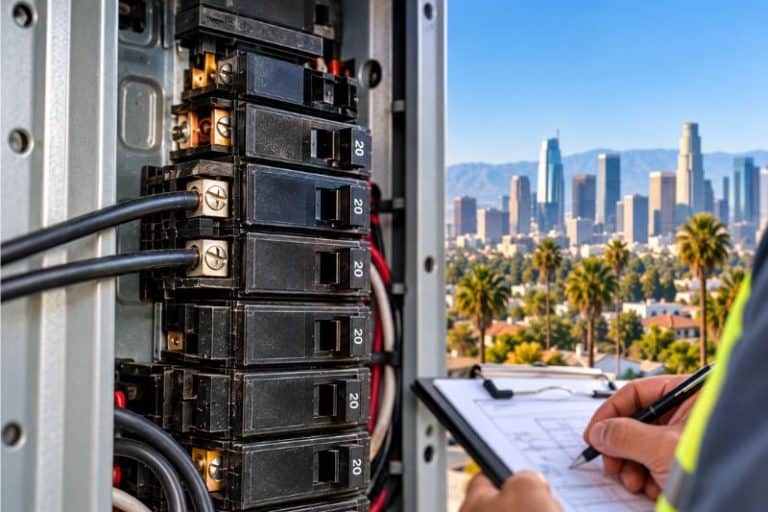
The panel and the service entrance are evaluated separately. A panel that was exposed to heat or water is often replaced, and a rebuild is the natural moment to size the service for the new home’s loads instead of the old one’s. Where the utility’s equipment ends and yours begins varies by utility and by property, so ask the utility to show you the connection point before work is priced.
Put simply, the question after a fire is not whether the electrical system looks damaged, but whether it has been tested and shown to be safe.
Repair Versus Rebuild: How the Scope Changes
How much of the house survived decides almost everything about the electrical scope.
Partial fire, smoke, or water damage
When part of the house is damaged, the electrical work is scoped to that area and whatever connects to it. A bedroom fire may mean new circuits for that room and an evaluation of the rest of the system, with the panel assessed on its own merits. The permit covers the work being done, and the inspector reviews it.
A total loss and a rebuild
When a home is destroyed, a rebuild is largely new construction on the lot. The electrical system is designed and installed from scratch, with new service equipment, a new panel, and new wiring throughout, and it is inspected at the stages a new house requires. County guidance on fire rebuilds notes that even a like-for-like replacement, one that matches the size and location of the old home, must meet the current Building Code, Fire Code, and Health and Safety Code. In practice, that means a rebuilt home is wired to today’s standards, not the standards of the house that burned.
The middle case
Many homes sit between those two. A house that is repairable but heavily smoke-damaged may need most of its wiring replaced even though the structure stands. In that case, we walk through the house with the owner and the insurance adjuster’s findings and give a written estimate that separates what is necessary from what is optional.
The scope grows with the damage, and a clear written estimate is how you keep track of it.
Temporary Power During Construction
Rebuilding takes months, and the crews need electricity before the new service exists. That is the role of temporary power.
What it is
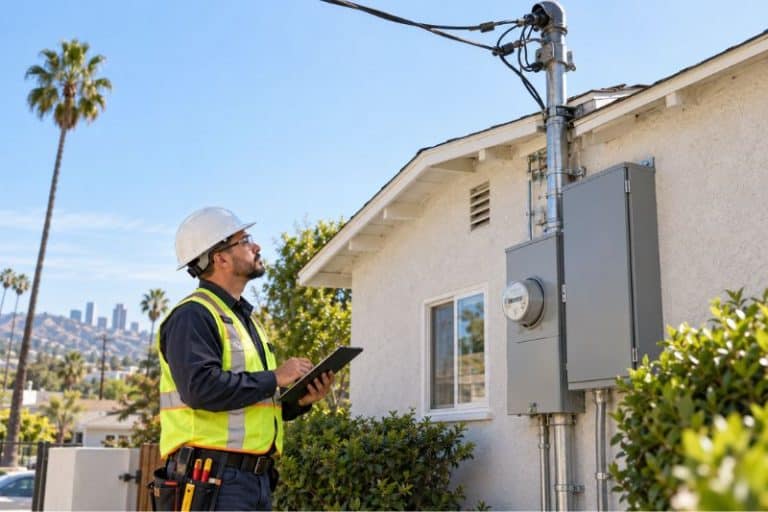
A temporary power pole provides construction power at the site: a service panel and outlets on a pole, connected to the utility. It runs saws, drills, lighting, and the other tools a job needs, and it comes down once permanent service is in. Our temporary power pole installation page explains how that service works.
Who approves it
Temporary power involves both the building department and the utility. LADWP, for example, publishes instructions for requesting temporary power service on rebuilding properties in its territory, and Edison and the municipal utilities have their own applications. Because the utility has its own timeline, we recommend starting that request as soon as the plans are approved so the site is not waiting on it.
Why it is worth planning early
Temporary power is easy to overlook because it is not part of the finished house. But a project that cannot get construction power does not start. Settling it early keeps the schedule from stalling on a step that has nothing to do with the design.
Permits and Inspections: LADBS, the County, and Local Cities
Whatever office applies, the sequence is the same in outline: a permit before the work, inspections during and after it, and a final approval that closes the permit.
What gets inspected
For electrical work after a fire, inspectors typically review the service and grounding, the panel and its labeling, the wiring methods, and the protection devices that current code calls for. Depending on the project, there may be a rough inspection before walls are closed and a final inspection after fixtures and devices are installed.
Why the paperwork matters
The permit record and the final sign-off matter well beyond the inspection. Insurers, lenders, and later buyers will want proof that the electrical work was done properly, and the permit is that proof. Keep the permit number and the final approval with your insurance claim file and your house records.
Fees and timelines
We do not quote permit fees or review times in an article, because they vary by agency and change often. Confirm them with your building department, and ask the utility for its connection timeline separately. We will tell you what we know when we see your project.
The pattern is straightforward: the permit starts the work, the inspection checks it, and the sign-off is what you keep.
Planning Capacity for the New or Repaired Home
A repair or rebuild is the cheapest time you will ever have to size the electrical system correctly, because walls are open and the service is being decided anyway.
Build for the loads you expect
Households are adding electric vehicle chargers, heat pump HVAC, induction cooking, and electric water heaters. A panel sized for the old house can force an expensive service upgrade a few years later. A load calculation at the start of the project takes these into account, and we use Siemens panels when we install one.
Think about future circuits
Running an extra conduit, leaving panel space, and labeling circuits during the rebuild costs little now. Adding them later costs a great deal more.
Document everything
Photograph the work before walls close. Ask for a written scope and keep the final sign-off. If your insurer asks later what was done, you will have a clear answer.
Working With Your Insurance Claim
The electrical scope and the insurance claim are tied together, and a few habits keep them from tangling.
Document before and during
Photograph the panel, the damaged wiring, and the affected rooms before anything is removed. Keep the electrician’s written findings with your claim file. An adjuster can work with documentation far more easily than with a description.
Keep the scope in writing
Ask for an estimate that lists each item of electrical work separately: circuits, panel, service, temporary power. When the adjuster’s scope and the electrician’s differ, line items make the gap easy to discuss. We do not interpret anyone’s policy, so ask your insurer what is covered and in what form they need the paperwork.
Save the permit and sign-off
The permit number and the final inspection approval are the records that show the work was done to code. They matter for the claim and again if you sell the house.
Choosing the Right Contractor After a Fire
Disasters bring out the best and the worst in the contracting trade. A few checks protect you.
Verify the license
Look up the contractor on the California Contractors State License Board website. For electrical work, you want an active C-10 license, a name that matches the estimate, and current bond and workers’ compensation status. Our number is C10 #910807, and we would rather you check it than take our word for it.
Be wary of pressure
A contractor who demands a large payment up front, offers to skip the permit, or arrives unsolicited and urges you to sign today deserves caution. A real electrician will explain what is wrong, put the scope in writing, and let you compare bids.
Ask who pulls the permit
The licensed contractor should pull the electrical permit in the contractor’s own name and be present for the inspection. If you are asked to pull it yourself to save a fee, that shifts responsibility for the work to you.
What to Expect From RG Electric
When you call (323) 521-5131, you reach someone on our team. For a fire-damaged home, the first step is an evaluation visit, which is a service call and carries a fee up front, because a technician has to inspect what is there before there is anything to price. The technician reports what was found to our supervising electrician, who writes the estimate, and someone on our team then calls to walk through each line and why it is there.
Replacement wiring, panels, and temporary power are new work, and new work gets a free estimate. We do not bill by the hour. You see the scope and the price in writing before we start, there are no hidden fees, and we stand behind our work for 12 months. Our service areas span Los Angeles County, and you can see the full list on our service areas page. If your home is outside it, we will say so plainly.
Questions Homeowners Ask About Electrical Work After a Fire
Can I turn the power back on myself?
Please do not. Re-energizing a system that has been through a fire can cause a second fire or an electric shock, and the utility or building department may require an inspection first. A licensed electrician should test the system before it is energized.
Do I need a permit to repair fire-damaged wiring?
In most cases, yes. Replacing wiring, a panel, or the service is permitted work, and the permit and inspection give you a record for your insurer and for any future sale. The office that issues it depends on your address.
Will the new electrical system have to meet current code?
For new and replaced work, yes. Even a like-for-like rebuild must meet the current Building Code, Fire Code, and Health and Safety Code, according to Los Angeles County guidance. Parts of the system that were not touched are treated differently, and your electrician and inspector can tell you where the line falls for your project.
How do I know if the panel survived?
You cannot tell by looking. Heat, smoke, and water can damage breakers and bus bars without leaving visible marks, so the panel is tested and inspected before a decision is made to keep it.
Is temporary power part of the rebuild budget?
Yes, it is a cost of the project, though it is not part of the finished house. Ask your contractor to include it in the written scope so it does not appear later as a surprise.
For immediate assistance or to schedule a professional evaluation, call RG Electric directly at (323) 521-5131.
Electrical work is hazardous. Always consult a licensed electrician like RG Electric before working on electrical systems.