
 Call (323) 5215131
Underground Electrical Repairs in Los Angeles: What Property Managers Need to Know
Updated May 2026
Most property managers in Los Angeles spend a lot of time thinking about what is visible — roofing, plumbing, HVAC, common area finishes. The electrical systems buried beneath parking lots, courtyards, and building foundations rarely come up until they fail. When they do, the failure is rarely subtle. A section of the building loses power. Breakers trip repeatedly with no indoor cause. Lights flicker across multiple units at once. The problem is underground, invisible, and the repair is more complicated than anything above grade. RG Electric, licensed C-10 #910807, specializes in diagnosing and repairing underground electrical systems for multi-unit properties and commercial buildings throughout Los Angeles. This guide covers why these systems fail, how the repair process works, what permits are required, and what property managers can do to reduce the likelihood of an emergency.
Why Los Angeles Properties Rely on Underground Electrical Systems
Underground power distribution became standard in Los Angeles commercial and multi-unit residential development for practical reasons. Burying electrical lines removes them from exposure to wind, falling branches, and the kind of weather events that regularly knock out overhead systems in other parts of the country. It also eliminates the visual clutter of overhead wiring in dense urban neighborhoods, which matters in a city where streetscape appearance affects property values and tenant desirability.
The tradeoff is that underground systems operate in a demanding environment. Soil moisture, temperature fluctuations, tree root systems, and the weight of vehicle traffic above buried conduit all create stresses that overhead wiring never encounters. In older properties throughout Koreatown, Hollywood, the San Fernando Valley, and the Westside, underground feeder lines installed in the 1960s and 1970s are now operating well past the service life their original materials were designed for. Those aging systems are the source of most of the underground electrical failures RG Electric is called to address.
The Most Common Causes of Underground Electrical Failure
Underground electrical failures in Los Angeles follow recognizable patterns. Understanding what causes them helps property managers identify risk factors on their own properties before a failure occurs.
Aging insulation and conductor degradation
The insulation surrounding underground conductors breaks down over time. In cables installed before modern materials were standard, the degradation process accelerates when the cable is exposed to soil moisture, which is nearly constant in irrigated properties. As insulation becomes brittle and cracks, the conductor becomes vulnerable to shorts, ground faults, and arcing. The consequence is not always immediate power loss — often the system degrades gradually, producing voltage irregularities and recurring breaker trips before the final failure occurs. By the time the outage happens, the underlying insulation problem may have been developing for years.
Water infiltration into conduit and junction boxes
Conduit systems are designed to be weatherproof, but seals and fittings degrade over time. In properties where irrigation systems run regularly, where drainage grades toward the building foundation, or where heavy rain events periodically saturate the soil, moisture finds its way into conduit runs and junction boxes. Once water is inside the system, it accelerates corrosion at termination points, degrades insulation, and can cause immediate ground faults or intermittent shorts that are difficult to diagnose without opening the system. Coastal properties in areas like Venice, Marina del Rey, and Santa Monica face this problem more acutely due to persistent soil moisture and salt air exposure.
Tree root intrusion
Los Angeles has a significant urban tree canopy, and the root systems of mature trees are one of the more common causes of mechanical damage to underground electrical conduit. Roots follow moisture gradients and will grow into and around conduit runs, eventually cracking or crushing the conduit wall. Once the conduit is breached, soil and moisture enter the cable run directly. Properties in neighborhoods with established street trees — West Adams, Los Feliz, Hancock Park, and much of the San Fernando Valley — should treat tree root intrusion as a realistic risk factor during any underground electrical evaluation.
Construction impact and soil disturbance
Underground electrical systems are vulnerable to damage from any construction activity that involves excavation near buried conduit. This includes work performed by other contractors — landscaping, irrigation installation, foundation repair, gas line work — as well as major street construction projects adjacent to the property. The damage is sometimes immediately apparent, and sometimes not discovered until the affected cable develops a fault weeks or months after the disturbance. Keeping an accurate map of underground conduit routes and sharing it with any contractor working on the property is one of the most effective ways to prevent this category of damage.
Overloaded circuits from increased demand
Underground feeder lines installed decades ago were sized for the electrical loads of that era. A building that has added EV charging stations, upgraded HVAC systems, added commercial kitchen tenants, or increased its overall occupied load over time may be running more current through underground cables than those cables were designed to carry. Overloading produces heat, and sustained heat degrades insulation and accelerates conductor wear. If a property has added significant electrical load without a corresponding evaluation of the underground distribution system, the feeder cables are a risk point worth examining.
Warning Signs Property Managers Should Not Ignore
Underground electrical problems rarely announce themselves cleanly. The symptoms are often ambiguous and easy to attribute to other causes — until the pattern becomes clear. Property managers who recognize these signs early and respond with a professional evaluation avoid the emergency repair scenario, which is more disruptive, more expensive, and harder to schedule on favorable terms.
Flickering or dimming lights affecting multiple units simultaneously, rather than a single fixture, suggests a voltage drop in a shared feeder rather than a localized fixture problem. Breakers at the main service panel or subpanel that trip repeatedly without an identifiable indoor cause — no new equipment, no obvious overload — are a common early indicator of an underground ground fault. Burning smells in electrical rooms, meter enclosures, or utility corridors should be treated as an emergency and evaluated immediately. Warm pavement or soil above a buried conduit run, particularly in an area without another heat source, is a sign of significant cable overheating. Water visible inside electrical enclosures or meter banks is both a safety hazard and a diagnostic indicator of conduit infiltration.
Any one of these symptoms warrants a call to a licensed electrician. The cause-and-effect relationship is straightforward: symptoms that are ignored persist and worsen, and an underground system that is deteriorating does not stabilize on its own. The consequence of delay is an unplanned outage affecting tenants, a potential code violation, and a repair performed under emergency conditions rather than as a scheduled project.
How Underground Electrical Faults Are Diagnosed
Locating a fault in an underground electrical system requires specialized diagnostic equipment. Guesswork and unnecessary excavation are expensive, disruptive, and rarely effective. The diagnostic process RG Electric uses is designed to identify the fault location with precision before any ground is opened.
Panel and load testing first
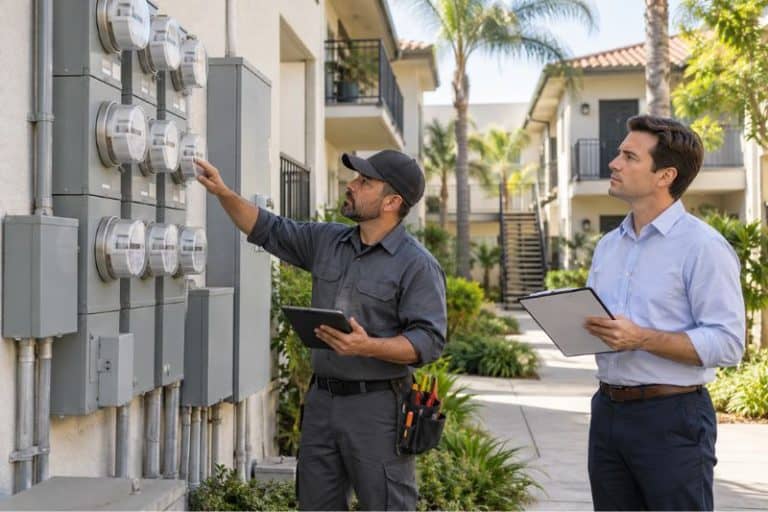
The process starts at the surface. We inspect the main service panel, meter banks, and any subpanels connected to the affected circuit to confirm that the issue is not a breaker failure, load imbalance, or upstream utility problem. Load testing establishes whether the power loss is isolated to a single circuit or affecting multiple downstream systems. Once surface-level causes are ruled out, subsurface diagnostics begin.
Cable tracing and fault localization
Electromagnetic cable tracing equipment sends a signal through the buried conductor, allowing the technician to map the cable’s route and identify where the signal degrades or disappears — which indicates the fault location. This step produces a precise map of where the cable runs and where the problem is before a shovel touches the ground. For complex properties with multiple conduit runs, this mapping also updates the property’s documentation of its underground layout, which is useful for all future maintenance.
Time-domain reflectometry and advanced testing
Time-domain reflectometry sends controlled pulses down the cable and measures the reflections to identify breaks, shorts, and insulation damage within a very small margin of error. This technology is particularly useful when the fault is not a complete break but a degraded section that produces intermittent symptoms. Thermal imaging identifies heat concentrations along conduit runs that indicate overloading or arcing. Together, these tools give the technician a clear picture of the fault type and location before excavation begins, which is what makes precise, minimal-disruption repairs possible.
Utility coordination before excavation
Before any ground is opened, RG Electric contacts DigAlert (811) to have all underground utilities marked. This is a legal requirement in California and a practical necessity on Los Angeles properties where gas, water, communications, and electrical conduit often share narrow corridors beneath parking areas and courtyards. Utility marking prevents damage to adjacent infrastructure and ensures the excavation scope is accurately defined before work begins.
How Underground Electrical Repairs Are Performed
Once the fault is located and utilities are marked, the repair process follows a consistent sequence designed to restore service safely, minimize disruption to tenants and operations, and produce a documented result that satisfies inspection and insurance requirements.
Targeted excavation
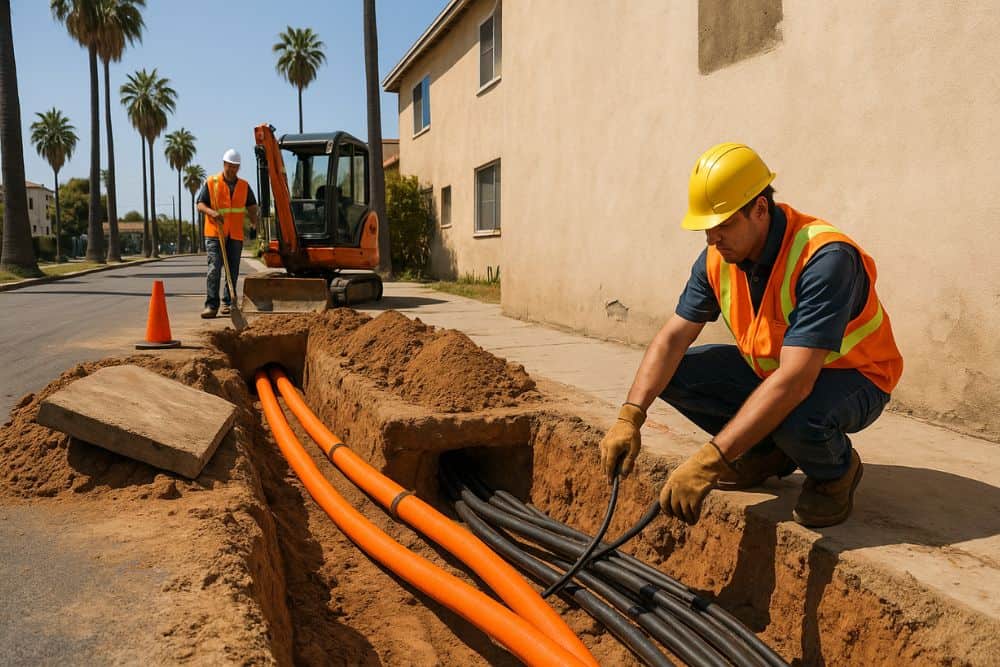
Using the fault location identified during diagnostics, we excavate only the area required to access the damaged cable. For most commercial and multi-unit properties, this means a narrow trench or a small cut through asphalt or concrete. Safety barriers and signage are installed to protect tenants, staff, and pedestrians during the repair. The goal is the smallest footprint necessary to complete the work correctly — not a standard trench length regardless of where the fault actually is.
Cable repair or replacement
Once the damaged section is exposed, we determine whether the cable can be spliced or must be replaced. Minor insulation damage at a discrete location can sometimes be addressed with a listed, waterproof splice and heat-shrink sealing. More extensive damage — burned conductors, crushed conduit, corroded terminations across a longer run — requires cable replacement. We use commercial-grade conductors rated for underground use, enclosed in conduit appropriate for the burial depth, soil conditions, and load requirements. Undersized or inappropriate materials are not used to reduce cost, because the repair is only as durable as what goes back in the ground.
Waterproofing and re-sealing
All connections and terminations are sealed against moisture intrusion using rated compounds and heat-shrink materials. Junction boxes and conduit fittings are reassembled with weatherproof hardware and inspected for proper seating before the trench is closed. In properties where moisture infiltration was the contributing cause of the failure, we address the drainage or conduit sealing issue as part of the repair rather than simply replacing the cable and leaving the same conditions in place.
Testing before backfill
Before the trench is closed, we test the repaired cable for load capacity, voltage stability, and insulation resistance. Thermal imaging or megohmmeter testing confirms that the fault is fully resolved and the circuit is safe to re-energize. This step is non-negotiable — a repair that has not been tested under load before backfill is a repair that may fail again in weeks or months.
Documentation and site restoration
After the repair passes testing, the trench is backfilled and the surface is restored. We provide a documentation packet that includes photos of the exposed fault, the completed repair, test results, and an updated conduit route map for the property’s records. This documentation is useful for insurance purposes, for future maintenance planning, and for demonstrating code-compliant work to LADBS if the repair required a permit.
Permits and LADBS Requirements for Underground Repairs
Underground electrical repairs that involve cable replacement, conduit reconstruction, or service rerouting typically require a permit from the Los Angeles Department of Building and Safety. The permit requirement exists because these repairs affect the structural integrity of the property’s electrical distribution system and need to be inspected by a city inspector before the trench is permanently closed.
Unpermitted underground electrical work creates problems at multiple points. Insurance carriers may deny claims related to electrical failures if the system was modified without permits. Property sales can be complicated when permit records show unreported work. And inspectors who discover unpermitted work during a subsequent permitted project can require the property owner to open and correct the previous work before approving the new scope.
RG Electric handles permit applications, inspector coordination, and documentation for all underground repair projects that require them. We schedule the inspection at the appropriate stage of the repair — before backfill, so the inspector can view the work in place — and provide the documentation the property owner needs at closeout. For our electrical repair services, the permit process is part of the job, not an add-on.
Preventing Future Underground Electrical Failures
The cost and disruption of an underground electrical repair makes prevention worth taking seriously. Property managers who maintain their underground systems proactively are not just avoiding emergency repairs — they are protecting their insurance eligibility, their tenant relationships, and their property’s long-term value.
Periodic electrical inspections
Routine inspections by a licensed electrician can identify early warning signs — recurring breaker trips, voltage irregularities, moisture in enclosures — before they develop into failures. For multi-unit properties with aging underground infrastructure, an inspection every two to three years is reasonable. For properties that have had a previous underground failure or that are located in high-moisture environments, annual inspections are worth the investment.
Managing irrigation and drainage near electrical infrastructure
Irrigation systems are one of the most consistent sources of moisture exposure for underground conduit. Sprinkler heads positioned near conduit runs, low drainage grades that direct water toward electrical enclosures, and irrigation schedules that saturate soil around buried cables all increase corrosion risk. Property managers should ensure that landscaping contractors understand where underground electrical conduit is located and that irrigation design does not create chronic moisture exposure for those runs.
Evaluating load before adding capacity
Before adding EV charging stations, upgrading HVAC equipment, or bringing in commercial tenants with high electrical demand, have a licensed electrician evaluate whether the existing underground feeder cables can support the additional load. Adding capacity at the panel without confirming that the underground distribution system can carry the increased current is a common pattern that produces failures in the feeder cables rather than at the panel itself. Our commercial electrical services include load evaluation as part of any capacity upgrade discussion.
Maintaining accurate system documentation
Many older Los Angeles properties have incomplete or nonexistent records of their underground conduit routes. When a failure occurs on a property without documentation, the diagnostic process takes longer and costs more because the technician has to trace the system from scratch. Properties that maintain current conduit maps, panel directories, and service records can be diagnosed and repaired more quickly, with less disruption. If your property lacks this documentation, the next electrical service visit is a good opportunity to start building it.
Why the Underground System Is the Last Thing to Budget For, and the First to Fail
Underground electrical infrastructure is invisible, which makes it easy to deprioritize in a property maintenance budget. It does not generate tenant complaints until it fails. It does not show up in a visual inspection. And because failures are infrequent on any individual property, it can be years between incidents — long enough for institutional memory of the last repair to fade.
The consequence of that deprioritization is predictable. When the failure eventually comes, it comes without warning, at the worst possible time, affecting tenants who have no patience for extended outages. The repair is performed under pressure, on an emergency timeline, with fewer options for scheduling and cost management than a planned project would allow. For properties with aging underground systems in Los Angeles, the question is not whether a failure will eventually occur, but whether it will be managed proactively or reactively.
RG Electric works with property managers throughout Los Angeles to inspect, maintain, and repair underground electrical systems before they become emergencies. We understand the permitting process, the diagnostic tools required, and the specific environmental conditions that affect buried electrical infrastructure in this city. If your property has aging underground systems, recurring electrical symptoms, or no recent inspection history on its underground distribution, the right time to evaluate it is before the next outage, not after.
For immediate assistance or to schedule a professional evaluation, call RG Electric directly at (323) 521-5131.
Electrical work is hazardous. Consult a licensed electrician like RG Electric before performing any work on underground electrical systems.