
 Call (323) 5215131


Pool Electrical Installation in Los Angeles: Bonding, GFCI, and LADBS Permit Requirements
Updated September 2026
A homeowner in Encino finally gets around to the backyard project they have been planning all year, new LED lighting for the pool and an upgraded pump for better circulation. A neighbor mentions doing something similar themselves over a weekend, and the idea of saving a contractor’s fee is tempting. RG Electric, license C10 #910807, hears from homeowners across Los Angeles at exactly this stage almost every summer, usually right before they start ordering equipment. Pool electrical work looks like an extension of ordinary home wiring, but the code requirements around water are stricter, more specific, and less forgiving of small mistakes than almost anything else a licensed electrician handles.
Why Pool Electrical Work Is Held to a Different Standard
Standard home wiring assumes a dry environment. Pool electrical work assumes the opposite, water, wet skin, and people standing in direct contact with the ground while touching metal ladders, handrails, and equipment. The National Electrical Code addresses this specifically in Article 680, which governs pools, spas, and other wet locations, and it layers several overlapping safety requirements on top of what a normal, everyday household circuit would ordinarily need to meet. Bonding, GFCI protection, and equipment clearance distances all exist for the same reason, to prevent a small electrical fault from becoming a shock hazard for someone in or near the water.
This is the detail that gets lost when pool lighting or a pump upgrade gets treated as a weekend project. The work itself, running a wire and connecting a fixture, is not complicated on its own. What makes pool electrical work demanding is everything around it, the bonding grid, the GFCI protection, and the inspection that confirms both were done correctly before anyone is allowed to use the equipment.
Grounding and bonding are also easy to confuse, and the difference matters more around a pool than almost anywhere else in a home. Grounding gives a fault current somewhere to go, tripping a breaker or a GFCI when something goes wrong inside a piece of equipment. Bonding is a separate system that ties every metal surface around the pool to the same electrical potential, so there is no voltage difference for a person to feel even if nothing has actually failed yet. Pool equipment needs both, not one in place of the other, and a system that only has grounding without proper bonding still leaves the underlying hazard bonding is designed to prevent.
The Bonding Grid Most Homeowners Never See
Every metal component within roughly five feet of a pool’s water line has to be tied together into a single bonding grid using solid copper conductor, typically 8 AWG or larger. That includes the reinforcing steel inside the pool shell, metal ladders and handrails, light fixture housings, pump and heater equipment, and any metal fittings around the deck. The pool water itself is also bonded, either through a listed bonding device or through conductive components already in contact with the water.
The purpose of this grid is to hold every metal surface around the pool at the same electrical potential. If one metal component is bonded and another nearby one is not, a person touching both at the same time, a metal ladder and a nearby light fixture, for example, can become the path that equalizes the difference. GFCI protection does not catch this kind of hazard on its own, because a voltage gradient between two bonded surfaces is not the same thing as a ground fault. Bonding and GFCI protection solve two different problems, and pool electrical work needs both done correctly, not one or the other.
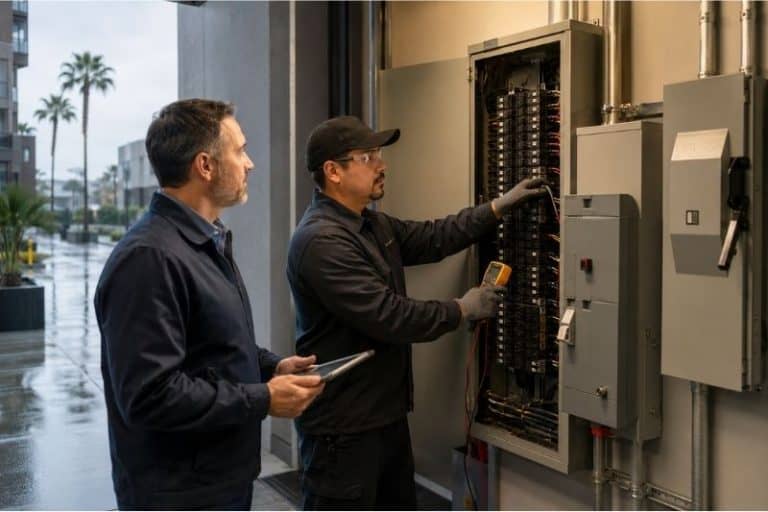
Verifying an existing bonding grid is not something that can be done by eye. A connection can look intact while carrying a corroded or high resistance path underneath, which is why licensed electricians test bonding continuity with dedicated equipment rather than relying on a visual inspection alone. This is also why bonding failures are so easy to miss during a casual DIY project. Everything can look correctly wired and still fail a continuity test, and the person who wired it has no way of knowing without the right tools to check.
GFCI Protection Applies to Nearly Every Pool Circuit
Pool pump motors need GFCI protection regardless of voltage, whether the pump runs on a 120 volt or 240 volt circuit. Underwater lighting, heaters, and other pool equipment carry the same requirement. Receptacles near a pool need GFCI protection as well, and code sets minimum and maximum distances for where a receptacle can be placed relative to the water’s edge, close enough to be useful but far enough to reduce risk.
Most pool pump GFCI trips homeowners experience are caused by moisture finding its way into the motor housing over time, not by a wiring mistake. That distinction matters because a homeowner who sees a GFCI trip repeatedly and simply resets it without diagnosing the cause is often looking at a failing motor seal or a developing insulation problem, not a nuisance trip that will resolve on its own.
Underwater lighting adds one more layer worth knowing about before choosing fixtures. Code favors low voltage lighting systems around pools, typically operating well under standard household voltage through a dedicated transformer, because the lower the voltage present in and around the water, the smaller the hazard if something does eventually fail. A homeowner selecting pool lights based purely on brightness or style without considering the voltage and transformer requirements can end up with a fixture that technically works but complicates the inspection, or that a licensed electrician has to correct before the rest of the project can be signed off.
What LADBS Requires Before Pool Electrical Work Begins
All pool and spa electrical work in Los Angeles requires a permit from the Los Angeles Department of Building and Safety, and the work itself needs to be performed by a licensed C10 electrical contractor. This applies whether the project is a brand new pool, a full equipment replacement, or something as contained as adding new underwater lighting to an existing pool. LADBS inspects the electrical rough-in and the equipment bonding as part of the standard pool inspection sequence, checking the bonding grid and GFCI protection before the work can be signed off.
This requirement applies the same way to smaller pool electrical projects as it does to a full new pool build, which surprises homeowners who assume a permit is only necessary for major construction. Swapping out a pool light fixture for one with different electrical requirements, adding a dedicated circuit for a new heater, or upgrading a pump to a variable speed model that draws power differently than the original all fall under the same permit and inspection requirement, even though none of them involve digging a new pool shell or pouring concrete.
Why the Disconnect Location Matters Too
Code also requires the disconnect for pool equipment to be readily accessible and installed within sight of the equipment it controls, meaning a person servicing the pump or heater should not have to search for or unlock a separate panel to shut power off. This detail is easy to overlook during a DIY project because it has nothing to do with whether the wiring itself works. It only becomes a problem during inspection, or worse, during an emergency when someone needs to cut power quickly and cannot find where.
Why DIY Pool Electrical Work Is a Worse Trade Than It Looks
The appeal of doing pool electrical work without a contractor usually comes down to saving money on labor for what looks like a straightforward job. The trade being made is not obvious until something goes wrong. A missed bonding connection does not announce itself the way a light that fails to turn on does. The hazard sits quietly until someone is standing in the pool and touching a piece of unbonded metal at the wrong moment, which is precisely the failure mode the code exists to prevent.
Permitting adds another layer to this decision. LADBS requires the permit and the contractor license regardless of who performs the work, so unpermitted pool electrical work does not avoid the requirement, it just leaves the property without a documented, inspected record of it. That gap tends to surface later, during a home sale, an insurance inspection, or any future electrical work that requires an inspector to look at the panel or the equipment near the pool.
Older LA Pools Add Another Layer of Risk
Pools built decades ago in neighborhoods across Sherman Oaks, Tarzana, Woodland Hills, and Beverly Hills were bonded and wired to the standards in place at the time, which were less comprehensive than what current code requires. A bonding grid installed in the 1980s may be missing components that a newer pool would have, particularly around equipment that has been replaced or upgraded since the original installation without the bonding being revisited at the same time. A pump swap that only replaces the pump, without checking whether the new equipment is still properly bonded into the existing grid, can quietly leave a gap that was not there before.
Salt water pool systems, increasingly common across Agoura Hills and other Los Angeles County neighborhoods with larger backyard pools, add a corrosion factor that accelerates the breakdown of bonding connections over time. Hardware that would last decades in a standard freshwater pool can corrode significantly faster in a salt water system, which is one more reason bonding on an older or salt water pool is worth having checked rather than assumed to still be intact.
The safest assumption for any pool built before current code standards were adopted is that the bonding grid should be verified rather than trusted based on age or the fact that nothing has gone wrong so far. A bonding failure does not announce itself with a flickering light or a tripped breaker the way most electrical problems do. The pool can operate normally for years with a gap in the bonding grid, right up until the specific set of conditions that make the hazard real actually lines up, which is exactly why periodic verification matters more here than it does for most other parts of a home’s electrical system.
Always consult a licensed electrician like RG Electric before working on electrical systems.
How RG Electric Handles Pool Electrical Projects
RG Electric provides free estimates for new pool electrical work, evaluating the existing bonding grid, the panel capacity, and the equipment being added or replaced before any wiring begins. The company pulls the required permit and schedules the electrical rough-in and bonding inspection with LADBS as a standard part of the project, not as an afterthought. RG Electric describes its approach to this kind of work simply as following code to the teeth, which around a pool means a bonding connection or a GFCI requirement does not get treated as optional because it is out of sight once the deck is finished.
On existing pools, that estimate often starts with a bonding continuity check rather than jumping straight to the equipment upgrade the homeowner called about. A pump replacement that seems straightforward can turn into a larger conversation once a technician confirms whether the pool’s existing bonding grid actually meets current standards, and having that information before equipment is ordered avoids the more expensive scenario of discovering a gap after the new pump is already installed and running.
Every completed pool electrical installation is backed by RG Electric’s twelve month workmanship guarantee. Pricing follows the same custom estimate approach used across every project, since the actual scope depends heavily on the condition of the existing bonding grid, the age of the pool, and whether the panel serving the equipment has enough capacity for what is being added. There is no flat rate for pool electrical work, because a straightforward lighting swap on a well maintained pool and a full bonding correction on a decades old system are not the same job even when the fixtures being installed look identical.
Getting Pool Electrical Work Right the First Time
Pool electrical work rewards getting the details right the first time far more than most other categories of residential electrical work, since the consequence of a missed bonding connection is not a callback, it is a safety hazard that can sit undetected for years. RG Electric handles pool and spa electrical wiring across Los Angeles with the bonding grid, GFCI protection, and LADBS permit built into the process from the first estimate, and coordinates receptacle and GFCI outlet work around the pool through the same licensed team handling the rest of the project.
Homeowners who bring in a licensed electrician before ordering pool equipment rarely run into a surprise during inspection. The ones who treat pool wiring as a weekend project are the ones most likely to find out what the bonding requirement was actually protecting against, usually at the worst possible time, either during an inspection that stalls the project or during an incident the bonding grid was specifically designed to prevent.
For immediate assistance or to schedule a professional evaluation, call RG Electric directly at (323) 521-5131.