
 Call (323) 5215131
How to Choose an Outdoor Extension Cord
Sometimes, you can’t do without an extension cord when you need power outside to work, for example, on a patio project or illuminate a birthday party you are throwing on the deck. You might be tempted to use your indoor extension cord, but the truth is that it is not intended for outdoor use, especially if you are working with power tools. So you need to know how to choose the right outdoor extension cord.
But before RG Electric deals with the topic, you need to know that neither indoor nor outdoor extension cords are intended for permanent use. They are temporary solutions, no more.
Outdoor Extension Cord Features
Outdoor extension cords can be exposed to high or low temperatures, excessive pressure or stretching. In order to withstand any of these factors, extension cords designed for outdoor use are made from materials that can withstand elements. They have a number of features.
- The cord’s jacket is made of rubber. It allows the cable to be flexible and avoid cracking when exposed to both high and low temperatures, in contrast to the PVC sheath, which becomes stiff under cold temperatures and can be easily broken.
- The socket and plug of such an extension cord must be made of rubber and caoutchouc. In this way, it is moisture-resistant, and can also withstand high current, for example, when working with a welding equipment.
- A cable or cord intended for outdoor use should have a mark “W,” which means it can be used at high and low temperatures.
Types of Outdoor Extension Cords
Regardless of the type of outdoor extension cord, it includes a socket, an electrical cord, and one or more sockets. But despite the design, all cables intended for outdoor use have a high amperage rating and can be classified into several types.
- Waterproof. The jacket of these cables is made of high-density rubber. The connection points between the socket and the cord are heavily insulated.
- Cold weather resistant. These are perfect for weather conditions when temperatures drop below freezing. They don’t stiff, crack or split.
- Standard. Regular outdoor extension cords can be used in an open space covered with a roof. They are also ideal for minor works, such as powering a shed or outbuilding.
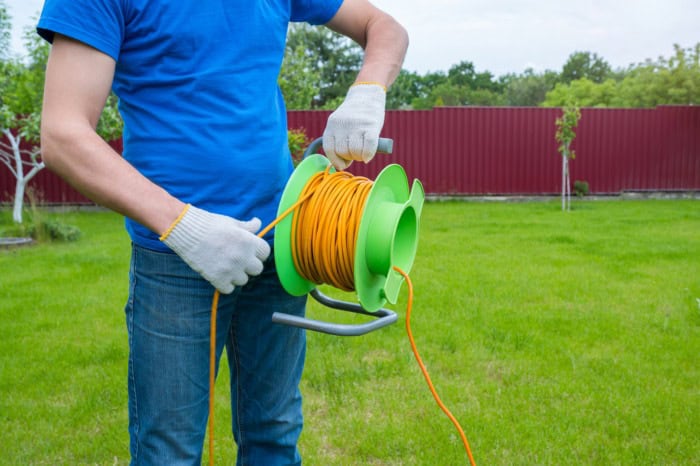
- Pro cable reels. These power extension cords feature a reel design with a durable cable that can be up to 50 feet. They are often used for power tools and equipment. Most models are light in weight and can be easily moved from one place to another.
Cords rated for outdoor use have bright orange rubber and plastic sheath to protect against moisture, weather changes, and sunlight. They always have three-prong plugs, with the third one serving as a grounding wire. It protects users from potential electrocution. Besides, a safe outdoor extension cord should have at least 12-gauge wires inside to handle up to 15 amps.
Tips for Buying an Outdoor Extension Cord
Don’t buy whichever extension cord that happens to be on the shelf of your hardware store. Instead, choose the safer, more durable, and more flexible cables than the ones you typically see at brick-and-mortar retailers.
- The number of sockets. An extension cord can have more than one socket. It’s better if the cable has at least three sockets.
- Thickness. The thicker (12-gauge wire) is the sheath, the better the outdoor cord is protected from high voltage. Thick cords also carry more power.
- Cable length. Preference should be given to the models with a cord length of 2-3 meters longer than the distance from the power source to the location where the power tool is plugged in. The longer the cord, the sicker the wires need to be to handle the same amount of power. A 50-feet cord should come with a 12-gauge wire thickness to avoid electrical overload.
- LED lights. See if the cord has a small LED at the outlet end that lights up when it is live.
- A locking switch. A locking switch is a useful feature as it prevents whatever you plug into the cord from accidentally disconnecting.
- Third-party approved. A good extension cord should be tested by a third party – UL or Intertek.
Bottom Line
NEC (National Electric Code) doesn’t allow using extension cords permanently, including outdoor cables. The right decision is to contact local electricians to install additional outlets. However, if you are in a situation where you need to use an extension cord for a long period and think that the outdoor extension cable is the solution because it’s more safe and durable, still we recommend contacting the LA Metro Area electrician near you to advise you on the extension cord for residential purposes.