
 Call (323) 5215131

How Much Electrical Load Can My Panel Handle in Los Angeles?
Updated July 2026
RG Electric is a licensed C10 electrical contractor in Los Angeles, California License #910807. When a homeowner in Encino or Sherman Oaks calls asking whether their panel can handle a new hot tub, an EV charger, or a garage conversion, the honest answer is usually the same. Nobody knows for certain until someone runs the numbers. That calculation, not a guess, not a gut feeling from a handyman, is what actually determines whether a panel has room left or is already stretched thin.
What a Load Calculation Actually Measures
A homeowner in an older Van Nuys bungalow might have a panel rated for 100 amps that has powered the house without incident for thirty years. The panel working is not the same question as the panel having capacity. A load calculation adds up every circuit the panel serves, from lighting and kitchen appliances to HVAC and any dedicated circuits, and compares that total demand against what the panel is rated to deliver safely.
The calculation is not a simple sum of nameplate ratings. The National Electrical Code allows for demand factors, meaning not every appliance draws its maximum rated load at the same time. A licensed electrician applies those factors correctly. A homeowner adding up numbers from appliance labels usually overestimates or, more dangerously, underestimates what is actually available.
The consequence of skipping this step is straightforward. Add enough load to a panel that is already near its ceiling, and the result is not a single dramatic failure. It is a slow pattern of nuisance tripping, warm breakers, and circuits that behave unpredictably under strain, which is often mistaken for a wiring problem rather than a capacity problem.
Two homes on the same street in Sherman Oaks, both built the same year with the same panel rating, can have completely different available capacity today. One family added central air conditioning a decade ago and never touched the panel again. The neighbor added a pool, a workshop, and a second refrigerator in the garage over the same period. On paper their panels look identical. In practice, one has meaningful room left and the other does not, and there is no way to know which is which without running the numbers.
How RG Electric Approaches a Load Calculation
We start by documenting every existing circuit on the panel, not just the major appliances a homeowner remembers offhand. Lighting circuits, kitchen small appliance circuits, HVAC, laundry, and any dedicated circuits already in place all factor into the existing demand. From there we apply the demand factors the California Electrical Code allows, since treating every circuit as though it draws its full rated load at all times would overstate demand and lead to an unnecessarily conservative, and expensive, recommendation.
Once the existing load is established, we add the proposed new demand, whether that is an EV charger, a spa, an ADU, or a major appliance, and compare the total against what the panel is rated to deliver. The result is a clear answer. Either the panel has room, the load needs to be redistributed, or the panel needs to be upgraded. We explain which of those three applies and why, in plain language, before any work begins.
The Moments That Usually Trigger the Question
Most homeowners never think about panel capacity until they are planning something specific. A few situations come up again and again across Los Angeles homes.
Adding an EV Charger
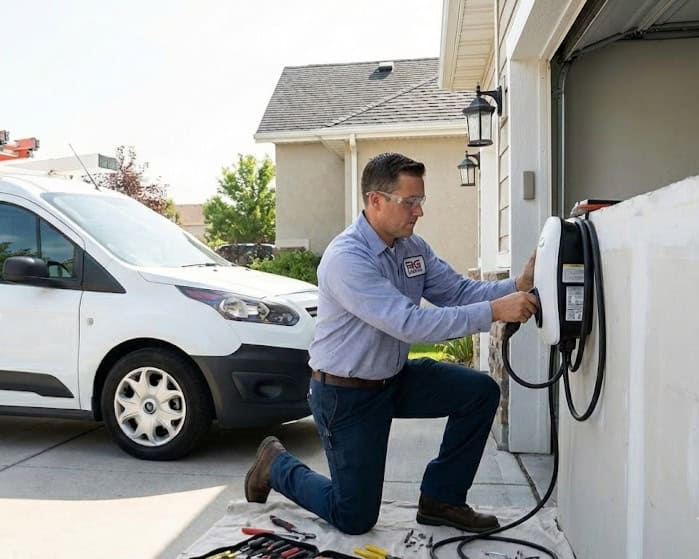
A Level 2 EV charger draws a significant, sustained load for hours at a time, unlike most household appliances that cycle on and off. In a Culver City or Santa Monica home with an older panel, this single addition is often the load that reveals a capacity problem that was already there but never tested.
Installing a Hot Tub or Spa
Hot tubs require a dedicated circuit sized specifically for the unit, and many require more amperage than homeowners expect. Skipping the calculation here does not just risk tripped breakers. It risks a failed inspection if the installer pulls a permit, or a serious hazard if no permit is pulled at all.
Converting a Garage to an ADU
An accessory dwelling unit effectively adds a second household’s worth of electrical demand, kitchen, HVAC, lighting, and outlets, onto a panel originally sized for one home. Los Angeles has seen a steady increase in ADU conversions, and load calculation is one of the first steps the city expects to see documented before permits move forward.
Adding a Major Appliance
A new electric range, a second HVAC condenser, or a workshop full of power tools in the garage can each shift a panel from comfortably within limits to running close to its rated maximum, particularly in homes built before central air conditioning was standard.
Signs a Panel Is Already Near Its Limit
A homeowner does not need an electrician’s training to notice early warning signs. Breakers that trip during ordinary use, not during a storm or a clear overload event, are one signal. Warm or discolored breaker switches are another. Lights that dim noticeably when a major appliance starts up point to a panel working harder than it should to keep up with demand.
None of these signs confirm a capacity problem on their own. They are reasons to have a load calculation performed rather than reasons to assume the worst. The calculation is what turns a suspicion into a documented answer.
There is also a category of home where none of these warning signs appear yet, and that is arguably the more important case to catch. A panel can be sitting close to its rated capacity for years without a single tripped breaker, simply because the household has not yet asked it to do anything demanding at the same time. The first time that changes, whether it is a hot afternoon with the air conditioning, the oven, and a car charging all at once, is often the first time anyone notices there was a problem at all.
Why a Licensed Electrician’s Calculation Is Different From a Guess
It is common for a homeowner, or an unlicensed handyman, to attempt a rough estimate by adding appliance wattages together and comparing the total to the panel’s amperage rating. This approach almost always produces the wrong answer, because it ignores demand factors, ignores continuous versus non-continuous loads, and ignores code requirements specific to certain circuit types.
RG Electric performs load calculations the way the California Electrical Code requires, accounting for the actual demand characteristics of each circuit rather than treating every appliance as though it draws full power at all times. This is also the calculation an inspector will expect to see documented if a permit is involved, which means a calculation done incorrectly does not just risk an electrical problem. It risks a failed inspection and a delayed project.
What Happens When the Calculation Gets Skipped
Skipping a load calculation before adding significant new demand tends to play out in one of a few ways. The most common is nuisance tripping, where a breaker shuts off under normal use because it is being asked to carry more than its rated load. The more serious version is a breaker that does not trip when it should, often because the panel itself is older and no longer performing to its original specification, which turns an overload into a fire risk rather than a mere inconvenience.
There is also a documentation consequence that many homeowners do not anticipate. Insurance carriers in California have grown more attentive to electrical risk, and a home with undocumented additions to its electrical load, particularly EV chargers, spas, or ADU conversions, can raise questions during a claim or a renewal. A completed load calculation on file is evidence that the work was done correctly, not just that it happened to work.
This matters most at the exact moment a homeowner can least afford a delay. A claim after an electrical fire, or an underwriter reviewing a policy renewal, will often ask directly whether recent electrical additions were permitted and performed by a licensed contractor. Without a documented load calculation and permit history, the homeowner is left trying to prove after the fact that work done years earlier was done safely. With the documentation on file, that question answers itself.
The same logic applies to resale. A buyer’s inspector or a real estate attorney reviewing an older Los Angeles home with an EV charger, a spa, or an ADU already installed will often ask for permit and load calculation records. Homes that can produce them move through escrow with fewer questions. Homes that cannot are the ones where a minor issue turns into a renegotiated price or a delayed close.
When the Answer Is a Panel Upgrade Versus a Simple Redistribution
Not every load calculation ends with a recommendation to replace the panel. In some cases, the existing panel has enough headroom, and the real fix is redistributing circuits so demand is balanced correctly across the panel rather than concentrated on one side. In other cases, particularly in older homes with panels rated at 100 amps or less, the math simply does not work, and a panel upgrade to 200 amps becomes the only path that supports both the new addition and the home’s existing needs safely.
This is precisely why the calculation should happen before a homeowner commits to a specific EV charger, hot tub, or appliance purchase. Knowing the answer in advance means the project can be planned around the panel’s real capacity, rather than discovered midway through installation when a contractor realizes the numbers do not work.
The Los Angeles Factor: Heat, Permits, and Older Housing Stock
Los Angeles adds a few local wrinkles to this picture. Summer heat waves push air conditioning systems to run longer and harder than the rest of the year, which means a panel that performs fine in March can be under real strain by August, especially once a home is also running a pool pump, an EV charger, or window units in addition to central air. A load calculation performed in cooler months should account for that seasonal peak, not just the demand present on the day of the visit.
Permitting is the other local factor. The Los Angeles Department of Building and Safety expects a documented load calculation for most projects that add significant new electrical demand, including EV charger circuits, ADU conversions, and spa installations. A calculation performed after the fact, once an inspector has already flagged the omission, tends to slow a project down considerably. Having it in hand before the permit application goes in keeps the project moving on schedule.
Finally, a large share of the city’s housing stock predates many of today’s electrical demands entirely. Homes built with 60 or 100 amp service in neighborhoods like Silver Lake, Highland Park, or parts of the San Fernando Valley were never designed with EV charging or whole-home air conditioning in mind. That does not automatically mean an upgrade is required, but it does mean the calculation matters more in these homes than in newer construction, where panels were sized with modern demand already in view.
Our electrical panel upgrade services in Los Angeles include a full load calculation as part of every assessment, so homeowners know exactly what their panel can support before any new work begins. When the panel checks out and the issue is really about how circuits are organized, our wiring services team handles the redistribution correctly the first time.
Frequently Asked Questions
How long does a load calculation take?
A standard residential load calculation is typically completed during a single site visit, since it depends on reviewing the existing panel, circuits, and planned additions rather than extended testing.
Do I need a permit for a load calculation itself?
The calculation itself does not require a permit, but it is typically part of the documentation required for a permit tied to the work that prompted it, such as an EV charger installation, a spa, or an ADU conversion.
Can an older 100 amp panel ever support an EV charger?
Sometimes, depending on the home’s existing load and the charger’s amperage draw. This is exactly the kind of question a load calculation answers with certainty rather than assumption.
What happens if I add a major appliance without checking capacity first?
In the best case, nothing happens immediately, and the panel simply runs closer to its limit than it should. In the worse case, the added demand causes breakers to trip repeatedly or, on an aging panel, fail to trip when they should, which is a genuine safety hazard rather than an inconvenience.
Is a load calculation the same thing as an electrical inspection?
No. An inspection reviews the physical condition and code compliance of existing wiring and equipment. A load calculation is a mathematical assessment of demand versus capacity. Many projects require both, since a panel can be in perfect physical condition and still lack the capacity for a new addition.
Will I need to update my load calculation if I add something else later?
Yes. A load calculation reflects the home’s electrical demand at the time it was performed. Adding another significant load later, a second EV charger, an additional HVAC unit, or an expanded ADU, changes the math and should prompt a new calculation rather than an assumption that the earlier result still applies.
For immediate assistance or to schedule a professional evaluation, call RG Electric directly at (323) 521-5131.