
 Call (323) 5215131

What Is a Double-Tapped Breaker, and Will It Fail an LADBS Inspection in Los Angeles?
Updated October 2026
A double-tapped breaker is one breaker with two wires under the same terminal screw, and yes, it can hold up an inspection in Los Angeles. It is one of the most common problems found inside older electrical panels, and it is easy to miss until an inspector opens the cover. RG Electric is a licensed C10 #910807 electrical contractor serving Los Angeles homeowners and property managers, and we have watched a double tap stop a panel project that was otherwise finished. This guide explains what a double tap is, why it is a safety problem, how it plays out at inspection, and what the fixes look like.
What a Double-Tapped Breaker Is and Why It Is a Problem
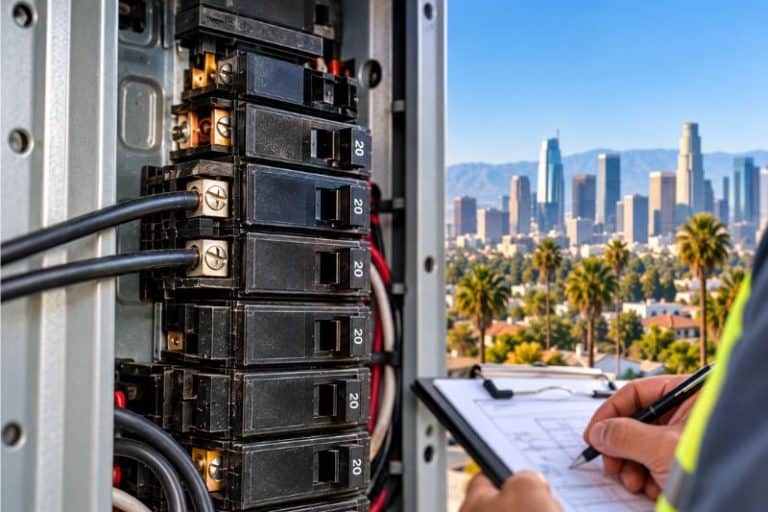
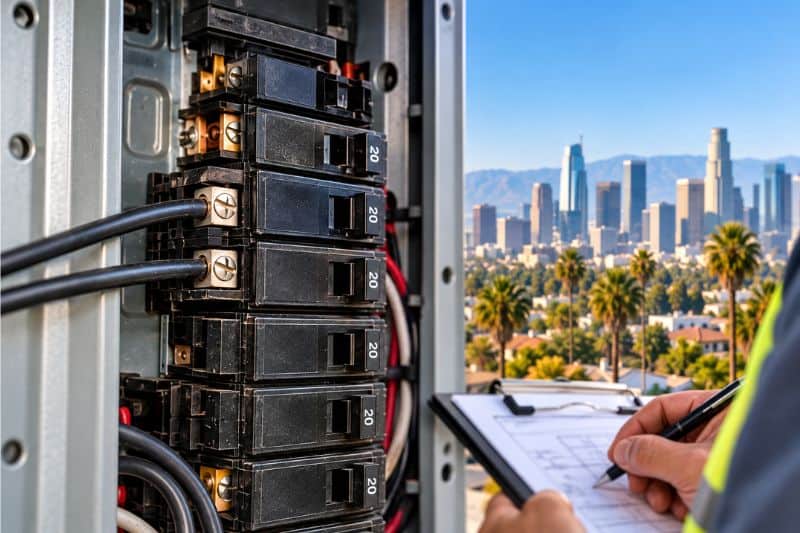
A circuit breaker has a terminal where the circuit wire attaches. Most breakers are built and tested for exactly one conductor under that screw. Double tapping means two conductors share it, usually because someone needed one more circuit and the panel had no open space.
What the code says
The National Electrical Code, which California adopts with state amendments, requires that a terminal be used only for the number of conductors it is identified for. Section 110.14(A) says terminals for more than one conductor must be identified as such. Most standard breakers are not. Some are specifically listed for two conductors, and the breaker’s marking or the manufacturer’s instructions say so. Without that listing, two wires under one screw is outside what the device was tested to do.
The neutral side has its own rule. Section 408.41 requires each grounded conductor to terminate in the panelboard on an individual terminal that is not also used for another conductor, with a narrow exception for parallel conductors. A neutral bar with two wires crammed under one screw is a double tap too.
Why it matters physically
Two wires under a single screw rarely seat evenly. The screw can bear on one conductor and barely touch the other, and the loose one runs hot. Heat loosens the connection further, which creates more heat. If the two wires are different sizes, the problem gets worse, because the screw cannot grip both properly.
There is also a protection problem. A breaker is sized to protect the wire connected to it. When two separate circuits share one breaker, the combined load can exceed what either wire was meant to carry before the breaker ever sees a problem. And the two circuits cannot be shut off independently, which means a person working on one may find the other still live.
So the cause is a shared terminal, the effect is a loose and heated connection, and the consequence is a hot spot inside the panel that nobody can see.
Why Older Los Angeles Buildings Are Full of Them
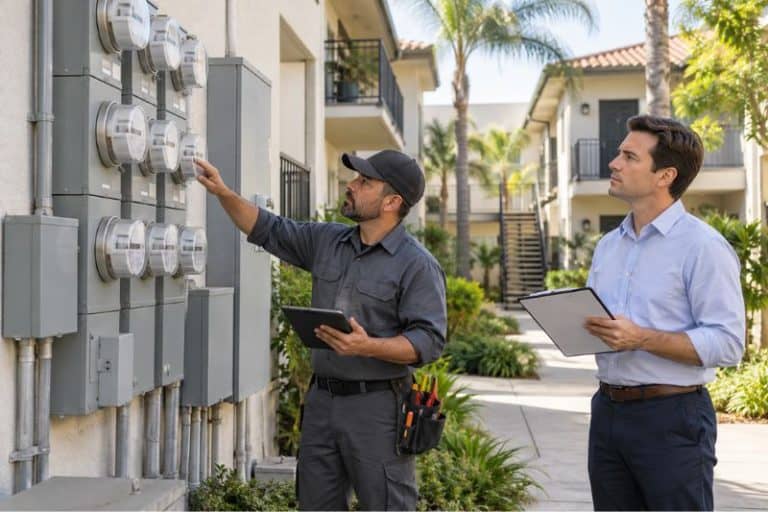
Panels in older buildings were sized for the loads of their era. A 1950s apartment building in Van Nuys or Koreatown was wired for a few lights and a refrigerator per unit. Decades later, every tenant has air conditioning, a microwave, and a dozen chargers, and the building needs more circuits than the panel has spaces.
How double taps happen
Someone adds a circuit for a window air conditioner or a new kitchen outlet. The panel is full. Rather than add a subpanel or replace the panel, the quick fix is to land the new wire on an existing breaker. It works that afternoon, and nobody writes it down. Over the years, several owners and contractors repeat the pattern.
Where we find them
In our experience, double taps cluster in older multi-unit buildings, in main panels that have been added to repeatedly, and in houses with a history of remodels by different people. A fourplex in Inglewood or a bungalow court in Culver City can carry them across several panels, and the panels nobody has opened in decades are the ones that surprise people.
That is the pattern behind the question: old demand met a full panel, and a shortcut became a permanent condition.
Will It Fail an LADBS Inspection?
Often, yes, if the inspector sees it. A permitted panel project in the City of Los Angeles ends with an inspection by the Los Angeles Department of Building and Safety. The inspector looks at the installation, and when the cover is off, the inspector looks at what is inside.
What an inspector can require
An inspector reviews the work covered by the permit, but the condition of the equipment the work touches is part of the picture. A double-tapped breaker is a visible violation of how the device is listed to be used. When an inspector sees one, the practical outcome is a correction before approval. The scope of what must be fixed depends on the inspector and the project, so we do not promise a particular outcome, only that the possibility is real.
Not every address answers to LADBS
LADBS covers the City of Los Angeles. Santa Monica, Beverly Hills, Culver City, Inglewood, and Torrance each have their own building departments, with their own inspectors. The code is the same state code, but the inspector, the permit process, and the way a finding is handled are local. We pull the permit in the right jurisdiction for your address.
Outside of a permitted project
A double tap does not announce itself between inspections. It surfaces at a sale, when a buyer’s inspector opens the panel, at an insurance review, or when a connection finally overheats. A property that has never had a permit pulled on its panels can carry these for decades.
The answer, then, is that a double tap can fail an inspection, and it can fail one in a place you did not expect.
The Fourth-Panel Inspection: What Happens When You Did Not Touch the Panel
This is a real job, and it is the clearest answer we know to the question of whether a double tap matters.
The job
We replaced three panels in an older apartment complex. When the inspector arrived, he went through them one at a time. This one was fine, and so was the next. Then he noticed a fourth panel in the building, one we had not worked on, and he opened it.
What he found
Some breakers in that fourth panel had two wires under a single screw. The inspector told us he knew we had not done it. He also told us he would not give approval unless the apartment complex had the panel replaced or wired properly.
What it cost
Nothing about our work was wrong, and the project was delayed anyway. The building owner now had a decision to make about a panel that was never in the scope, and the approval everyone was waiting on sat idle until it was made.
The lesson is not that inspectors are unreasonable. It is that an old building rarely has just the one panel problem you came in for, and that the cheapest time to learn about the rest is before the inspector arrives. This is why we recommend that property managers have every panel in a building looked at when one is being replaced, and why we tell owners about this possibility at the estimate stage, not on inspection day.
Signs a Panel May Have a Double Tap
You cannot see a double tap without opening the panel, and opening a live panel is a job for a licensed electrician. You can notice what surrounds one, though.
Clues from outside the panel
A panel cover that feels warm, a faint buzzing or crackling from the panel, discoloration or a burnt smell near it, and a breaker that trips repeatedly or feels loose in its slot are all reasons to call. So is a panel that has no open spaces left in a building that has clearly added circuits over the years, because that is exactly the setup that produces double taps.
What not to do
Do not remove the cover to look, and do not try to tighten anything. A screw that is loose may be carrying live current at the moment you touch it. Make a note of what you noticed and when, and ask for an evaluation.
What an evaluation finds
A licensed electrician opens each panel, checks every terminal for the number of conductors under it, looks at wire sizes, and compares the breakers to the circuits they feed. The deliverable is a plain list of what is wrong and what each fix involves, so you can decide before any inspector forces the question.
How a Double Tap Gets Fixed
There is no single fix, because the right one depends on why the double tap exists.
Pigtailing or a listed breaker
Sometimes the two conductors really are one circuit, split at the breaker. In that case, they can be joined to a single conductor in a proper junction box with a listed connector, and that one conductor lands on the breaker. Where a breaker is specifically listed for two conductors and the sizes and types match its marking, that can be an option too. Both depend on the wiring being in good enough condition to work with.
Giving each circuit its own breaker
If the two wires are separate circuits, each needs its own protection. Where the panel has the room, we add breakers. Where it does not, some panels are labeled to accept twin or tandem breakers in designated slots, and that is an option only where the panel’s label allows it. Our circuit breaker services cover choosing the right breaker type for each circuit and installing it properly.
Adding capacity or replacing the panel
When the panel is full, the double tap is the symptom and the real problem is capacity. The solutions are a subpanel to carry some of the circuits, or a panel replacement sized for what the building needs now and what it will need next. We install Siemens panels, and the replacement starts with a load calculation. Our electrical panel services cover the assessment, the permit, the installation, and the inspection as one scope.
Whichever route fits, the end result should be one conductor per terminal, each circuit protected as designed, and a panel directory that matches reality.
What to Do Before an Inspection, and What It Means for Insurance and Sales
Most of the cost of a double tap comes from finding it at the wrong time. A few steps move the discovery to a time you can control.
Before an inspection
If a permitted project is coming, ask the electrician to review every panel in the building, not only the one in the scope. Ask what else they see when covers are off. Settling these items in advance means the inspector finds a clean installation instead of a list.
For insurance
Insurers increasingly ask about the electrical system, and a panel with visible double taps raises the same questions as any outdated equipment. A permitted correction with a passed inspection gives your agent something to send. Doing this before a notice arrives lets you choose the timeline instead of racing a deadline.
For a sale
Buyers’ inspectors check panels. A double tap in the report becomes a repair request or a credit negotiation. Fixing it before listing turns a negotiating point into a finished improvement with paperwork behind it.
A double tap costs the least to fix when it is found on your schedule.
What to Expect From RG Electric
When you call (323) 521-5131, you reach someone on our team. If you suspect a problem in a panel, the first visit is a service call, which carries a fee up front, because a technician has to open the panel and see what is there before anything can be priced. The technician reports what was found to our supervising electrician, who writes the estimate, and someone on our team then calls to walk through each line.
Corrections and panel replacements are new work, and new work gets a free estimate. We do not bill by the hour. You see the scope and the price in writing, there are no hidden fees, and we stand behind our work for 12 months.
Questions Property Managers and Homeowners Ask About Double Taps
Is a double-tapped breaker a fire hazard?
It can be. A shared terminal tends to loosen and heat over time, and two circuits on one breaker can exceed what either wire was meant to carry without tripping. Not every double tap leads to a fire, but all of them are outside how the breaker was designed to be used.
Can I fix one myself?
We would not recommend it. Working inside a live panel is hazardous, and the correct fix depends on why the double tap was made in the first place. A licensed electrician can tell which option fits and can pull the permit if the work calls for one.
Are all double taps a code violation?
Not in every case. Some breakers are listed for two conductors, and the marking on the device says so. Without that listing, two conductors under one terminal does not meet the code. A neutral bar has its own rule, which is one wire per terminal unless the terminal is identified for more.
Will an inspector fail me for a panel I did not touch?
It can happen, and it did on a job of ours. An inspector who opens a panel and finds a double tap can decline to approve until it is corrected, even when the contractor did not do the original work. That is why we recommend looking at every panel in a building before inspection day.
How common are they?
In older Los Angeles buildings, very. Any panel that has been added to over the years without a plan is a candidate.
For immediate assistance or to schedule a professional evaluation, call RG Electric directly at (323) 521-5131.
Electrical work is hazardous. Always consult a licensed electrician like RG Electric before working on electrical systems.