
 Call (323) 5215131
Do I Need a Permit for Landscape Lighting in Los Angeles?
Updated September 2026
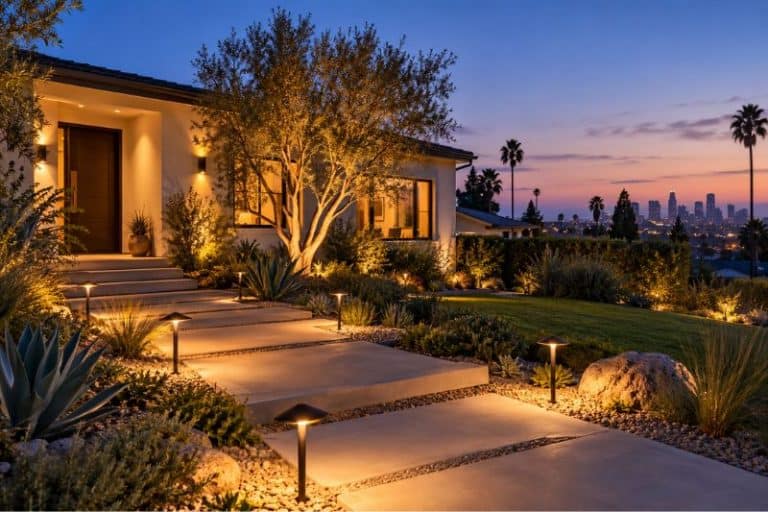
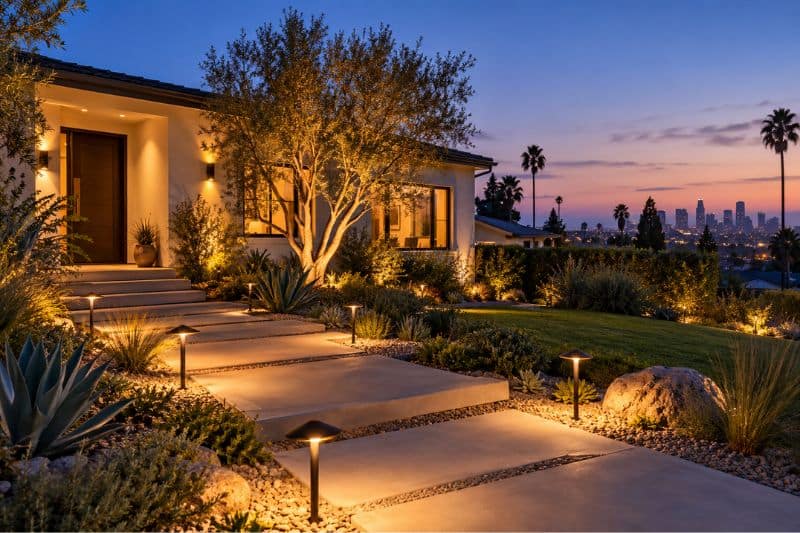
A homeowner in Culver City finishes redoing the front yard and wants to add path lights along the walkway and a few uplights on the ficus tree by the porch. Before calling anyone, the question comes up almost automatically after a summer of hearing about permits for everything from panel upgrades to pool equipment. Does landscape lighting need one too? RG Electric, license C10 #910807, gets this question often, and the answer here is more forgiving than most of the permit questions homeowners ask. In most cases, low voltage landscape lighting in Los Angeles does not require a permit. The exception, and it is an important one, is anything that runs at standard household voltage.
The Short Answer: Voltage Decides the Permit Question
Nearly all residential landscape lighting in Los Angeles runs on a low voltage system, typically 12 volts, stepped down from standard household power through a transformer. Because everything past that transformer operates at such a low voltage, it falls outside the electrical work that triggers a standard LADBS permit. A new 120 volt circuit run outdoors for flood lights, an exterior outlet, or a patio fixture is a different category of work entirely, and that does require a permit through LADBS the same way any other new circuit would, whether the fixture is technically part of a landscape lighting plan or not.
This distinction is not unique to Los Angeles. California maintains a separate contractor license classification, C-7, specifically for low voltage systems operating at 91 volts or less, and low voltage landscape lighting is explicitly named as one of the systems that classification covers. The existence of a dedicated license category for this kind of work is part of why the permitting picture looks different for landscape lighting than it does for a panel upgrade or a new circuit.
It helps to understand why the code draws the line where it does rather than treating this as an arbitrary exemption. A 120 volt circuit carries enough current to be genuinely dangerous if the wiring is done incorrectly, which is why the permit and inspection process exists, to catch mistakes before they become a fire or shock hazard. A 12 volt landscape lighting circuit carries a small fraction of that risk. The lower the voltage, the less a wiring mistake is likely to cause serious harm, and the permitting requirements scale down accordingly rather than treating every wire in the ground as an equal hazard.
Why the Transformer Is Where the Real Electrical Work Happens
The low voltage side of a landscape lighting system, the wire running to each fixture, is genuinely lower risk than standard household wiring, and that is reflected in how lightly it is regulated. The transformer itself is a different story. It needs to plug into or be wired to a GFCI protected exterior outlet with enough spare capacity to run the system, and that outlet, along with the circuit feeding it, is standard voltage work. If a property does not already have a suitable GFCI protected exterior outlet near where the transformer needs to sit, adding one is exactly the kind of work that does require a licensed electrical contractor and, in most cases, a permit.
This is where a project that started out sounding entirely permit free can pick up a permit requirement partway through planning. A homeowner who assumes the whole project is exempt because landscape lighting itself does not need one can be surprised to learn that the outlet supplying the transformer does, if that outlet does not already exist in a convenient location.
This is a more common gap than most homeowners expect. Older properties, and even some newer ones where the yard was never a priority during construction, frequently have no exterior outlet anywhere near where landscape lighting fixtures would actually go. The nearest outlet might be on the opposite side of the house, on a circuit that is already carrying other loads, or missing GFCI protection entirely and in need of an upgrade before it can legally power anything new outdoors.
What Still Needs to Be Done Correctly, Permit or Not
Not needing a permit is not the same as there being no standard to follow. Low voltage cable for landscape lighting is typically buried around six inches deep along beds and lawn edges, with sleeving used wherever the cable crosses under a path or a driveway. Every splice needs a sealed, waterproof connector, since a landscape lighting system lives outdoors year round and any connection that lets moisture in eventually fails, usually at the least convenient time.
The transformer itself needs to be sized correctly for the total wattage of every fixture on the system, with some room to spare rather than run at its absolute limit. Undersizing a transformer is one of the more common mistakes in a do it yourself landscape lighting project, and it shows up later as dim fixtures at the far end of a run or a transformer that fails early from being pushed too hard for years.
Voltage drop across a long cable run causes a similar symptom and gets confused with an undersized transformer more often than it should. Fixtures near the transformer run at full brightness while fixtures at the far end of the same run appear noticeably dimmer, not because the transformer is underpowered but because the cable itself is losing voltage over distance. The fix is different in each case, either a larger transformer or a heavier gauge cable and a redesigned wiring layout that splits long runs into shorter ones, and diagnosing which problem is actually present takes more than swapping in a bigger transformer and hoping.
When a Landscape Lighting Project Crosses Into Line Voltage Work
A handful of scenarios turn a straightforward low voltage project into something that needs an electrician and a permit from the start. Adding a new exterior GFCI outlet to power the transformer is the most common one. Running a dedicated circuit for larger scale landscape lighting on a bigger property is another, particularly on commercial or multi-unit sites where lighting loads add up faster than on a typical residential yard. Any lighting tied to security or safety, illuminating a required exit path or serving a documented security function, moves into a different regulatory category entirely and should be scoped by a licensed electrician regardless of voltage.
Property managers overseeing common area landscape lighting at apartment buildings and commercial properties should treat this distinction carefully. A small residential yard project and a common area lighting system serving an entire building are not evaluated the same way, and what qualifies as exempt low voltage work on one property can look different at the scale a multi-unit building requires.
Commercial landscape lighting also tends to involve a larger number of transformers spread across a property rather than a single unit near one outlet, which multiplies the number of line voltage connection points that need to be planned correctly. A property manager evaluating a landscape lighting proposal for a commercial or multi-unit site should ask specifically how many transformers the design calls for and where each one will draw power, since that detail determines how much of the project actually falls under standard electrical work rather than the lighter low voltage category.
Why Hiring a Licensed Electrician Still Matters at Low Voltage
The lighter permit requirement for low voltage work does not mean licensing stops mattering. Anyone performing low voltage contracting work in California above a minor work cost threshold needs to hold the appropriate license, and the practical reality is that most landscape lighting projects also touch line voltage at some point, the outlet, the circuit, or the transformer connection, which is squarely electrical contractor territory. Homeowners who hire based purely on the fact that the fixtures themselves are low voltage sometimes end up with a contractor who is not actually qualified to touch the part of the job that carries the real electrical risk.
This is a particularly easy trap to fall into with landscape lighting specifically, since the low voltage exemption creates the impression that almost anyone can legally do the work. A landscaping company or a handyman may install the fixtures and low voltage wiring competently enough, but if the project also requires a new exterior outlet or circuit, that portion needs a licensed electrical contractor regardless of how the rest of the job is being handled. Splitting a single project between an unlicensed installer for the fixtures and no one at all for the electrical portion is how homes end up with a transformer plugged into an outlet that was never rated or protected for the load it is now carrying.
Always consult a licensed electrician like RG Electric before working on electrical systems.
Why This Comes Up Differently Across Los Angeles Neighborhoods
Landscape lighting requests in Beverly Hills, Santa Monica, and Encino tend to involve larger properties with more fixtures, longer cable runs, and correspondingly larger transformers, which raises the stakes on correct sizing and outlet placement from the start. In Culver City, Sherman Oaks, and Van Nuys, landscape lighting more often comes up as one piece of a broader yard renovation, where the outdoor GFCI outlet question intersects with other exterior electrical work already planned for the same project. Older homes throughout the San Fernando Valley sometimes lack a conveniently located exterior outlet altogether, which is usually the detail that turns an otherwise permit free landscape lighting job into one that needs an electrician for the outlet portion before the lighting itself ever goes in the ground.
Hillside properties scattered through the Hollywood Hills and parts of Encino add a further wrinkle worth planning for. Longer distances between a home’s exterior outlets and the areas where landscape lighting is wanted, retaining walls, terraced yards, and slope stabilized planting beds, all push cable runs longer than a flat suburban lot would ever require. Longer runs make the voltage drop question more relevant, not less, and a landscape lighting design for a hillside property benefits from being planned around the electrical realities of the site rather than adapted after the fact once fixtures are already dim at the far end of the yard.
How RG Electric Handles the Line Voltage Side of Landscape Lighting
RG Electric evaluates the full scope of a landscape lighting project during a free estimate, confirming whether a suitable GFCI protected exterior outlet already exists or needs to be added, and sizing that circuit correctly for the transformer load. Where a new outlet or circuit is required, RG Electric pulls the permit and handles the inspection the same way it would for any other new electrical work, following code to the teeth rather than treating the outdoor portion of a project as less important because it sits outside the house.
Even on projects where nothing about the lighting itself requires a permit, RG Electric documents the work performed on the electrical side, the outlet added, the circuit sized, the GFCI protection confirmed, so there is a record if the property is ever sold, refinanced, or reviewed by an insurer. A homeowner who can produce that documentation years later is in a noticeably better position than one who can only say the work was done by someone at some point, with no paperwork to show for it.
Every completed installation is backed by RG Electric’s twelve month workmanship guarantee, and pricing reflects the actual scope of the electrical work rather than a flat rate, since a yard with an existing outlet in the right spot is a very different job from one that needs new wiring run from the panel. A homeowner who calls expecting a single number for landscape lighting is often surprised to learn how much that number depends on details that have nothing to do with the fixtures themselves, the distance to the nearest suitable outlet, the condition of the panel feeding it, and whether a new dedicated circuit makes more sense than adding load to an existing one.
Getting the Electrical Side Right Before the Fixtures Go In
Landscape lighting is one of the rare projects in Los Angeles where the answer to the permit question is often no, but the electrical work behind it still deserves the same care as anything else touching a home’s wiring. RG Electric supports landscape and outdoor lighting installation across Los Angeles and coordinates any needed exterior GFCI work through the same team handling outlet and switch installation, so the line voltage side of the project is never an afterthought, even on a job where most of the wiring never needs a permit at all.
Homeowners who confirm the outlet situation before ordering fixtures and transformers tend to have the smoothest projects. The ones who assume the whole job is permit free without checking are the ones most likely to discover, partway through, that part of it was never exempt to begin with, usually right around the point where fixtures and cable have already been purchased for a layout that now needs to change.
For immediate assistance or to schedule a professional evaluation, call RG Electric directly at (323) 521-5131.