
 Call (323) 5215131

What Permits Are Required for a Temporary Power Pole in Los Angeles?
Updated September 2026
RG Electric is a licensed C10 electrical contractor in Los Angeles, License #910807, and one of the most common questions we hear from general contractors, developers, and homeowners starting a large remodel is whether a temporary power pole needs its own permit, separate from the building permit already in hand. It does. A temporary power pole is treated as its own electrical installation, which means it goes through its own permit review, its own utility approval, and its own inspection, even though the job site already has an active building permit covering the larger project.
Why a Temporary Power Pole Needs a Permit of Its Own
Before permanent electrical service exists on a construction site, tools, trailers, site lighting, and safety systems still need power. A temporary power pole bridges that gap. It is a metered service, not a generator or a borrowed extension cord, which means it carries the same code obligations as any other electrical installation feeding a structure.
Because it is a real electrical service rather than a temporary workaround, the city and the utility both treat it that way. The building permit for the project covers the structure being built. It does not cover the temporary electrical service that powers the work while that structure goes up. Skipping the separate permit does not save time. It creates a point where an inspector or the utility can stop the job cold until the paperwork catches up.
Who Pulls the Permit, and Which Department Issues It
A temporary power pole permit has to be filed by, or through, a licensed C10 electrical contractor. This is not a permit a general contractor or property owner can pull on their own behalf for the electrical scope, since the work has to be tied to a licensed electrician of record.
Which department reviews the permit depends on where the job site sits. Inside the City of Los Angeles, the Los Angeles Department of Building and Safety handles electrical permits, including temporary power. Outside city limits, jurisdiction shifts to whichever city or county building department has authority over that address. RG Electric works across Los Angeles County, from Encino and Sherman Oaks in the Valley to Downtown LA, Culver City, and the South Bay, and the permitting authority is not the same in every one of those cities. Pasadena, Burbank, Glendale, and unincorporated county areas each run their own plan check and inspection process, separate from LADBS. Confirming the correct department before filing is the first step, not an afterthought, because submitting to the wrong jurisdiction resets the clock.
The Utility Side Is a Separate Approval
The building department permit is only half of the process. The serving utility, whether that is the Los Angeles Department of Water and Power, Southern California Edison, or a local municipal utility depending on the site’s location, has to independently approve the connection. This is a separate service request, filed alongside or shortly after the permit application, and the utility issues its own service planning confirmation before anything gets energized.
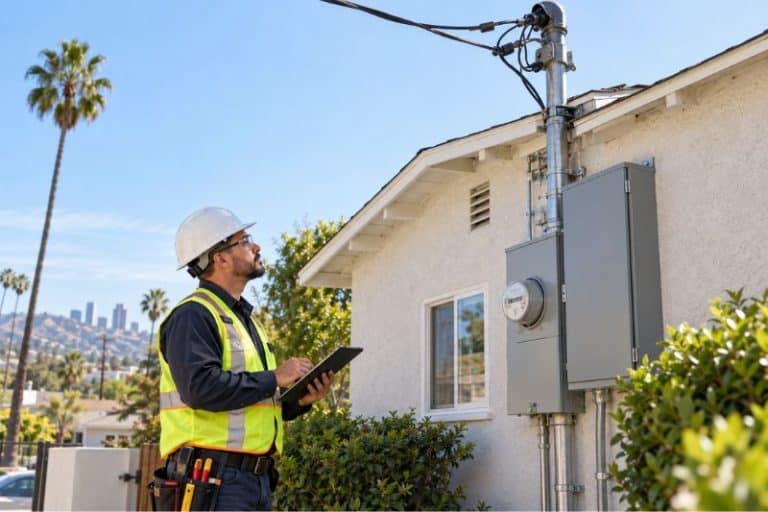
The utility also sets physical requirements for where the pole can go. LADWP’s current siting guidance places the temporary pole between 10 and 100 feet from the serving utility pole, clear of any on-site construction activity, with a minimum 3 foot by 3 foot level workspace maintained in front of the meter panel and pull box. Those clearances exist so a utility crew can safely access the equipment once the site starts moving, and a pole sited too close to active construction, or without that clear workspace, will not pass.
Two separate approvals are required before power flows: the building department signs off on the electrical installation, and the utility separately confirms the service connection. Missing either one stalls the project, regardless of how complete the other approval is.
Overhead Versus Underground Temporary Service
Temporary power can be run overhead or underground, and site conditions usually decide which one applies. Overhead is faster to install and typically less expensive. Underground is common where an overhead drop would cross a driveway, sidewalk, or an area with equipment traffic, or where the site’s aesthetics or space constraints rule out an overhead run.
What surprises a lot of general contractors is that an underground temporary pole still requires its own inspection and approval from the building department, the same as an overhead installation. Trenching the service does not exempt it from review. The conductor, the burial depth, the conduit, and the panel itself all still have to meet code and pass inspection before the utility will energize the connection. Assuming that underground service can skip a step because it is out of sight is one of the more common reasons a temporary power request gets delayed on re-inspection.
What the Pole Itself Has to Meet
Whether overhead or underground, the physical installation has standard requirements across almost every jurisdiction in the Los Angeles area. The pole or pedestal has to be solidly set and braced so it cannot lean or shift once equipment starts loading it. The meter socket has to be mounted at the height the utility specifies. The panel needs a main disconnect sized to the job, with 100 amp service typical for a single-family remodel, 200 amp common on multifamily or small commercial sites, and 400 amp reserved for large sites running tower cranes or batch plants. Every 125 volt, 15, 20, or 30 amp receptacle on the assembly has to be GFCI protected, which the National Electrical Code requires for construction power specifically because job site conditions, wet ground, damaged cords, shared use, create exactly the shock risk GFCI protection is designed to catch.
None of these requirements are unique to Los Angeles, but the review process that confirms a site meets them is, and that review is what actually determines the timeline.
What Actually Determines the Timeline
The physical work of setting a temporary power pole is fast. Once materials are on site, building and bracing the pole itself is usually a half day of labor. The paperwork is what takes weeks, not the installation. Permit review at the building department and the utility’s service planning queue are both processes RG Electric does not control the pace of, and they are almost always the longer part of the timeline, not the electrical work.
The practical consequence is straightforward: temporary power needs to be requested during pre-construction planning, not after the first subcontractor shows up looking for an outlet. A general contractor who treats the temp pole as day-one paperwork, filed alongside the building permit rather than after mobilization, avoids the single most common cause of early-schedule delay on a Los Angeles job site.
How Long a Temporary Power Pole Stays Active
In Los Angeles, temporary electrical service is tied to the life of the active building permit rather than to a fixed calendar limit set at installation. A short remodel might run on temporary power for a matter of months. A larger multifamily or commercial build can keep a temp pole in service for well over a year, as long as the underlying building permit stays active and the project is progressing. Once the permanent electrical service is inspected and approved, the temporary pole is disconnected, removed, and the utility connection is closed out, since it was never meant to be a long-term fixture.
What this means for planning is that the temporary service does not need to be re-permitted every few months on a long project, but it also is not a set-it-and-forget-it installation. If a project stalls long enough that the building permit lapses, the temporary electrical service is affected along with it.
What Happens If a Job Runs on Unpermitted Temporary Power
Every so often a general contractor asks whether a temporary power setup can go in first and get permitted afterward, once the site is already running. It happens, but it creates real exposure. An inspector who finds an energized temporary service without an approved permit can red tag the connection, which cuts power to the entire site until the paperwork is corrected, not just the electrical scope. That stops every trade on site at once, not only the electricians.
There is a liability dimension as well. An unpermitted temporary service has not been reviewed against code by the building department or approved by the utility, which means grounding, GFCI protection, and panel sizing have not been independently verified. If an incident occurs on that connection, whether an injury, a fire, or equipment damage, the absence of a permit and inspection record becomes a central fact in any insurance or liability review that follows. The permit and inspection are not paperwork for its own sake. They are the record that the installation was checked before anyone relied on it.
What Drives the Cost
There is no flat rate for a temporary power pole, and any quote given without a site visit is a guess. Amperage is the biggest factor, since a 100 amp residential setup costs less in materials and labor than a 200 amp multifamily assembly or a 400 amp commercial build. Distance from the utility’s existing drop matters too, particularly for underground service, where trenching and conduit add cost that an overhead run does not carry. Jurisdiction fees vary by city, and how fast the job needs power factors in as well, since expedited review is sometimes available at an added cost.
RG Electric prices temporary power the same way we price every project: with a site assessment and a written estimate scoped to that specific job, not a chart of flat rates that ignores what the site actually needs.
How RG Electric Handles Temporary Power Pole Installation
When a general contractor or developer calls RG Electric for temporary power pole installation, the process starts with a site visit to confirm amperage needs, siting, and distance to the utility drop. From there, we file the electrical permit with the correct jurisdiction, whether that is LADBS or another city or county department, and submit the parallel service request to the utility serving that address. We build the assembly to current code, GFCI protection included, coordinate the inspection, and stay on the job until the utility energizes the connection. At the end of the project, removal and site restoration are part of the scope, not a separate call later.
For contractors managing multiple properties or larger developments, our commercial electrical services team coordinates temporary power alongside the rest of a project’s electrical scope, so the same crew that sets the temp pole is available for the permanent service work that follows it.
Common Questions About Temporary Power Pole Permits
Can a general contractor pull the temporary power permit directly?
The electrical permit itself has to be filed by, or through, a licensed C10 electrical contractor. A general contractor can coordinate the request and timeline, but the permit and the electrical work it covers need a licensed electrician of record.
Does a temporary power pole need its own separate permit from the building permit?
Yes. The building permit covers the structure under construction. The temporary power pole is its own electrical installation and requires its own permit review, its own utility approval, and its own inspection, independent of the building permit’s status.
Is an inspection required for underground temporary service, or only overhead?
Both require inspection. Trenching the service underground does not exempt it from building department review. The conductor, burial depth, conduit, and panel all still have to pass inspection before the utility will energize the connection.
How far in advance should temporary power be requested on a construction project?
Temporary power should be requested during pre-construction planning, filed alongside the building permit rather than after the site mobilizes. Permit review and utility service planning are typically the longest part of the process, often taking several weeks, while the physical installation itself is usually completed in about half a day once materials are on site.
How is the amperage for a temporary power pole determined?
Amperage is sized to what the site actually needs to run, not to a default. A single-family remodel with hand tools and basic site lighting typically runs on 100 amp service. Multifamily and small commercial sites, where multiple trades draw power at once, commonly need 200 amp service. Large sites running tower cranes, batch plants, or heavy equipment simultaneously may require 400 amp service or higher. Sizing the pole too small means running out of capacity mid-project and having to upgrade the temporary service itself, which costs more in the long run than sizing it correctly the first time.
The Bottom Line
A temporary power pole in Los Angeles requires its own electrical permit, filed by a licensed C10 contractor, plus a separate approval from the serving utility, regardless of whether the service runs overhead or underground. The physical installation is fast. The review process is not, and it is almost always the reason a project loses time waiting on power rather than the pole itself. Requesting temporary power during pre-construction planning, rather than after the first trade is already on site, is the difference between a project that stays on schedule and one that stalls in its first weeks over a permit that should have been filed a month earlier.
For immediate assistance or to schedule a professional evaluation, call RG Electric directly at (323) 521-5131.