
 Call (323) 5215131
How to Read an Electrical Estimate in Los Angeles Before You Sign
Updated August 2026
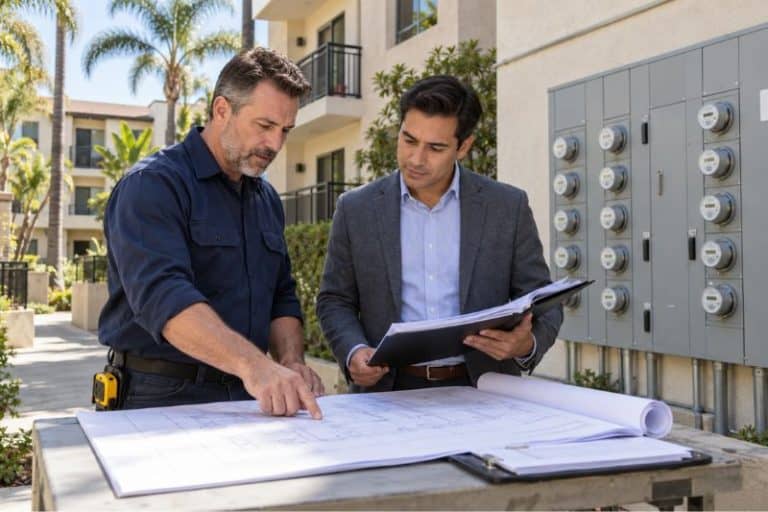
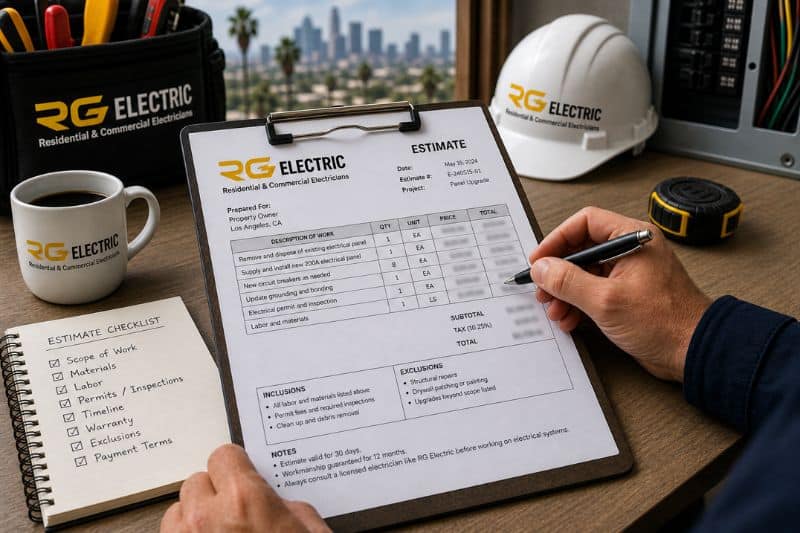
Most homeowners and property managers in Los Angeles receive an electrical estimate the same way: a document arrives by email, the total is at the bottom, and the decision is whether to approve it or not. What is in the middle, the line items, the scope language, the terms, is rarely read carefully, and the questions that should be asked before approval are rarely asked. The result is that customers either approve work they do not fully understand, or they decline work they actually need because the estimate felt vague and the price felt unjustified. RG Electric, licensed C-10 #910807, provides written estimates for every project before any work begins, with itemized line items and a clear explanation of what each one covers. This post explains how to read any electrical estimate, what the line items actually mean, what questions to ask, and what the difference looks like between an estimate from a contractor who operates transparently and one who does not.
Why the Estimate Matters More Than Most Customers Realize
The estimate is not just a price, it is a description of the scope of work the contractor intends to perform. When the work is complete and the invoice arrives, the invoice should match the estimate. If it does not, the estimate is the document that establishes what was agreed to and what was not. A customer who approved a vague estimate with a single line item and a total has very little basis for disputing an invoice that has added charges. A customer who approved an itemized estimate with specific scope language for each line knows exactly what was included and what was not.
In Los Angeles, where electrical projects frequently involve permits, inspections, and code corrections that were not apparent at the initial site visit, having a clearly written estimate also establishes what happens when additional conditions are discovered. A professional contractor documents the base scope in the estimate and communicates changes in writing before performing additional work. A contractor who does not use written estimates, or who uses vague single-line estimates, is leaving the customer without the documentation needed to manage that process.
What a Professional Electrical Estimate Should Contain
Before evaluating any specific line item, check whether the estimate contains the basic elements that a professional electrical contractor should always include. Their presence or absence tells you a great deal about the contractor before the work begins.
Contractor license information
A licensed electrical contractor in California holds a C-10 license issued by the California Contractors State License Board. The estimate should include the contractor’s license number. With that number, you can verify the license status, the license holder’s name, and any disciplinary actions at the CSLB website in about two minutes. An estimate that does not include a license number may be from an unlicensed contractor, which means the work will not be permitted, will not be inspected, and will not be covered by the contractor’s liability insurance if something goes wrong. In Los Angeles, where there are more unlicensed contractors operating than most homeowners realize, this check is worth doing before any work begins.
Scope description
The estimate should describe what work will be performed in enough detail that a third party reading it could understand what the contractor agreed to do. “Install panel” is not adequate scope language. “Replace existing 100-amp main service panel with new 200-amp Siemens panel, including new breakers, ground bar, and panel labeling. Permit and LADBS inspection included” is adequate scope language. The difference matters if there is a dispute about what was included, and it matters for your records when you go to sell the property or make an insurance claim that involves the electrical system.
Materials specification
For significant work, panel replacements, rewiring, EV charger installations, the estimate should specify the materials being used. Panel brand and ampacity rating, wire gauge and type, breaker manufacturer and ratings, and charger make and model are all relevant specifications that affect the quality and longevity of the installation. An estimate that specifies Siemens panels and UL-listed wire is more verifiable than one that says “materials included.” You can confirm that what was quoted is what was installed, and you have documentation of the materials for future maintenance reference.
Permit and inspection language
For any project that requires a permit, panel replacements, new circuits, significant wiring work, the estimate should state explicitly whether permit fees are included or are to be billed separately. It should also indicate whether the contractor will handle the permit application and inspection coordination or whether those are the customer’s responsibility. In Los Angeles, the permit process for electrical work involves LADBS and sometimes LADWP, and a contractor who leaves permit coordination to the homeowner is leaving a significant responsibility in the hands of someone who typically does not know the process.
Payment terms and timeline
The estimate should state when payment is expected, on completion, in stages, or with a deposit. California law limits the deposit a contractor can require before starting work to ten percent of the total contract price or one thousand dollars, whichever is less. An estimate that requests a large upfront deposit before work begins is either non-compliant with California contractor law or a signal that the contractor has cash flow problems that should give you pause. Payment on completion, or in stages tied to defined milestones, is the standard for professional electrical work.
Understanding Common Line Items
Once you have confirmed the basic structural elements of the estimate, the line items themselves are worth understanding. The following are the most common categories and what they typically cover.
Labor
Labor is typically the largest line item in an electrical estimate, and it is also the one customers most frequently underestimate. Electrical labor pricing reflects the skill level required, the complexity of the installation, the time involved, and the overhead of running a licensed, insured operation. A licensed electrician in Los Angeles is not billing a simple hourly rate the way a day laborer would. The rate reflects workers’ compensation insurance, liability insurance, licensing costs, vehicle and tool overhead, and the cost of the expertise that prevents the work from creating a safety hazard or a code violation that costs more to fix than the original job.
RG Electric does not charge by the hour. We price by project scope after evaluating what the job actually involves. This approach protects the customer from labor rate surprises if a job takes longer than anticipated, and it gives both parties a clear agreed price before work begins. If you receive an estimate that bills hourly rather than by scope, ask for a not-to-exceed figure in writing before approving the work.
Materials
Materials in an electrical estimate include the panel, breakers, wire, conduit, boxes, devices, and fixtures specified for the project. Material costs vary based on quality tier, current supply chain conditions, and the specific requirements of the installation. A panel replacement estimate that comes in significantly lower than others you have received may reflect a lower-quality panel brand, undersized components, or a scope that omits something the other estimates included, such as the permit fee or the grounding system inspection. Asking which panel brand is being installed and what ampacity rating is included is a reasonable question that a professional contractor will answer directly.
Permit fees
LADBS permit fees for electrical work are based on the project valuation and scope. For a standard panel replacement in Los Angeles, permit fees typically run several hundred dollars. Those fees are a real cost and should appear somewhere in the estimate, either as a named line item or as an explicit inclusion in the total. An estimate that does not mention permits at all for work that clearly requires them either omits the permit from the scope entirely, which means the customer will be billed separately, or means the contractor does not plan to pull a permit. Neither outcome is acceptable for significant electrical work.
Code corrections
In older Los Angeles properties, electrical work frequently reveals code conditions that need to be corrected before the project can receive inspection approval. Double-tapped breakers, missing GFCI protection, ungrounded circuits, and deteriorated wiring are all conditions that an inspector may require to be corrected even if they were not part of the original scope. A professional estimate should note whether the scope includes addressing common code conditions found during the work, and what the process is if the inspector requires additional corrections. A contractor who commits to a firm price without any acknowledgment of this possibility is either planning to absorb those costs, which means they priced for it, or planning to bill them separately as change orders after the work has begun.
Questions to Ask Before You Approve
Reading the estimate carefully is the first step. Asking a few specific questions before approving it is the second. These questions are reasonable for any homeowner or property manager to ask, and a professional contractor will answer them without hesitation.
Ask whether the permit fee is included in the total or billed separately. Ask which brand and model of panel or equipment is being installed. Ask whether the estimate includes the cost of addressing common code conditions found during the work, or whether those are billed as change orders. Ask what the process is if the inspector requires additional corrections to systems the contractor did not touch. Ask what warranty covers the workmanship and for how long. Ask whether the contractor carries liability insurance and workers’ compensation, and ask to see the certificate of insurance before work begins, especially for commercial projects where your property management agreement or lease may require it.
A contractor who answers these questions directly and specifically is operating transparently. A contractor who becomes defensive, vague, or dismissive when asked basic professional questions is telling you something important about how they will handle the project once the work begins.
Red Flags in an Electrical Estimate
Some characteristics of an estimate are not just gaps in professionalism, they are genuine warning signs that the contractor is operating in a way that creates risk for the customer.
No license number on the estimate
An electrical contractor operating without a license is breaking California law. Work performed by an unlicensed contractor cannot be permitted or inspected, voids the homeowner’s insurance coverage for damage related to that work, and leaves the customer with no recourse through the CSLB if the work is defective. The absence of a license number on an estimate should stop the process before it goes further.
A single-line estimate with no scope description
An estimate that reads “electrical work: $X” with nothing else is not an estimate. It is a price with no commitment attached to it. There is no way to verify after the fact what was agreed to, no way to confirm that the work was completed as discussed, and no basis for dispute if the invoice is different from what the customer understood. Professional electrical contractors provide itemized estimates because it protects both parties.
No mention of permits for work that requires them
Panel replacements, new circuit installations, service upgrades, and significant rewiring all require permits in Los Angeles. An estimate for this type of work that makes no mention of permits indicates either that the contractor does not plan to pull them, or that permit costs will be added later as a surprise line item. Unpermitted work creates problems at the point of sale, during insurance claims, and when a future licensed contractor has to assess what has been done to the property. It is also illegal, and the property owner who allowed the unpermitted work shares the exposure.
A deposit requirement that exceeds California law
California Business and Professions Code limits contractor deposits to ten percent of the contract price or one thousand dollars, whichever is less, before work has begun. A contractor who requests a larger deposit upfront is either unaware of the law, which suggests other compliance gaps, or is knowingly violating it, which is a more serious problem. Either way, a large deposit demand before work begins is a reason to pause and verify the contractor’s license status and reputation before proceeding.
How RG Electric’s Estimate Process Works
For new work, panel upgrades, EV charger installations, rewiring, lighting projects, and other installations that do not require diagnosing an existing fault, RG Electric provides free estimates. A technician or foreman visits the property, evaluates the scope, and Roy prepares an itemized estimate that reflects the actual materials, labor, and permit costs for that specific job. There are no chart prices or standard packages, every estimate is built from the actual conditions at the property.
For service calls, diagnosing an existing electrical problem, we charge a service call fee upfront that covers the technician’s time and travel. Once the fault is identified, Roy prepares a repair estimate and our customer care coordinator contacts the customer to review every line item before any repair work begins. Nothing is performed without the customer’s explicit approval of the estimate.
The estimate the customer receives reflects everything the project requires. Permit fees are included. Materials are specified. The scope is written clearly enough that there is no ambiguity about what is included and what is not. If the inspector identifies additional conditions during the project, we document them and discuss the options before performing any additional work. For our electrical repair services and our electrical panel services, that process is the same on every project, for every customer.
When the Lowest Estimate Is Not the Right Choice
The lowest estimate is frequently the most appealing one and the most dangerous one. Electrical work that is priced significantly below the other estimates you receive is almost always priced that way because something has been left out, the permit, the correct materials, the code corrections the inspector will require, or the insurance that protects you if something goes wrong. A panel replacement performed without a permit for two thousand dollars less than the permitted alternatives saves that two thousand dollars at the point of installation and potentially costs far more when the property is sold, when a claim is filed, or when the work has to be opened and corrected by a licensed contractor who discovers what the unpermitted work actually involved.
The right way to evaluate competing estimates is to confirm that each one includes the same scope, permits, materials specification, code correction language, and warranty terms, and then compare them on that basis. An estimate that includes everything and comes in higher than one that omits the permit and uses unspecified materials is not more expensive. It is a different product. Understanding that distinction is what allows a homeowner or property manager to make a genuinely informed decision before approving any electrical work.
For immediate assistance or to schedule a professional evaluation, call RG Electric directly at (323) 521-5131.
Electrical work is hazardous. Consult a licensed electrician like RG Electric for inspections, permits, and code-compliant electrical installations throughout Los Angeles.