
 Call (323) 5215131
What Los Angeles Property Managers Need to Know Before a Tenant Requests EV Charging
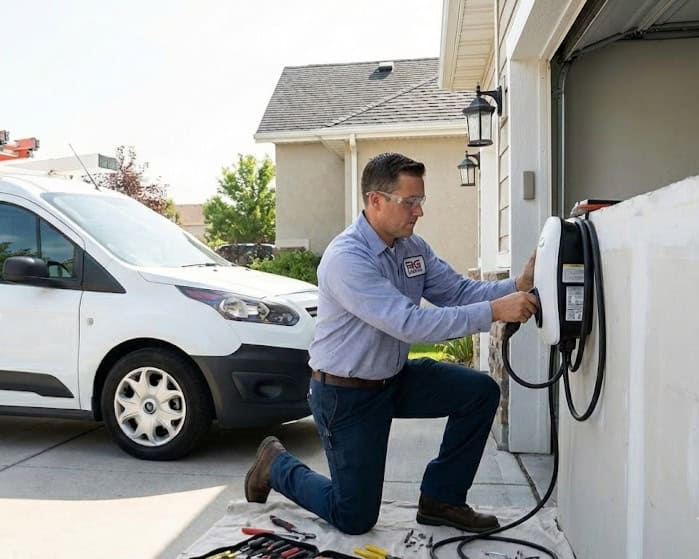
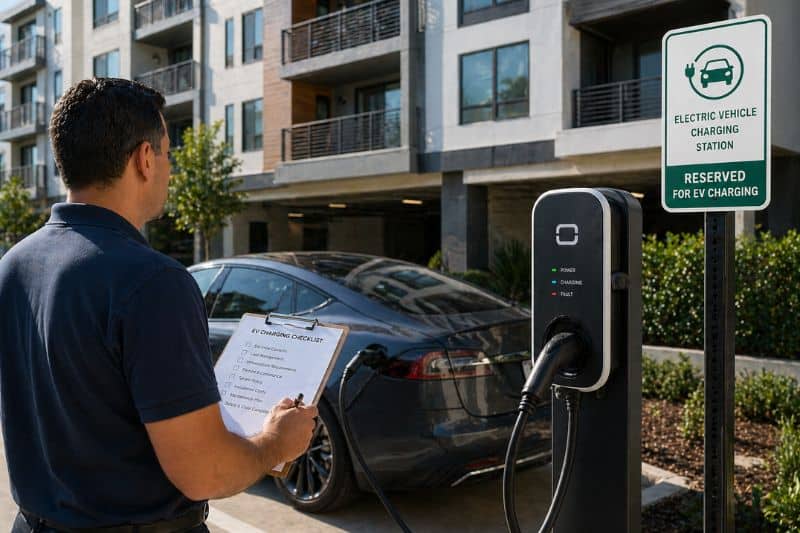
The tenant EV charging request used to be an unusual situation. It is now routine. In Los Angeles apartment buildings from the San Fernando Valley to the Westside, property managers are fielding requests from tenants who own electric vehicles and want a dedicated place to charge them. The request sounds simple. The answer is not. Before a property manager can say yes — or structure a meaningful response of any kind — several electrical questions need to be answered, a California law governing the landlord-tenant relationship on this issue needs to be understood, and the building’s long-term capacity strategy needs to be considered. RG Electric, licensed C-10 #910807, installs EV charging infrastructure for multi-unit buildings throughout Los Angeles and works directly with property managers to evaluate, plan, and execute these projects. This post covers what property managers need to understand before that first request arrives.
The Electrical Reality Behind a Simple Request
When a tenant asks for EV charging, what they are actually asking for is a dedicated 240-volt circuit run to their parking space, capable of supporting a Level 2 charger. A Level 2 charger typically draws between 32 and 48 amps continuously for several hours. That is a substantial and sustained electrical load — more than a central air conditioning unit, more than a dryer, and significantly more than any standard outlet circuit in the building was designed to carry.
The effect of adding that load without a corresponding capacity evaluation is predictable. If the building’s main panel or the subpanel serving the parking area is already operating near its rated capacity, adding one or more EV charging circuits pushes the system past its safe operating range. The consequence is not just tripped breakers — sustained overloading degrades wiring insulation, accelerates breaker wear, and creates conditions that increase fire risk over time. The right response to a tenant EV request is not to approve or deny it based on convenience. It is to evaluate the building’s electrical capacity first and then make the decision based on what the system can actually support.
California’s Right-to-Charge Law and What It Means for Landlords
California Civil Code Section 1947.6 gives tenants in multi-unit residential buildings the right to request EV charging installations in their designated parking spaces. The law limits a landlord’s ability to deny a reasonable request outright and creates a framework within which the landlord and tenant negotiate the terms of the installation. Understanding that framework changes how property managers should approach the first request.
What the law requires and what it permits
Under the statute, a landlord may not unreasonably deny a tenant’s written request to install EV charging in their designated parking space. The landlord can require the tenant to obtain the necessary permits, use a licensed contractor, carry additional insurance, and enter into a written agreement governing the installation and ongoing costs. The landlord can also require that the charger comply with applicable electrical and building codes — which in practice means a permitted installation by a licensed C-10 contractor.
The landlord is not required to subsidize the tenant’s charging costs. The tenant is responsible for the cost of the installation and, typically, for the ongoing electricity cost if a dedicated meter or submeter can be arranged. The landlord does have the right to require reasonable conditions that protect the building and other tenants — including load management controls that prevent a single tenant’s charging demand from affecting the building’s shared electrical systems.
The practical implication for property managers
The practical consequence of the right-to-charge law is that a property manager who receives a written EV charging request cannot simply say no without a legitimate basis. Having a documented electrical capacity evaluation in hand — showing exactly what the building’s current load is and what it can support — gives the property manager the factual basis to respond to a request accurately, whether that response is yes with conditions, yes with a phased implementation plan, or a documented explanation of why the timing requires a capacity upgrade first. Without that evaluation, the property manager is making decisions without the information needed to make them correctly.
The Capacity Evaluation Every Building Needs First
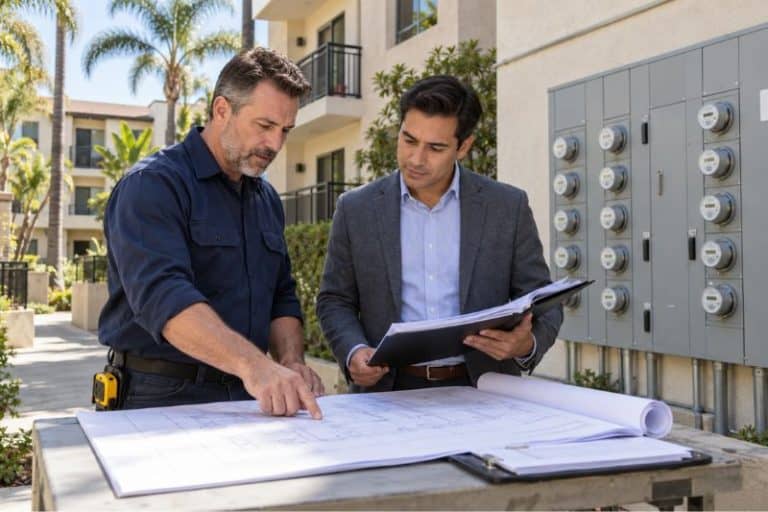
Before any EV charging installation can be planned responsibly, a licensed electrician needs to evaluate the building’s electrical system from the service entrance through the distribution panels to the parking area circuits. That evaluation answers several questions that determine what is possible and what it will cost.
Main service capacity
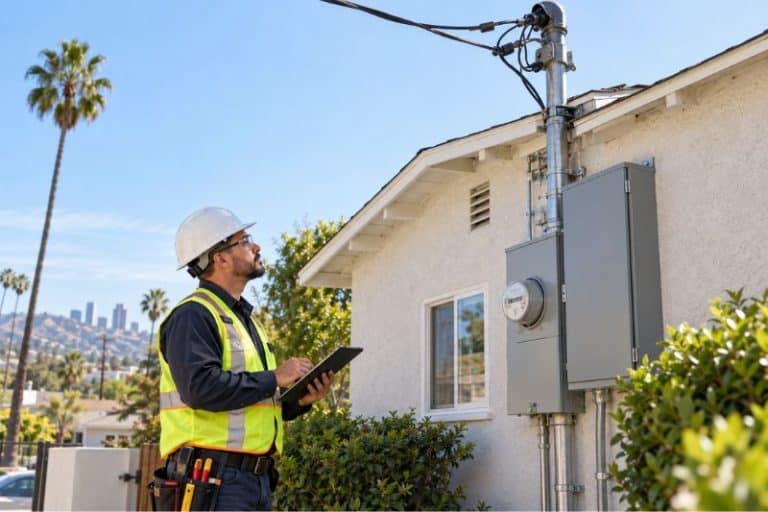
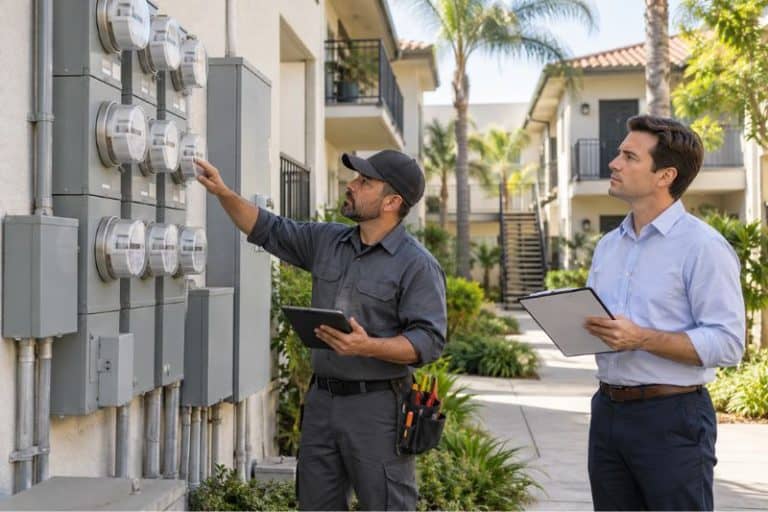
The evaluation starts at the utility meter and the main service panel. The key question is how much of the building’s total service capacity is currently being used under peak load conditions, and how much headroom remains. In older apartment buildings throughout Koreatown, the Eastside, and the San Fernando Valley — where the original service was sized for electrical loads that predate modern appliances, central HVAC, and in-unit laundry — the available headroom is often smaller than the panel’s rated ampacity suggests. A panel rated for 200 amps that is routinely running at 180 amps under summer peak conditions does not have room for even one Level 2 charging circuit without a service upgrade.
Parking area distribution
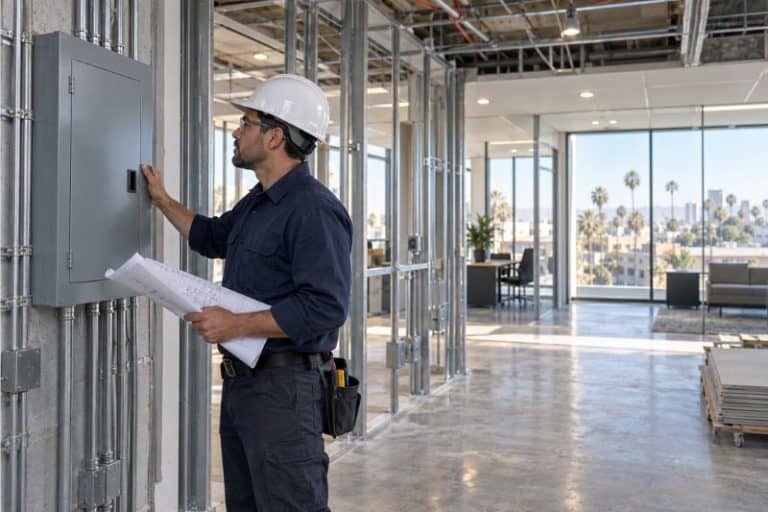
The evaluation also covers the electrical infrastructure in the parking area itself. Many Los Angeles apartment buildings have parking structures or carports that were wired decades ago with minimal electrical service — enough to power lighting and perhaps a few outlets, but not remotely adequate for EV charging loads. If the parking area has no existing subpanel, or if the existing subpanel is undersized, the EV charging project includes installing new distribution infrastructure before any charger circuits can be run. That scope affects both the cost and the timeline significantly.
Available conduit and routing
Running circuits from a distribution panel to individual parking spaces requires conduit through the parking structure. The evaluation identifies the available routing options — whether existing conduit sleeves are present, whether surface-mounted conduit along walls is feasible, or whether trenching under the parking surface is required. In covered concrete parking structures, surface conduit routing is typically the most practical approach and the one that allows future expansion without repeated disruption to the parking surface.
Load Management: The Tool That Makes Scaling Possible
One of the most important concepts for property managers to understand about multi-unit EV charging is load management. Without load management, each EV charger draws its full rated current independently of what the other chargers are doing. In a building with eight chargers rated at 40 amps each, simultaneous full-speed charging could draw 320 amps — far more than most apartment building electrical systems can provide, and far more than the utility connection supports.
Load management systems address this by coordinating the charging rate across multiple stations. When the total system load approaches the available capacity limit, the load management controller reduces the charging rate at individual stations proportionally so the total draw stays within the system’s safe operating range. Each vehicle still charges — just at a rate that the building’s electrical system can support given what else is drawing power at that moment.
Why load management matters for scalability
For property managers, load management changes the economics of EV charging infrastructure. Without it, each additional tenant EV request requires an individual assessment of whether the system has capacity for another full-speed charger. With a load management system in place, the building’s available capacity is shared dynamically across all chargers, and adding another charger is a matter of adding a circuit and a station rather than potentially triggering a service upgrade. This is the difference between a charging infrastructure that can grow with tenant demand and one that hits a hard ceiling after the first few installations.
Metering and cost allocation
Load management systems also typically support energy metering at the individual charger level, which gives property managers the data needed to allocate charging costs accurately to individual tenants. This is important both for fairness and for the practical management of a building where some tenants drive EVs and others do not. Tenants who charge pay for the electricity they use. Tenants who do not charge are not subsidizing those who do. That clarity prevents billing disputes and simplifies the administration of the EV charging program over time.
The Case for a Building-Wide Plan Rather Than Unit-by-Unit Responses
The most common pattern for EV charging in Los Angeles apartment buildings is reactive: one tenant requests charging, the property manager arranges an installation for that tenant’s space, and then the next request arrives and the cycle repeats. Each individual installation is handled as a standalone project. The result, after three or four cycles of this, is a patchwork of chargers served by individually run circuits with no coordination, no load management, and an electrical system that has been incrementally stressed without a plan for where the load is going.
The alternative is a building-wide EV charging plan developed before the first request arrives — or at least before the second one does. That plan identifies the total number of parking spaces, estimates the realistic percentage that will eventually need charging based on current EV adoption trends in Los Angeles, sizes the subpanel and load management infrastructure to support that eventual total, and phases the installation so the upfront cost is reasonable while the long-term capacity is in place.
The building-wide approach is almost always less expensive per charger than the unit-by-unit approach, because the infrastructure — subpanel, conduit routing, load management system — is installed once to serve the full eventual scope rather than being expanded incrementally with each request. For property managers managing multiple buildings in Los Angeles, developing a standard EV charging infrastructure template and applying it consistently across the portfolio produces even greater efficiency.
Permits, LADBS, and What the Installation Requires
EV charger installations in apartment building parking areas require permits from LADBS. The permit covers the electrical work — the circuit from the distribution panel to the charger location, the charger mounting, and any subpanel or load management infrastructure associated with the installation. Work performed without a permit creates documentation gaps that affect the property’s record and can complicate future permitted work when an inspector identifies unpermitted circuits in the parking area.
The installation itself requires a licensed C-10 electrical contractor. Handyman installation of EV charger circuits is not legal, is not covered by the building’s liability insurance, and is not inspectable — which means the tenant’s charger is operating on an unpermitted, uninspected circuit that no one has confirmed is correctly sized or safely installed. If an electrical problem develops in that circuit, the property manager who allowed the installation carries exposure for the outcome.
We handle permit applications, load calculations, and LADBS coordination for all EV charging projects. The documentation package at closeout includes the permit, inspection sign-off, and a circuit schedule for the parking area that accurately reflects the installed infrastructure — useful for insurance carriers and for any future contractor who needs to understand the building’s electrical layout.
Utility Incentives and California Programs Worth Knowing
California and LADWP offer incentive programs for multi-unit dwelling EV charging infrastructure that can offset a portion of installation costs for qualifying properties. Program availability and eligibility requirements change periodically, but property managers planning a building-wide EV charging installation should check current program status before finalizing their budget. The incentive programs typically require that the installation be performed by a licensed contractor, that permits be pulled, and that the equipment meet specific standards — all of which align with the installation approach we recommend regardless of incentive eligibility.
For properties in historically underserved communities as defined by California’s DAC mapping, additional incentive layers may be available. We do not administer incentive applications, but we can provide the documentation a property manager needs to submit an application — permit records, load calculations, equipment specifications, and installation photos.
How to Get Started
The right starting point for any property manager who anticipates EV charging requests — which, in Los Angeles in 2026, means essentially every property manager with a parking structure — is a capacity evaluation. That evaluation answers the foundational questions: what the building’s current load is, what the available headroom is, what the parking area infrastructure looks like, and what a phased EV charging plan would involve. From there, the property manager has the information needed to respond to tenant requests accurately, plan the capital expenditure on a realistic timeline, and avoid the reactive unit-by-unit cycle that consistently produces worse outcomes than a planned approach.
Our commercial electrical services team handles EV charging infrastructure planning and installation for multi-unit buildings throughout Los Angeles — from initial capacity evaluation through permit, installation, and inspection closeout. For buildings where the main panel or parking area subpanel needs to be addressed before EV circuits can be added, our electrical panel services cover that scope as part of the same coordinated project.
For immediate assistance or to schedule a professional evaluation, call RG Electric directly at (323) 521-5131.
Electrical work is hazardous. Consult a licensed electrician like RG Electric for EV charging installations, permits, and code-compliant electrical upgrades in multi-unit buildings.