
 Call (323) 5215131

Electrical Upgrades Insurers Require in Los Angeles: Panels, Wiring, and Permit Records
Updated October 2026
The letter from the insurance carrier arrives a few weeks before renewal. It names an electrical panel, or it asks for proof that the building’s wiring has been updated, and it gives you a deadline that is shorter than any contractor’s schedule. RG Electric, License C10 #910807, handles insurance-driven electrical upgrades for homeowners, property managers, and building owners across Los Angeles County, and we see the same surprise every time. Nothing was failing, nobody complained, and the building still has a compliance problem. This guide explains what insurers look at, which equipment and wiring they flag, what documentation closes the loop, and how to act on your own timeline instead of the carrier’s.
What Insurers Flag First in Los Angeles Buildings
California carriers have grown more cautious about the properties they insure. Wildfire losses, higher construction costs, and large claims have pushed underwriters to look harder at conditions they can identify in advance. Electrical equipment is one of the easiest to identify, because a panel has a visible brand, an approximate age, and a known record.
Los Angeles has one of the oldest and most varied building stocks of any major American city. Homes and apartment buildings from the 1950s, 1960s, and 1970s are still running original panels and wiring that were never sized for today’s loads. From the insurer’s perspective, the question is not whether the system works today. It is whether the design and age of the equipment represent an acceptable risk for the next policy period.
The conclusion
Carriers are acting before failures happen. A building with no incidents can still receive a notice, and a building that has not received one may simply not have been reviewed yet.
The Four Panel Brands in Brief
Four panel designs come up again and again in insurance notices for Los Angeles buildings. Federal Pacific Electric panels, often called Stab-Lok, have a documented record of breakers that fail to trip under overload. Zinsco panels have a record of connections that loosen and bus bars that overheat. Pushmatic panels, recognizable by their push-button breakers, are obsolete and hard to service. Challenger panels carry similar concerns and limited replacement parts.
Insurers treat these designs as a risk whatever their current condition, because a panel can appear to work for decades before the failure that matters. If your building in Encino, Sherman Oaks, Koreatown, or anywhere else in Los Angeles has one of these, a replacement requirement is a question of when.
The conclusion
The brand on the label is often enough to trigger a requirement. Reading it takes a minute, and it tells you whether to plan ahead.
Subpanels and Common Area Wiring
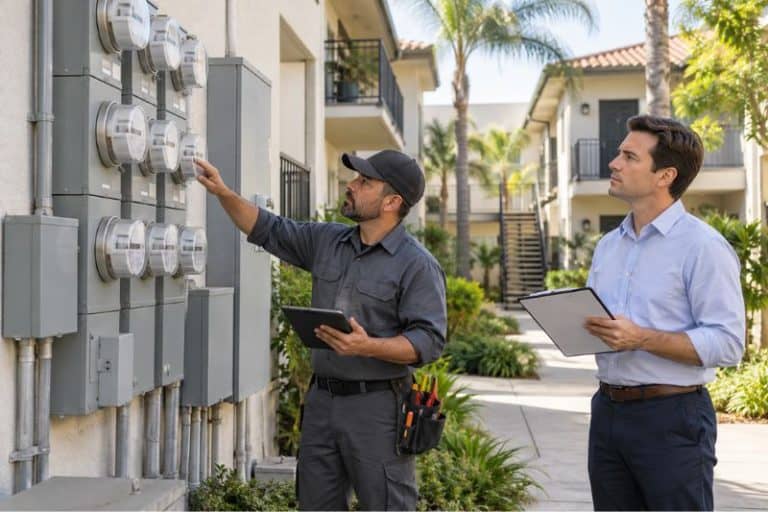
In a single-family home, the review often stops at the main panel. In an apartment building, the electrical system has layers, and insurers increasingly look at the subpanels that serve groups of units and at the common area circuits behind the scenes.
A subpanel installed in 1975 to serve four units was sized for the appliances of that decade. Today those units may carry several large appliances, a lot of electronics, and in some buildings EV chargers. The subpanel cannot tell a designed load from an overload, and an aging breaker may not trip when it should.
Common areas collect the gaps
Laundry rooms, garages, exterior lighting, hallway outlets, and mechanical rooms tend to be the least maintained parts of a building’s electrical system. Laundry-room outlets without ground-fault protection, aging garage circuits, and unlabeled panels are what an inspection report lists, and what an underwriter reads.
The conclusion
A compliant main panel does not make a compliant building. Subpanels and common areas are part of the same review.
Wiring Age and Condition
Some insurance requirements have nothing to do with the panel. For properties built before about 1960, the wiring itself can be the primary concern.
Knob and tube
Knob and tube wiring, standard from roughly the 1880s through the 1940s, runs individual conductors through ceramic knobs and tubes with no ground and no protective sheath. It was never designed for modern loads, and its insulation breaks down over time. Many carriers will not write coverage on a home with active knob and tube, and others require it to be replaced.
Aluminum branch circuit wiring
Aluminum branch wiring, used in many homes built from the mid-1960s into the early 1970s, expands and contracts differently from the copper devices it connects to. Connections can loosen, and loose connections run hot. Approved connection methods or replacement wiring are the usual fixes.
Cloth-insulated wiring
Cloth insulation from the 1940s through the 1960s dries out, turns brittle, and cracks, which exposes conductors. When an inspection report notes degraded insulation, an insurer will typically require remediation. Depending on what an inspection finds, the answer may be targeted repairs or, where the wiring is uniformly old, a rewire.
The conclusion
Wiring ages in predictable ways. If your building falls in one of these eras, ask for an assessment before the insurer does.
Why Multi-Unit Buildings Feel the Most Pressure
A panel failure in a single-family home affects one household. In an apartment building, it can affect many units, shared systems, and common areas at once. That raises the potential size of a claim and the liability behind it, which is why underwriters are less flexible with older panels in multi-unit properties.
Carriers also evaluate the whole building, not individual units. A property manager can have no tenant complaints, no tripping breakers, and no outages and still receive a requirement, because the building’s infrastructure does not meet current expectations. That surprises many managers who assume a quiet building is an acceptable one.
Why one flagged panel can lead to a building-wide review
When one panel is flagged, the review often widens. The underwriter asks about the other panels, the subpanels, the common areas, and the paper trail. In older buildings in Van Nuys, Inglewood, and Downtown LA, that tends to uncover a mix of age, capacity, and documentation questions at once. It helps to answer them together.
The conclusion
For a multi-unit owner, an insurance notice is rarely about one panel. Treat it as an invitation to review the building’s electrical record.
Ground-Fault Protection and Grounding
Ground-fault protection is one of the most commonly flagged deficiencies in apartment buildings. Outlets near water, outdoors, and in damp areas such as kitchens, bathrooms, laundry rooms, and garages are expected to be protected. Buildings from before those rules existed often have none, and in a multi-unit building the same gap repeats in every unit.
Grounding is a related but separate issue. Older systems often used two-wire circuits with no ground conductor. Replacing an outlet with a three-prong receptacle does not create a ground. It only creates the appearance of one, which is worse than an honest two-prong outlet. Correct fixes depend on the wiring and are best assessed by a licensed electrician.
The conclusion
Ground-fault protection and grounding are visible, fixable, and widely cited. They are often the least expensive items on the list to resolve.
The Documentation Insurers Ask For
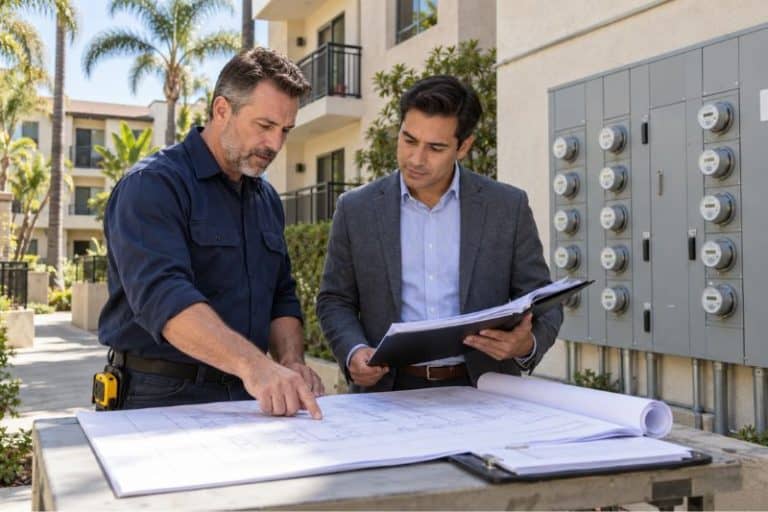
Insurers are rarely satisfied by a new panel alone. They want a record. The standard package includes the permit pulled for the work, the inspection record showing it passed, and the contractor’s license number and certificate of insurance. A closed permit shows that a city inspector reviewed the work, which an invoice alone cannot.
For commercial and multi-unit properties, a certificate of insurance from the electrical contractor is often requested as well. A licensed, insured contractor can provide it as a matter of course. An unlicensed handyman cannot.
When earlier work had no permit
Past work done without permits is a common snag at renewal. Without a closed permit, the work cannot be documented the way an underwriter expects. The path forward is usually to have a licensed electrician inspect the work, then either confirm it and document it or correct it under a new permit. Keeping a file for each property, with permits, inspection reports, invoices showing license numbers, and certificates of insurance, saves time at every renewal.
The conclusion
The upgrade fixes the hazard. The paperwork fixes the insurance problem. You need both.
Conditional Renewals and Deadlines
A conditional renewal means the insurer agrees to extend coverage if specific upgrades are completed and documented within a stated window. The window is often short, and it must cover scheduling, permits, the work, and the inspection. Exact lengths and requirements vary by carrier, so confirm yours in writing.
The risks of missing a deadline are real. A policy may not renew. Some insurers add an electrical exclusion instead, so the policy looks active but removes coverage for electrical claims. Neither is a position you want to discover after an incident. We are electricians, not insurance advisers, so ask your broker how your carrier handles these cases.
The conclusion
A deadline does not go away because it is ignored. It only becomes harder to meet.
A Quick Self-Check Before a Notice Arrives
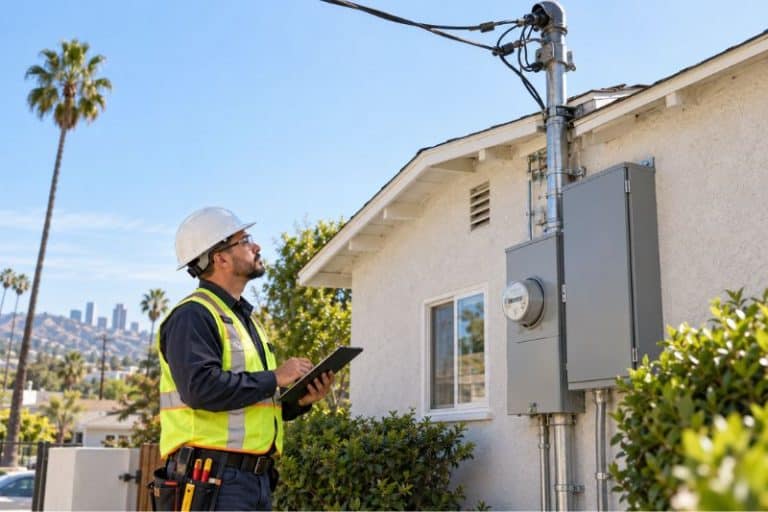
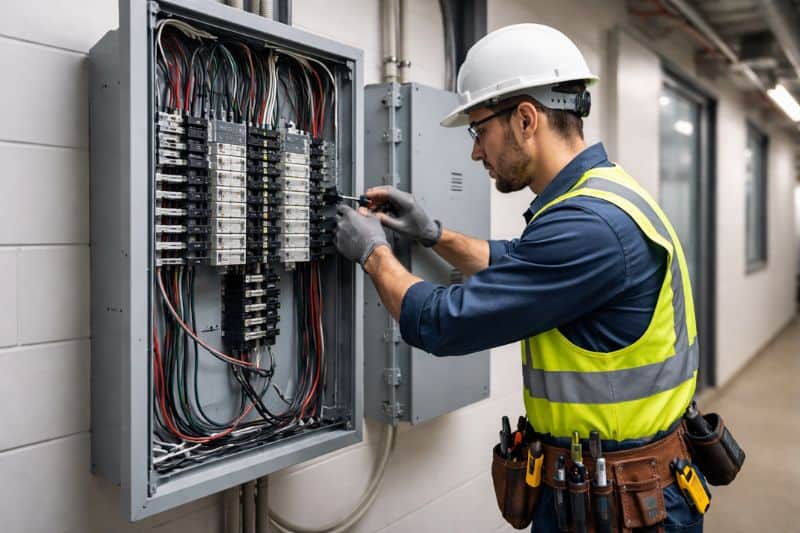
You do not need an electrician to spot the first warning signs, though you do need one to fix them. Open the panel door and read the label. Look for the four flagged brands. Note whether the panel is labeled, whether any breaker has two wires under one screw, and whether the panel feels warm or smells of burning. Walk the laundry rooms, garages, and exterior outlets and check whether they have ground-fault protection. Gather whatever permits and inspection records exist for past electrical work.
Do not open breaker enclosures or touch wiring yourself. The goal is a short list of questions for a licensed electrician, not a repair plan. A walkthrough from RG Electric turns that list into a prioritized scope, with the safety items first and the paperwork items alongside them.
The conclusion
An hour of looking now gives you a list. A list gives you a schedule, and a schedule is what an insurer wants to see.
Why Early Action Costs Less
Acting before a notice arrives gives you control of the schedule, the scope, and the tenant coordination. A planned project can be phased by building section, with shutoffs posted in advance and work done at sensible hours. A rushed one cannot.
Early action also lets you decide the order of work. In multi-unit buildings, a panel project rarely stays confined to the panel. Once it is open and inspected, double-tapped breakers, undersized wiring, and grounding gaps come into view. Our commercial electrical services are organized to deal with those findings together, so the building ends up with one coordinated scope instead of a string of surprises.
The conclusion
The same work costs less when you choose the timing. A notice takes that choice away.
What Replacement Involves
When a panel needs replacing, we pull the required LADBS permits before work begins, coordinate utility shutoffs when they are needed, and meet the inspector. We use Siemens panels for replacements. At closeout you receive the closed permit, the inspection sign-off, a labeled circuit directory, and photos of the finished work. That packet is what insurers and property records ask for. Our electrical panel services cover the evaluation, the permit, and the installation as one scope.
For multi-unit properties, we phase the schedule so shutoffs happen by building section. We post notices in advance, coordinate access with management, and work at off-peak hours when the scope calls for it.
The conclusion
A project is finished when the paperwork is finished. We deliver both.
What to Expect From RG Electric
When you call, you speak with someone on our team. A panel that trips breakers or a building that has received a notice usually starts as a service call, because a technician has to find the cause before there is anything to price, and that visit carries a fee up front. The technician reports what was found to our supervising electrician, who writes the estimate, and someone on our team then calls to walk through each line and why it is there.
An upgrade is new work, and new work gets a free estimate. We do not bill by the hour. You receive a written scope with everything necessary in it, and we stand behind our work for 12 months. If something we installed misbehaves in that window, you are already our customer, and we come back without charging another service call.
Questions Owners Ask About Insurance and Electrical Upgrades
Does my insurer have to give me a deadline?
Not always, and the terms vary by carrier and by policy. If you receive a notice, ask for the requirement in writing and confirm the deadline with your broker.
My panel works fine. Why is it a problem?
Because the concern is the design and its record, not today’s condition. A panel from a flagged brand can look normal until the failure that matters.
What paperwork should I send my insurer?
The permit, the passed inspection record, and the contractor’s license and certificate of insurance. We assemble that packet at closeout.
Can I just replace the panel myself or use a handyman?
Not if you need insurance credit. Insurers look for licensed, permitted, inspected work, and a replacement without those leaves the requirement unmet.
Will a new panel lower my premium?
We cannot promise that, and it depends on the carrier. What a documented replacement can do is satisfy a requirement, keep a policy in force, and give your broker something concrete to present.
What if I find unpermitted work?
Have a licensed electrician inspect it. It may be confirmed and documented, or corrected under a permit.
For immediate assistance or to schedule a professional evaluation, call RG Electric directly at (323) 521-5131.
Electrical work is hazardous. Always consult a licensed electrician like RG Electric before working on electrical systems.