
 Call (323) 5215131


Title 24 Lighting Compliance for Los Angeles Common Areas: LADBS Permits, Controls, and Inspection Failures
Updated October 2026
A hallway light that stays on all night, a stairwell sensor that never turns off, or a parking garage lit at full brightness at 3 a.m. can all become a correction notice when the inspector arrives. RG Electric, License C10 #910807, retrofits and corrects common area lighting for property managers and building owners across Los Angeles, from Koreatown and Downtown LA to Van Nuys and Torrance. This guide explains what Title 24 expects from lighting in shared spaces, how the LADBS permit and inspection sequence works, which mistakes fail inspections most often, and how to plan an LED upgrade that passes the first time.
What Title 24 Requires for Common Areas
Title 24 is the California Building Standards Code. Its energy provisions, found in Part 6, govern how lighting must perform, and the current cycle is the 2025 Energy Code, which took effect on January 1, 2026. For a property manager, the practical meaning is simple. Lighting in shared spaces must be efficient, must be controlled, and must be documented.
Three ideas run through the lighting requirements. First, fixtures must be efficient, which in practice means LED in nearly every common area. Second, lights must respond to the space, turning down or off when nobody is there and dimming when daylight is available. Third, the installation must be verified, meaning the controls are tested and the paperwork shows they work.
Which buildings are covered
Common areas in multi-unit buildings, such as corridors, stairwells, lobbies, laundry rooms, and garages, are generally treated under the code’s lighting provisions along with offices, retail spaces, and warehouses. Exactly which section applies depends on the type of building and the type of work, so we confirm the pathway during the design phase instead of assuming it. What you can count on is that a permitted lighting project in these spaces is reviewed against the energy code.
Conclusion
Title 24 asks three questions of every common area. Is the fixture efficient, do the controls respond to the space, and can you prove both. A building that can answer yes to all three passes.
Controls: Where Most Lighting Projects Succeed or Fail
Fixtures get the attention, but controls cause most of the trouble. Occupancy sensors, daylight sensors, and time-based controls are what turn an efficient fixture into a compliant system.
Occupancy sensing in corridors, stairwells, and garages
The 2025 code clarifies occupancy sensing requirements for corridors, stairwells, and parking areas. When a space becomes vacant, occupant sensing controls may delay shutoff by no more than 20 minutes. The older rule of thumb of a few minutes is not what the current code says, so a project designed from an old template should be checked against the current text. In a garage, lights commonly step down to a low level when no one is around and return to full brightness the moment motion is detected. Stairwells need the same logic, along with a design that keeps egress lighting reliable.
Daylight-responsive controls
Spaces with windows or skylights may need controls that reduce electric light when daylight is sufficient. The 2025 update adjusted the thresholds, and for garages the trigger is lower than for other indoor spaces. Long luminaires must be controlled in segments so one end of a run can dim while the other stays bright. A lobby in Culver City with a glass storefront is a typical example. The front fixtures should dim in the afternoon while the rear fixtures hold steady.
Dimming and manual controls
Multilevel lighting controls in indoor spaces must dim smoothly across a wide range, and manual controls must be located where the person using them can see the lights they operate. These sound like small details, but they are the details an inspector checks with a flashlight and a clipboard.
Conclusion
A fixture can be perfect and still fail because the control that goes with it is missing, misplaced, or wired around. Controls are where compliance is won.
Exterior and Parking Lighting
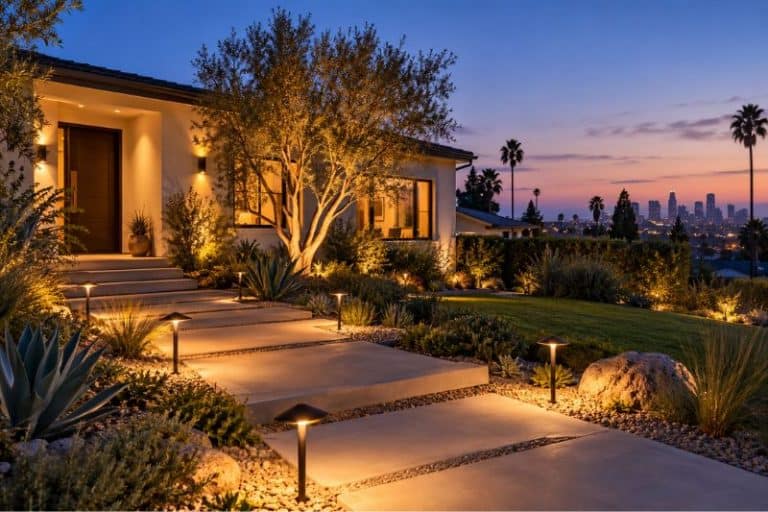
Outdoor lighting follows its own set of rules. The 2025 update broadened the motion-sensing exception to cover building facades, ornamental hardscape, and outdoor dining areas, and it clarified occupancy sensing for parking and loading areas. In practice, exterior lighting combines photocells that switch lights on at dusk with motion sensors that step them down when the area is empty.
These systems pay off beyond compliance. A walkway that brightens as someone approaches reads as attentive management, and a lot that stays dim and brightens on motion saves energy through the night. Exterior retrofits sometimes involve poles, conduit, and trenching, which raises the scope. Our indoor lighting services cover interior corridors, lobbies, and garages, and exterior work can be scoped with the same site visit.
Conclusion
Exterior lighting rewards a design that matches light to activity. The best-performing properties use less energy and feel safer at the same time.
The LADBS Permit and Inspection Sequence
Lighting work that changes fixtures, circuits, or controls in the City of Los Angeles generally requires a permit through LADBS. Replacing a lamp does not. Replacing fixtures and adding controls usually does. The permit application includes the lighting scope and the energy compliance documentation for the project.
Plan review and documentation
Before work starts, the plans show where fixtures, circuits, and control devices go. Property managers can speed this up by locating any existing as-built drawings. When they do not exist, a site walk produces what the reviewer needs. The energy compliance paperwork travels with the plans, and it describes the fixtures and the control strategy for each space.
Installation and testing
During installation, each control is tested against the approved design. Occupancy sensors are checked for coverage and time delay, daylight sensors are checked for response, and the dimming range is verified. The documentation is then completed, because the inspector will want to see both the installed work and the paper that describes it.
Final inspection
At final inspection, the LADBS inspector compares what is installed to what was approved and watches the controls operate. If something does not match, the fix is a correction and a re-inspection. The common cause is not the fixture. It is a control that was wired out of the system or a sensor mounted where it cannot see the space.
Conclusion
A clean inspection is the result of decisions made in design and in the sensor tests, not of anything that happens on inspection day.
Planning an LED Upgrade That Passes the First Time
An LED upgrade is usually the right move for common areas, and Title 24 turns it from a good idea into a design exercise. The better the plan, the less rework.
Start with an audit
Walk every common area and record the fixture type, the control type, and whether the control works. Many older Los Angeles buildings still carry fluorescent and halogen fixtures on switches or timers that no longer match how the building is used. Lights that run continuously are the first sign of non-compliance and the biggest source of wasted energy.
Choose fixtures and controls together
Fixture and control selection is one decision, not two. A fixture that dims poorly will not work with the control strategy you need, and a sensor that does not suit the ceiling height will miss people in a stairwell. We specify the two together, and for common areas we typically look at LED fixtures with integrated sensors, networked controls for larger buildings, and simple standalone sensors for small ones.
Plan for the electrical side
Lighting upgrades touch more than the fixtures. Old wiring, overloaded circuits, and undersized panels show up once the walls are open. Our commercial electrical services cover the circuit and panel work that lighting retrofits sometimes require, so you do not need a second contractor.
Rebates and incentives
Utility incentive programs for lighting exist from time to time, and amounts, eligibility, and application rules change. We do not quote a figure here. Before you commit to a budget, confirm what is currently available directly with LADWP or your utility, and ask whether the incentive requires pre-approval before installation.
Conclusion
The upgrades that go smoothly start with an honest audit and treat fixtures and controls as a single design.
Smart Lighting and Networked Controls for Larger Buildings
Smaller buildings do well with standalone sensors. Larger properties, such as a mid-rise in Downtown LA or a multi-building complex in Van Nuys, often benefit from networked controls that tie the whole system together. A networked system lets you set schedules, adjust sensor sensitivity, and see which fixtures have failed without walking every floor.
The tradeoff is complexity. Networked controls need someone to own them after installation, and they need to be commissioned so that each zone behaves as the approved plans describe. We set the system up, test each zone, and leave your staff with a plain written summary of how to change settings without breaking compliance. If nobody on your team wants to manage a control system, a simpler design with standalone sensors may serve you better, and we will say so.
Conclusion
Smart controls are worth it when someone will use them. Otherwise, the simplest compliant design is usually the best one.
Why Compliance Pays Off After the Inspection
Passing inspection is the minimum. The more lasting benefit is operational. Lights that run only when needed burn fewer hours, which stretches the life of the fixtures and cuts the number of lamp-change calls. Tenants notice corridors that are bright when they walk through and stairwells that never go dark unexpectedly.
There is also a documentation benefit. A building with permits, drawings, and test results on file answers questions from insurers, lenders, and prospective buyers quickly. Property managers in Inglewood, Encino, and Koreatown tell us the paper trail matters most when ownership changes or an insurer asks about the building’s electrical condition. We do not promise a savings figure, because it depends on how many hours the lights ran before and what they cost to run. A before and after comparison from your own utility bills is the honest measure.
Conclusion
Compliance is the price of admission. The return comes from lower maintenance, fewer complaints, and a record you can hand to anyone who asks.
What a Lighting Walkthrough Looks Like
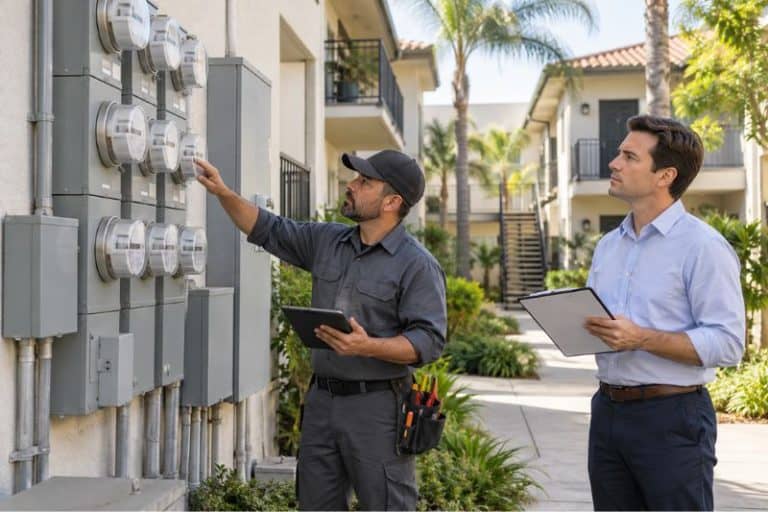
Our first visit to a building follows the same pattern each time. We walk every common area with a notepad and a photo log. For each space, we record the fixture, the control, and whether the control works. We note which circuits feed which lights and whether they are shared with outlets or equipment.
Back at the office, the technician reports what was found to our supervising electrician, who builds the scope and the estimate. You receive a room by room summary showing what passes today, what needs correcting, and what a retrofit would involve. Having it in writing means you can share it with an owner or board before anyone commits to a project.
Conclusion
A walkthrough turns a vague worry about compliance into a list with an order of priority.
Mistakes That Fail Inspection
Most failed lighting inspections come from a short list of causes, and nearly all of them are preventable.
Controls bypassed or missing
The most frequent failure is a fixture wired to constant power, bypassing the control system. It wastes energy, and it violates the control requirements. A missing sensor in a corridor or a stairwell is the second most common.
Wrong fixtures or mismatched wattage
Fixtures that look efficient may not meet the efficacy requirement, and a retrofit on an older circuit can create wattage and loading problems. These are caught at design when the contractor specifies carefully.
Incomplete paperwork
Missing cut sheets, missing compliance forms, and missing test records slow down approval even when the installation is correct. Keep permits, drawings, and test results together in one file for the building.
Unpermitted or unlicensed work
Unpermitted lighting work can leave a building with no record that it complies, and an unlicensed installer may have no way to produce the documentation. Fixing it afterward often means opening ceilings and redoing the work.
Conclusion
Every item on this list is visible in advance. A walkthrough before the inspection finds them while they are still cheap to fix.
What to Expect From RG Electric
When you call, you speak with someone on our team. A lighting problem that starts as a symptom, such as flickering, sensors that will not respond, or fixtures that stay on, usually begins as a service call, because a technician has to find the cause before there is anything to price. That visit carries a fee up front. The technician reports what was found to our supervising electrician, who writes the estimate, and someone on our team then calls to walk through each line and why it is there.
A full common area retrofit is new work, and new work gets a free estimate. We do not bill by the hour. You receive a written scope with everything necessary in it. We handle the permit, coordinate the inspection, and stand behind our work for 12 months. If something we installed misbehaves in that window, you are already our customer, and we come back without charging another service call.
Questions Property Managers Ask About Title 24 Lighting
Do I need a permit to replace common area fixtures?
Usually yes when you replace fixtures or add controls, and usually no when you only swap lamps. Tell us what you plan to change and we will tell you which side of the line it falls on.
How long can a sensor wait before turning lights off?
Under the current energy code, occupant sensing controls can delay shutoff by no more than 20 minutes. Many projects use a shorter delay to save more energy.
Can I keep my existing fluorescent fixtures?
Existing fixtures that are not being altered may remain, but a permitted retrofit is reviewed against the current code. In most cases, replacing them with LED and adding controls is both the compliant and the economical path.
Will an upgrade help with insurance or tenant complaints?
Reliable, well-lit corridors and stairwells reduce complaints, and documented, inspected work gives you a record to show an insurer. We cannot promise any premium change.
Does my stairwell need to stay lit all night?
Stairwells are an egress route, so the design has to keep them safe to use at all hours. Most compliant designs hold a low light level and raise it when someone enters. We design that balance with the sensor and the fixture together.
What happens if my building fails inspection?
We correct the item that failed and schedule a re-inspection. It is a fix, not a restart.
For immediate assistance or to schedule a professional evaluation, call RG Electric directly at (323) 521-5131.
Electrical work is hazardous. Always consult a licensed electrician like RG Electric before working on electrical systems.