
 Call (323) 5215131
Why Electrical Panel Labeling Matters for Los Angeles Apartment Buildings
Updated July 2026
An unlabeled electrical panel is not a minor administrative oversight. In a Los Angeles apartment building, it is a safety hazard, a compliance liability, and a problem that surfaces at exactly the wrong moment: during an emergency, an insurance inspection, or an LADBS review. RG Electric is a licensed C10 electrical contractor, License #910807, serving multi-unit properties and commercial buildings across Los Angeles County. We handle panel labeling as part of every panel replacement, subpanel upgrade, and building assessment we perform, because a correctly labeled panel is the foundation of a building’s electrical documentation and the starting point for any future work.
What panel labeling actually requires under California code
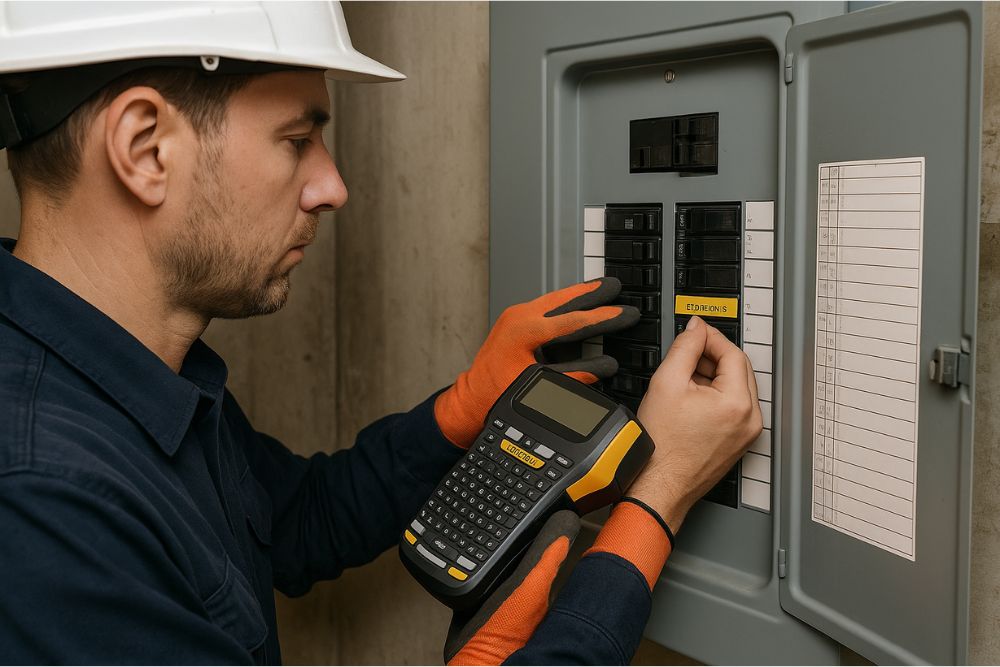
The National Electrical Code, adopted and amended by California, requires that every circuit in a panel be legibly identified as to its clear, evident, and specific purpose or use. That requirement is not satisfied by a list of numbers, a set of labels that read “breaker 1” through “breaker 20,” or a directory that was accurate when the building was constructed forty years ago but has not been updated since.
A code-compliant circuit directory identifies each breaker by the specific load or location it serves: Unit 4 kitchen, laundry room outlets, exterior north parking, pool pump, HVAC compressor. The identification must be permanent, legible, and located on or inside the panel cover. When a circuit has been modified, extended, or rerouted since the original installation, the directory must reflect the current condition of the circuit, not the original design.
In multi-unit buildings, the requirement extends to subpanels as well. Each subpanel must be labeled to identify the area it serves, and the circuits within each subpanel must be identified the same way as in the main panel. A building with a main panel and four subpanels has five panel directories to maintain. In many older Los Angeles apartment buildings, none of them are current.
LADBS inspectors enforce the labeling requirement during permit inspections. When a panel is opened during a permitted project, the inspector reviews the directory. An unlabeled or inaccurate directory is a deficiency that can delay final approval and require a corrected directory before the permit closes. Property managers who have deferred labeling corrections will encounter them at the worst possible time, which is during a project they need to close quickly.
Why unlabeled panels create problems during emergencies
The practical consequence of unlabeled panels becomes visible the moment something goes wrong in a building. A tenant reports that power is out in their bathroom. Maintenance staff goes to the panel. None of the breakers are labeled, or the labels say things like “upstairs” and “downstairs” without identifying which unit or which circuit. The staff begins tripping breakers one at a time to find the right one, interrupting power to other units in the process. By the time the correct breaker is located, the incident has affected multiple tenants and taken far longer than it should have.
In a more serious emergency, the consequences are worse. A fire department responding to a reported electrical odor needs to de-energize specific circuits quickly. An unlabeled panel forces responders to either de-energize the entire building or spend time they do not have trying to determine which breaker serves which area. Neither outcome is acceptable, and the property manager bears responsibility for the condition of the panel that created the delay.
Tenant safety incidents connected to electrical systems also carry documentation implications. When a tenant files a complaint or a claim related to an electrical problem in their unit, the property manager’s response is examined. A panel directory that cannot identify the circuit serving the unit in question, or that has not been updated since the building was originally constructed, signals to an insurer or an attorney that the electrical system has not been properly maintained. That signal is worth taking seriously before an incident occurs rather than after.
How labeling connects to inspection readiness and insurance compliance
Insurance carriers conducting underwriting inspections of multi-unit buildings in Los Angeles are looking at panel condition as part of their review. A panel that is unlabeled or inaccurately labeled is a documentation deficiency that some carriers treat as a maintenance failure. In the current California insurance environment, where carriers are applying stricter criteria and some have withdrawn from the market entirely, a maintenance deficiency noted during an inspection can become a condition on renewal or a factor in a coverage decision.
The connection between labeling and insurance compliance is not just about the label itself. It is about what the label represents. A property manager who can produce a current, accurate circuit directory for every panel in the building is demonstrating that the electrical system is known, documented, and maintained. A property manager who cannot is demonstrating the opposite. In an underwriting context, those two positions are materially different.
For properties that have undergone panel replacements, subpanel upgrades, or tenant improvement work in recent years, the circuit directory should have been updated as part of that work. When it was not, the existing directory is unreliable and potentially misleading. A directory that shows circuits as they were configured before a renovation but does not reflect what was added or changed during the renovation is worse than no directory at all, because it creates false confidence in information that is incorrect.
Our commercial electrical services in Los Angeles include panel documentation as a standard component of every project closeout. When we replace a panel or perform work that affects circuit configuration, the directory we deliver at closeout reflects the actual current state of every circuit in that panel.
What property managers should verify in their buildings right now
A property manager who wants to assess their building’s panel labeling status without scheduling a full electrical assessment can start with a few direct questions. First, does every panel in the building have a circuit directory on or inside the panel cover? Second, does the directory identify each circuit by the specific location or load it serves, not just by number? Third, has the directory been updated to reflect any work done on the electrical system since the building was originally constructed or since the panel was last replaced?
If the answer to any of those questions is no, the building has a labeling deficiency that should be corrected before the next inspection or insurance renewal, not after. The correction is not a major project on its own, but it becomes more complicated when it is part of a reactive response to an inspection finding rather than a planned maintenance task.
For buildings in Van Nuys, Sherman Oaks, Inglewood, and other parts of Los Angeles where the housing stock includes a significant proportion of buildings constructed in the 1960s and 1970s, the labeling situation is frequently one where the original directory is either missing, illegible, or reflects a circuit configuration that no longer exists. Tenant improvements, unit renovations, and common area upgrades over the decades have added and modified circuits without corresponding updates to the directory. The result is a panel that cannot reliably be identified without tracing each circuit individually.
Common labeling mistakes RG Electric finds in older Los Angeles buildings
The most common labeling deficiency we find in older multi-unit buildings is a directory that identifies circuits by unit number without specifying what within the unit the circuit serves. A label that reads “Unit 3” tells a maintenance technician which tenant is affected but not whether the circuit serves the kitchen, the bathroom, the bedroom outlets, or the HVAC equipment. In a unit with multiple circuits, that distinction matters.
Double-tapped breakers present a labeling problem that goes beyond the directory. A double-tapped breaker, where two conductors are connected to a single breaker terminal, serves two separate circuits from one breaker slot. The directory may show only one of those circuits, or may show neither, because the condition was created after the original installation and was never formally documented. When an inspector finds a double-tapped breaker, the labeling deficiency is secondary to the code violation, but both need to be corrected.
In buildings where subpanels have been added over the years to serve additions or outbuildings, the main panel directory frequently does not identify the breaker feeding each subpanel correctly. A breaker labeled “garage” may actually feed a subpanel that serves the garage, the laundry room, and two exterior circuits. The main panel directory should identify it as feeding a subpanel and the subpanel directory should identify each of its circuits.
Handwritten directories that have been updated multiple times over the years are often illegible or contain corrections layered over previous entries that make it impossible to determine which notation is current. A directory that cannot be read is not a directory. When we find these conditions, we trace each circuit and produce a new directory that reflects the actual current state of the panel.
How RG Electric handles panel labeling as part of larger projects
Panel labeling is rarely a standalone project. In most cases it is addressed as part of a panel replacement, a subpanel upgrade, a building assessment, or a permitted renovation that requires an inspector to review the panel. When we perform any of those projects, the circuit directory is updated as part of the scope, not treated as an afterthought.
For buildings where the labeling situation is unclear and a full assessment has not been performed recently, we can conduct a panel review that traces each circuit, identifies any conditions that affect the accuracy of the directory, and produces a corrected directory for each panel. That review can be conducted as a standalone project or as part of a broader electrical safety assessment.
Property managers who are preparing for an insurance renewal inspection, planning a capital improvement project, or responding to a prior inspection finding that identified labeling deficiencies benefit from addressing the directory before those events rather than during them. The correction is straightforward when it is planned. It is disruptive when it is required on a deadline imposed by an inspector or a carrier.
Our electrical panel services in Los Angeles cover the full range of panel work that affects labeling: panel replacements, subpanel upgrades, double-tap corrections, and circuit additions. In every case, the directory delivered at project closeout is accurate, legible, and compliant with the current code requirement.
Why labeling should be part of every capital improvement conversation
Property managers who are planning panel replacements, subpanel upgrades, or any permitted electrical work in the coming year have an opportunity to address labeling as part of that project at no additional disruption cost. The panels will already be open, the circuits will already be traced, and the inspector will already be reviewing the directory. Producing an accurate directory under those conditions is straightforward. Producing one as a separate remediation project, after a panel replacement that did not include it, requires reopening the panel and retracing work that was already done.
The same logic applies to buildings that are being prepared for sale or refinancing. A lender or buyer conducting due diligence on a multi-unit building in Encino, Torrance, or Koreatown will review the electrical system as part of their inspection. A building with current, accurate panel directories across all panels presents differently than one where the directories are missing or inaccurate. The first signals a well-maintained building. The second signals deferred maintenance and invites further scrutiny.
For portfolio property managers overseeing multiple buildings across Los Angeles, a systematic labeling review conducted building by building over a defined period creates a documented baseline that is useful for insurance renewals, lender reviews, and internal capital planning. Once the baseline exists and is accurate, maintaining it requires only that new work is documented correctly at project closeout, which is a standard part of how we close every permitted job. That discipline, applied consistently across a portfolio, eliminates the labeling problem as a recurring finding.
Scheduling and what to expect
Panel labeling corrections as part of a larger project are included in the project scope and do not require separate scheduling. For buildings where a standalone panel review and directory update is the goal, the process begins with a site visit to assess the number of panels, the current state of each directory, and what tracing will be required to produce an accurate updated directory.
Access to all panels is required during the review. For multi-unit buildings, that means coordinating with tenants where unit-level panels are involved, and ensuring that meter rooms, electrical closets, and utility spaces are accessible. We work with property managers to schedule access in a way that minimizes tenant disruption and fits the building’s operational requirements.
All work is estimated with full itemization before any work begins. There are no hidden fees and no work performed without written agreement on scope and price. Our 12-month workmanship guarantee covers all completed work. Property managers who need documentation of completed labeling work for insurance or compliance purposes receive a written record of what was assessed, what was corrected, and the current state of each panel directory at project closeout.
For immediate assistance or to schedule a professional evaluation, call RG Electric directly at (323) 521-5131.