
 Call (323) 5215131
The Hidden Cost of Deferred Electrical Maintenance in Los Angeles Apartment Complexes
Property managers in Los Angeles make constant decisions about what gets fixed now and what can wait. Plumbing leaks get addressed because tenants complain immediately. Electrical problems often don’t, because a panel running near capacity, wiring insulation that’s become brittle over decades, or breakers that are slower to trip than they should be don’t produce obvious symptoms until they fail. That invisibility is what makes deferred electrical maintenance one of the most expensive decisions a property manager can make. By the time the problem surfaces, it’s no longer a maintenance issue. It’s a crisis. RG Electric holds California C10 License #910807 and works with property managers throughout Los Angeles on exactly the kind of proactive assessment and planning that keeps deferred maintenance from becoming a building emergency. This article explains what deferred electrical maintenance actually costs, why it compounds over time, and what the proactive alternative looks like.
Why Electrical Systems Are Easy to Overlook
Unlike a dripping faucet or a broken window, electrical problems stay hidden until they escalate. Wiring runs behind walls. Panels sit in utility rooms that tenants rarely enter. Outlets and switches may appear to function normally even when the connections behind them are overloaded or deteriorating. This invisibility creates a false sense that the system is fine, and in property management, what doesn’t generate a tenant complaint tends not to generate a work order either.
The problem is that every year of deferred maintenance increases the probability of a failure that doesn’t give warning. An overloaded circuit that trips a breaker occasionally becomes an overloaded circuit that doesn’t trip the breaker at all when the breaker itself ages and loses responsiveness. Wiring insulation that’s slightly brittle becomes wiring insulation that cracks under load and creates an arcing condition behind the wall. A panel running at 80 percent capacity with a 1970s brand known for breaker reliability problems becomes a panel that fails during peak summer demand and takes the building offline on a Saturday night.
Budget pressure is a real factor. When resources are limited, visible repairs generate immediate complaints and immediate pressure to act. Electrical risk is silent. The result is that electrical systems in older Los Angeles apartment buildings frequently go years or decades without meaningful assessment, accumulating deficiencies that individually seem manageable but collectively represent serious exposure.
The Four Recalled Panel Brands Still in Los Angeles Buildings
Los Angeles has thousands of multi-unit buildings constructed between the 1950s and the 1980s, and a significant number of them still have electrical panels from four brands that are no longer considered safe: Zinsco, Federal Pacific Electric, Challenger, and Pushmatic. These panels appear throughout the city’s older housing stock, and their deficiencies are well documented. The shared problem is that the breakers in these panels cannot be relied upon to trip when they should.
Zinsco panels have a known failure mode in which breakers can fuse to the aluminum busbar, preventing them from tripping under overload. Federal Pacific panels, sold under the Stab-Lok name, have breakers that fail to trip at rates far above what code permits. Challenger and Pushmatic panels have their own reliability issues that make sustained trust in their breaker mechanisms unreasonable. In all four cases, the breaker that fails to trip turns an overload condition into a sustained heat event inside the wall, which is how electrical fires start.
Because these panels often continue to function in the sense that lights stay on and circuits carry current, property managers defer replacement. The panel appears to be working. Tenants aren’t complaining about it specifically. And a panel replacement is a significant line item. The deferred decision seems defensible until the panel fails in a way that makes the cost of not replacing it obvious. Insurance carriers in California have reached their own conclusion about these panels and are increasingly requiring replacement as a condition of coverage renewal. Property managers who still have one of these panels in their building are carrying risk that the market has already priced.
What Deferred Maintenance Actually Costs
The financial consequences of deferred electrical maintenance consistently exceed the cost of the maintenance that was deferred. The gap isn’t marginal. It’s often an order of magnitude.
Emergency repair calls carry a premium that scheduled maintenance doesn’t. A panel failure that takes a building offline on a weekend requires emergency response, temporary power arrangements, expedited permitting, and tenant coordination on a timeline that has no flexibility. A planned panel replacement on a scheduled weekday, with tenants notified in advance and permits pulled ahead of time, is a fraction of that cost. RG Electric responded to a 20-unit apartment building in North Hollywood where a failed main breaker in a Federal Pacific panel left half the tenants without power. The estimated cost to replace that panel during a planned upgrade had been around $5,000. The actual cost after emergency service, temporary power, expedited permits, and tenant coordination came to $35,000. The property manager described it as the most expensive decision of the year, and the decision had been made years earlier when the planned upgrade was postponed.
Insurance complications compound the direct repair costs. Outdated panels, ungrounded systems, and unpermitted work can void policies, trigger denied claims, and result in coverage non-renewal. A building in West LA where we found scorched wiring behind dryer circuits, the result of breakers that had stopped responding to overload, had been experiencing the problem for months without the property manager’s knowledge. A routine inspection years earlier would have identified the overloading before any damage occurred. By the time we arrived, the claim situation was complicated by the condition of the panel, which the insurer identified as a contributing factor.
Failed inspections create their own cost category. Los Angeles building inspectors reviewing permitted work are not limited to the scope of the permit. An inspector who opens a panel during a permitted upgrade and finds conditions that don’t meet current code can require corrections before approving the permitted work, regardless of whether those conditions were part of the original scope. A building that has deferred electrical maintenance for years may face a much larger correction bill than anticipated when any permitted work triggers a broader inspection.
Tenant turnover and vacancy have a cost that’s harder to quantify but real. Tenants who experience repeated outages, delayed responses to electrical complaints, or safety concerns don’t renew leases. In a competitive rental market, a building with a reputation for electrical problems loses tenants to better-managed properties. Vacancy rates rise, and rental income drops. When the building is eventually listed for sale, buyers factor in the cost of a full electrical overhaul and discount their offers accordingly.
How Deferred Maintenance Affects Insurance Renewals
California’s insurance market has made the connection between electrical condition and coverage eligibility explicit in ways it hadn’t previously. Carriers who once renewed policies with minimal electrical scrutiny are now requiring documentation of panel age and brand, evidence of permitted upgrades, and in some cases licensed electrical inspections as conditions of renewal. The Pacific Palisades fire and the broader wildfire liability environment have accelerated requirements that were already moving in this direction.
For property managers, this creates a practical problem. A building that has deferred electrical maintenance and cannot produce documentation of permitted upgrades and inspection approvals is in a weak position at renewal. The carrier may require corrections on a short timeline that eliminates the ability to plan and budget the work properly. Emergency compliance under an insurance deadline is exactly the situation where costs escalate and options narrow. The property manager who scheduled the work proactively, on their own timeline, with permits and documentation, is in a categorically different position than the one responding to a renewal ultimatum.
Property value follows the same logic. Two similar apartment buildings in the San Fernando Valley, one with a documented history of electrical upgrades and permitted work, and one with a decades-old panel and no inspection record, will appraise differently and attract different buyers at different price points. The electrical system is infrastructure. Buyers and lenders evaluate it accordingly, and the building that has maintained it carries less risk and commands a premium that reflects that.
Why Los Angeles Buildings Face Compounding Pressure
The problem of deferred electrical maintenance is more acute in Los Angeles than in many other cities because of the specific characteristics of the building stock and the direction of policy and energy demand. Buildings constructed between the 1950s and the 1980s were wired for the load patterns of their era. Most apartments were designed for basic lighting, a few small appliances, and low-capacity kitchen equipment. The electrical demand of a typical Los Angeles apartment today, with multiple devices drawing continuous power, modern HVAC systems, and increasingly EV chargers, is categorically different from what those systems were designed to handle.
California’s push toward electrification adds a forward-looking dimension to the problem. Tenants increasingly expect EV charging infrastructure. Energy-intensive HVAC systems are becoming the standard as summers grow hotter. Buildings that haven’t kept their electrical infrastructure current are going to face larger and more disruptive upgrades as these demands increase, and the cost of retrofitting a building that has deferred maintenance for decades is significantly higher than the cost of keeping pace with incremental upgrades along the way.
Code evolution adds a third layer. Requirements for GFCI protection, arc-fault circuit interrupters, updated load calculations, and grounding standards have all changed significantly since most of these buildings were wired. Catching up from a large accumulated deficit is harder, more expensive, and more disruptive to tenants than addressing code requirements as they arise. The longer the deferral, the larger the gap between where the building is and where current code requires it to be.
What Proactive Electrical Management Looks Like
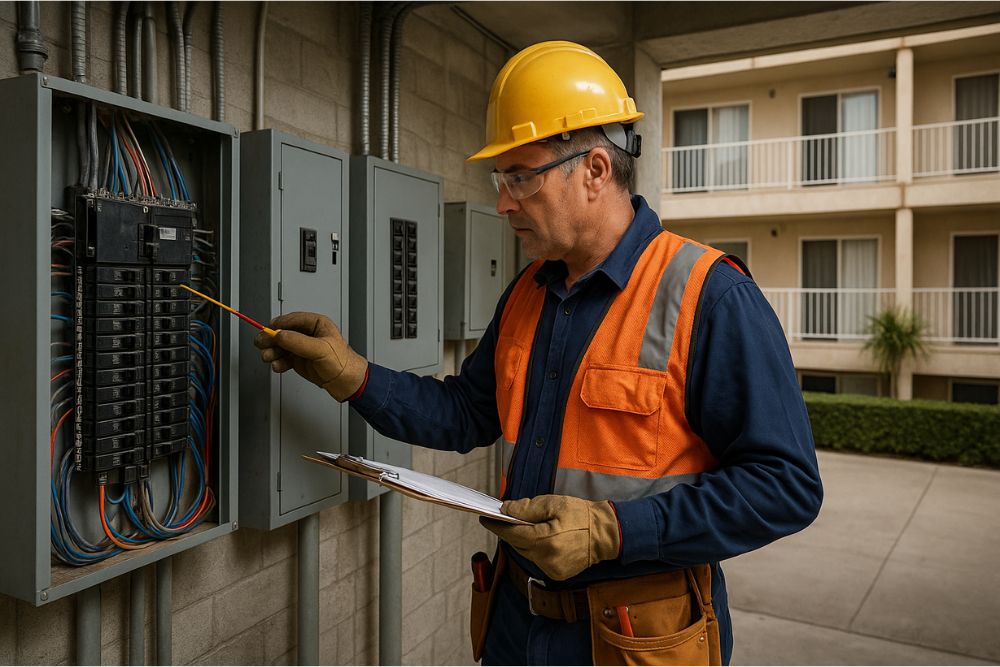
Proactive electrical management for a Los Angeles apartment building starts with knowing what the building actually has, not assuming it’s probably fine because nothing has visibly failed yet. A licensed assessment covering the full panel inventory, the condition of branch circuit wiring, the status of grounding systems, and the presence of any of the four recalled panel brands gives the property manager a factual baseline rather than an assumption that everything is probably fine. That assessment produces a prioritized list of conditions, not a single repair order, so the property manager can sequence the work in a way that addresses the most urgent items first and plans the rest within a manageable budget cycle.
Recalled panels are the first priority on that list, every time. They should be addressed before the insurer requires it, before a permitted upgrade triggers an inspection that surfaces them, and before the failure mode they’re known for produces a real event. The panel replacement, done on a planned schedule with permits and proper inspection, is a defined cost with a defined outcome. The same replacement done under emergency conditions, or after an incident, is a much larger cost with legal and insurance dimensions that the planned version avoids entirely.
Beyond panels, proactive management means keeping pace with GFCI requirements in wet locations, maintaining documentation of permitted work for insurance and sale purposes, and planning for the load increases that EV chargers and modern HVAC systems will place on the building’s electrical infrastructure. It also means treating the documentation of completed work as an asset rather than an afterthought. Permit records, inspection approvals, and contractor COIs create a paper trail that has direct value during insurance renewals, refinancing, and sales. Buildings that approach these questions proactively have more options, better pricing, and more control over timing than buildings that wait for a triggering event to force the issue.
Our commercial electrical services in Los Angeles are built around the specific requirements of multi-unit buildings, from panel assessments and replacements to code corrections, permitted upgrades, and the documentation that insurance carriers and building departments require. For buildings where the panel condition is the most pressing issue, our electrical panel services in Los Angeles cover the full process from evaluation through permitted installation and inspection approval.
For immediate assistance or to schedule a professional evaluation, call RG Electric directly at (323) 521-5131.