
 Call (323) 5215131

Does My Older Los Angeles Home Need Arc-Fault (AFCI) Breakers Under California Code?
Updated October 2026
The question usually arrives with a trigger: a home inspector’s note during a sale, an electrician warning that a kitchen remodel will bring new breaker requirements, or a bedroom breaker that keeps tripping. The short answer is that California code requires arc-fault protection on new and modified circuits in most living areas of a house, but it does not force you to retrofit every old circuit you have never touched. The details decide which side of that line your home falls on. RG Electric is a licensed C10 #910807 electrical contractor serving homeowners from Encino and Sherman Oaks to Culver City, Inglewood, and Torrance, and this guide explains what the rule says, how it applies to older houses, and what to expect from the permit and inspection.
What AFCI Protection Is and What It Catches
A standard breaker protects against two things: a circuit drawing too much current for too long, and a dead short. It does nothing about the small, intermittent electrical arcs that happen when insulation cracks, a connection works loose, or a nail or staple nicks a cable behind a wall. Those arcs can be hot enough to ignite framing and insulation while the current stays well below what a standard breaker would ever trip on.
An arc-fault circuit interrupter watches the electrical waveform on a circuit and shuts it off when it recognizes the signature of a hazardous arc. It is built to tell the difference between a dangerous arc and the harmless sparking a vacuum motor or a light switch produces, which is why a quality AFCI does not trip every time you run an appliance.
Why older houses are where AFCI matters most
Arcing is a function of aging wiring and loose connections, and a Los Angeles house built in the 1950s or 1960s has had decades of heat cycling, remodels, and amateur additions. The wire behind the walls of a Van Nuys ranch house or a Koreatown fourplex has been through more than any code book contemplated when it went in. The cause is aging insulation and loosened terminations, the effect is intermittent arcing out of sight, and the consequence is a fire that starts inside a wall cavity before anyone smells smoke.
Put plainly, AFCI protection targets the failure mode that older wiring is most likely to produce.
What California Code Requires in Dwellings
California adopts the National Electrical Code with state amendments. The 2025 California Electrical Code, based on the 2023 National Electrical Code, took effect statewide on January 1, 2026, and local jurisdictions can add their own amendments on top of it. The AFCI rule sits in Section 210.12.
The areas that must be protected
For dwelling units, Section 210.12 requires AFCI protection on 120-volt, single-phase, 15 and 20 amp branch circuits supplying outlets or devices in kitchens, family rooms, dining rooms, living rooms, parlors, libraries, dens, bedrooms, sunrooms, recreation rooms, closets, hallways, laundry areas, and similar rooms or areas. In practical terms, that covers nearly every habitable space in the house.
The requirement began in bedrooms in the early 2000s and has widened with each code cycle since. That is why the answer depends on when a circuit was installed or last altered: a bedroom circuit from 1998 was built under a code that had no AFCI rule at all.
How the protection is provided
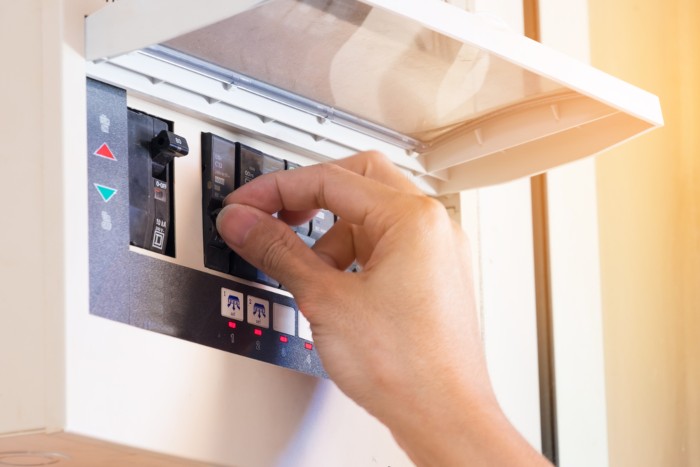
The most common method is a combination-type AFCI breaker in the panel, which protects the whole circuit from the panel to every outlet downstream. The code also recognizes a listed outlet branch-circuit AFCI device installed at the first outlet on a circuit, though it has installation conditions on the cable between the panel and that outlet. In kitchens and laundry areas, where GFCI protection is also needed, a dual-function AFCI/GFCI breaker handles both in one device. At RG Electric we install Siemens panels, and when a circuit needs AFCI protection we match a Siemens combination-type breaker to that panel instead of mixing brands.
So the code is broad about where AFCI belongs and flexible about how it gets there.
What That Means for an Older Los Angeles Home
Here is the part that surprises most homeowners. The code text does not tell you to rip out and replace every standard breaker in a house that was wired before AFCI existed. Section 210.12 is triggered by what is done to a circuit, not by the age of the house alone.
What triggers the requirement
AFCI protection is required when new branch circuits are installed, and when existing branch-circuit wiring in the listed areas is modified, replaced, or extended. Adding a new bedroom circuit, running a new line for a remodeled kitchen, or extending a hallway circuit to feed new outlets all bring the circuit under today’s rule. There is a narrow exception for extending an existing circuit a short distance, up to 6 feet, without adding outlets or devices. Beyond that, the circuit needs protection.
What does not trigger it
A house whose circuits have not been touched is generally not required by the code text to be retrofitted just because the rule exists now. If your panel and branch circuits are as the builder left them and you are not changing them, nothing in Section 210.12 compels an upgrade on its own.
The three situations where it still comes up
Even where the code does not require retrofitting, three real-world situations bring AFCI back into the conversation:
A sale: A buyer’s inspector will often note the absence of arc-fault protection, and buyers sometimes ask for it as a credit or a repair. That is a negotiation, not a code violation, but it is one that Los Angeles sellers regularly face.
An insurer: Underwriters increasingly ask about the electrical system. Documented modern protection can help, and a panel with no arc-fault capability can raise questions.
A remodel: This is the most common trigger. The moment a permit is pulled for work in a kitchen, bedroom, or laundry area, the circuits being touched have to meet today’s rule.
Age alone rarely forces an upgrade. Your plans for the house usually do.
When the Rule Applies: Remodels, Added Circuits, and Replaced Outlets
A kitchen remodel in a 1960s Sherman Oaks house is a typical example. New counter circuits, new lighting, and a relocated range outlet are all new or modified branch circuits in a listed area. Each one needs AFCI protection, and because kitchens also need GFCI protection at counter receptacles, dual-function breakers are common here. The remodeler who budgets for new cabinets and counters and not for the breakers that go with the electrical work is the one who discovers the cost at inspection.
Panels and AFCI together
When a panel is replaced, the question of which existing circuits come under AFCI rules is one that inspectors can read differently, depending on how much of the circuit wiring is being altered. Rather than guess, we confirm the approach with LADBS when the permit is pulled, so there are no surprises at inspection. Our circuit breaker services cover choosing and installing the right breaker type for each circuit as part of that work.
Replacement outlets
Swapping a worn receptacle on a circuit that falls under the AFCI rule can also carry requirements about the type of device used. This is a detail that varies with the circuit and the code cycle, and it is one reason a quick outlet replacement is not always as quick as it sounds on a permitted job.
Change more of a circuit, and you inherit more of today’s rule.
Permits and Inspections Through LADBS
In the City of Los Angeles, electrical work like adding circuits, replacing a panel, or running new wiring is permitted through the Los Angeles Department of Building and Safety. The permit is pulled before the work, the inspector reviews the finished installation, and the AFCI protection is one of the items looked at, along with breaker sizing, labeling, grounding, and bonding.
Not every address answers to LADBS
LADBS covers the City of Los Angeles only. Beverly Hills, Santa Monica, Culver City, Inglewood, and Torrance each run their own building departments. The AFCI rule in the state code is the same, but the permit process and the inspector are local. We pull the permit in the correct jurisdiction for your address.
What the inspector sees
An inspector typically checks that each circuit that needs AFCI protection has it, that the breakers are the correct type for the panel they sit in, and that the panel directory is accurate. A circuit that trips the AFCI the moment the inspector tests it is a sign of a wiring problem behind the wall, and that is a correction before approval.
What you end up with is a paper trail, and it answers the questions buyers, lenders, and insurers eventually ask.
Why an AFCI Breaker Trips, and What It Means
New AFCI breakers in an old house sometimes trip repeatedly, and homeowners blame the breaker. More often, the breaker is reporting something real that a standard breaker could not see.
Shared neutrals and loose connections
Older homes often have circuits that share a neutral conductor between two breakers, and an AFCI needs its own dedicated neutral. A shared neutral will make it trip. So will a loose connection at an outlet, a nicked conductor, or damaged insulation, all of which are arc sources.
Appliances and electronics
Certain motors and electronics can occasionally cause nuisance trips. The way to tell is to unplug everything on the circuit, reset, and plug devices back in one at a time. If the breaker holds with the circuit empty and trips when one device returns, you have found your cause.
When tripping means call an electrician
If the breaker trips with nothing plugged in, the problem is in the wiring, and that is exactly what the AFCI was meant to find. This is a service call, not a do-it-yourself fix. Our wiring services include tracing the circuit, locating the fault, and repairing it so the protection can do its job quietly.
A tripping AFCI is information. The fix is usually in the wiring, not the breaker.
What AFCI Protection Costs You, and What It Prevents
AFCI breakers cost more than standard breakers, and the price of a project goes up with the number of circuits that need them. We do not quote numbers in an article, because the right number depends on the panel, the circuits, and the condition of the wiring. What we can tell you is how the cost is shaped: the count of protected circuits, whether the panel has room, and whether the wiring needs correction before the breakers will hold.
The other side of that ledger is what the protection is for. An arc inside a wall is a fire you cannot see, and the homeowner’s cost of that fire dwarfs the cost of breakers. For many homeowners, the clear answer comes down to what they are already planning. If a remodel, a panel replacement, or a sale is on the horizon, adding AFCI protection is usually the right call and often a required one.
What to Expect From RG Electric
When you call (323) 521-5131, you reach someone on our team. If the issue is a symptom, like a breaker that keeps tripping, the first step is a service call, which carries a fee up front, because a technician has to find the cause before there is anything to price. The technician reports what was found to our supervising electrician, who writes the estimate, and someone on our team then calls to walk through each line.
Adding AFCI protection to circuits you already know you want upgraded is new work, and new work gets a free estimate. We do not bill by the hour. You see the scope and the price in writing before we start, and we stand behind our work for 12 months.
Questions Homeowners Ask About AFCI
What is the difference between an AFCI and a GFCI?
They protect against different things. A GFCI guards people against electric shock by cutting power when current leaks to ground, which is why it belongs near water. An AFCI guards the house against fire by cutting power when it detects a dangerous arc. Kitchens and laundry areas need both, and a dual-function breaker can supply them together.
Can I install an AFCI breaker myself?
Working inside a live panel is hazardous, and the permit and inspection on a Los Angeles home are a separate matter from the physical swap. If you are replacing a breaker on a circuit you intend to document for a sale or an insurer, a licensed electrician and a permit are the sensible route.
Will a home inspector flag a missing AFCI?
Often, yes. A missing AFCI on an older circuit is a common note in a pre-sale inspection report. It is usually treated as a recommended improvement and not a code violation, but buyers sometimes ask for it to be handled before closing.
Does a house with ungrounded two-wire circuits need AFCI?
Not automatically. The question turns on whether the circuit is new or modified, not on how it was originally wired. If a project touches an old two-wire circuit in a listed area, the electrician will tell you what the work requires before the permit is pulled.
How long does it take to add AFCI breakers?
The breaker swap itself is typically quick for a handful of circuits. The calendar is set by the permit and inspection around it, and by any wiring corrections the inspector asks for.
For immediate assistance or to schedule a professional evaluation, call RG Electric directly at (323) 521-5131.
Electrical work is hazardous. Always consult a licensed electrician like RG Electric before working on electrical systems.