
 Call (323) 5215131
Why emergency and egress lighting matters for Los Angeles commercial buildings
Emergency and egress lighting plays a crucial role in keeping Los Angeles commercial buildings safe, compliant, and ready for unexpected power interruptions. While everyday lighting ensures visibility for normal operations, emergency and egress fixtures protect occupants during outages, fires, or evacuation events. These systems activate when regular lighting fails, guiding people safely toward exits and keeping critical areas illuminated long enough for a coordinated response.
In a city as dense and diverse as Los Angeles, commercial buildings vary from multi unit office complexes and retail centers to industrial facilities and mixed use properties. Each of these structures relies on emergency lighting to meet building and safety codes, support accessibility, and protect tenants and visitors. When these systems fail or underperform, property managers face risks ranging from tenant injuries to failed inspections and increased liability exposure.
Tenant safety in darker winter months
Winter in Los Angeles brings shorter daylight hours, meaning building occupants depend on interior lighting for longer periods each day. If a power outage occurs just after sunset, stairwells, hallways, parking structures, and corridors can become dangerously dark within seconds. Emergency and egress lighting ensures that even in complete darkness, occupants can find their way to exits and navigate spaces without confusion or panic.
During winter, many commercial properties experience increased evening activity—from retail holiday traffic to extended office hours—making emergency lighting readiness essential. An outage at 5 p.m. in January has a much different impact than an outage at 5 p.m. in July. For this reason, winter is often the season when emergency lighting failures become most apparent.
Legal, insurance, and habitability expectations
Los Angeles building codes require commercial properties to maintain functional emergency and egress lighting at all times. These systems must activate automatically when power fails, and they must remain illuminated long enough to support evacuation. If the lighting does not perform as required, property managers can face consequences during LADBS inspections, insurance evaluations, or fire life safety reviews.
Insurance carriers increasingly review emergency lighting performance as part of liability assessments. In some cases, a failed emergency light or nonfunctional exit sign may be cited as a contributing factor in an incident, complicating claims or increasing premiums. For multi unit commercial buildings, inadequate egress lighting can even lead to habitability concerns, particularly in structures where tenants depend on well lit corridors, stairwells, and parking areas.
Why emergency lighting failures spike in winter
Emergency lighting systems rely on backup batteries, dedicated circuits, and automatic switching equipment. As temperatures drop, aging components become more likely to fail. Batteries may not hold their full charge, photocells may respond unpredictably, and fixtures exposed to cooler air in garages or stairwells may flicker or shut off prematurely.
Winter also brings increased electrical load throughout commercial properties. When circuits are overworked, even momentary voltage drops can trigger emergency lighting activation or reveal system weaknesses. Property managers often notice problems such as dim egress signs, flickering backup fixtures, or emergency lights that fail to turn on at all.
Winter offers a unique opportunity to evaluate how reliably a building’s emergency and egress lighting would perform during an outage. Because seasonal conditions reveal issues that remain hidden during other months, addressing those concerns now helps protect both tenants and operations during the season when lighting matters most.
The required components of compliant emergency and egress lighting systems
Emergency and egress lighting in a commercial building must do more than simply switch on during a power loss. It has to deliver consistent illumination, meet Los Angeles–specific code requirements, and operate long enough to support a safe and orderly evacuation. These systems rely on a combination of dedicated circuits, battery backup fixtures, exit signs, control devices, and failover components that must perform flawlessly whenever normal lighting goes out.
Because emergency systems are interconnected with branch wiring, backup power, and the building’s main electrical panel, even a minor failure can compromise visibility in critical areas such as stairwells, corridors, parking garages, and lobbies. Property managers in Los Angeles must ensure that each part of the system is installed properly, maintained regularly, and tested according to code.
Battery backed fixtures and egress signs
Most emergency fixtures and illuminated exit signs include internal battery packs designed to supply power when the normal circuit loses voltage. These batteries must turn on instantly and remain functional for the minimum required duration. Over time, batteries weaken, corrode, or lose capacity, reducing the reliability of the entire system. In older buildings, worn battery packs are one of the most common reasons emergency lighting fails during testing.
Emergency circuits, branch wiring, and lighting levels
Emergency lighting circuits must be separated from general use circuits, properly labeled, and routed so that they remain operational during an outage. In Los Angeles commercial buildings, especially those with older electrical infrastructure, it is not uncommon to find emergency fixtures wired into circuits that experience voltage drops or frequent breaker trips. When this happens, emergency lights may flicker or fail entirely.
If property managers see signs of wiring fatigue, inconsistent illumination, or repeated circuit issues, they often rely on commercial electrical services in Los Angeles, located at:
https://www.rgelectric.net/commercial-electrical-services-in-los-angeles/
When the problem originates from aging or undersized wiring, wiring services may be needed to restore proper performance:
https://www.rgelectric.net/wiring-services-in-los-angeles/
Photocells, sensors, and backup activation timing
Emergency lighting depends on control devices that detect when normal power is lost. Photocells and sensors ensure that fixtures activate only under the right conditions. If sensors lag, misread conditions, or fail entirely, emergency lights may not come on quickly enough. This delay can create confusion or unsafe conditions during actual emergencies, particularly in stairwells or large common areas where immediate visibility is essential.
When sensors or circuits fail repeatedly, emergency electrical repairs in Los Angeles may be required:
https://www.rgelectric.net/emergency-electrical-repairs-in-los-angeles/
Operating emergency lighting without reliable controls places buildings at risk of inspection failures and compromised tenant safety.
Common emergency lighting failures found in LA commercial buildings
Even well managed Los Angeles commercial properties experience emergency lighting failures over time. These systems run quietly in the background, and because they are not used during normal operations, problems often remain unnoticed until a test or outage reveals them. Winter is the season when property managers most commonly discover issues, because cooler temperatures and heavier electrical loads expose weaknesses in backup components and circuits.
Battery degradation and insufficient backup time
The most frequent cause of emergency lighting failure is battery degradation. Backup batteries lose capacity with age, heat exposure, and lack of regular testing. When fixtures are required to illuminate for a specific duration, typically 90 minutes, weak batteries cannot maintain adequate light levels. Property managers often notice dim, flickering, or completely nonfunctional fixtures during seasonal testing.
Battery failures can also occur when fixtures are installed in areas with temperature fluctuations, such as parking garages, rooftops, or exterior stairwells common throughout Los Angeles.
Egress signs losing illumination
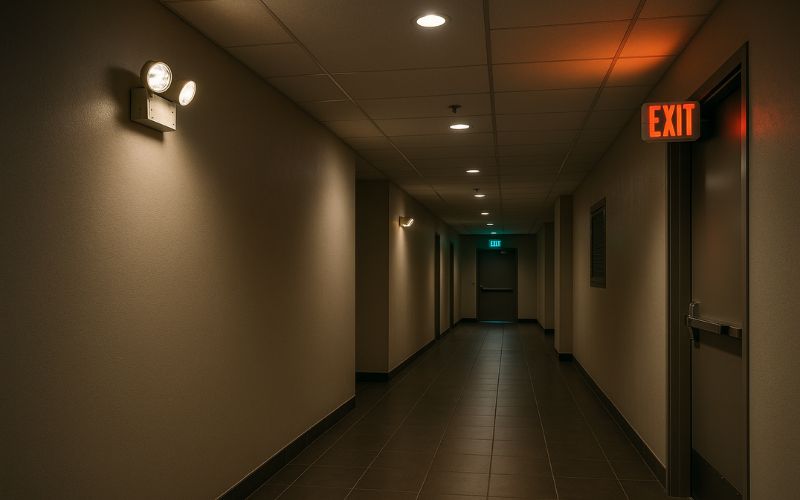
Exit signs must remain illuminated at all times, and they must switch to battery power instantly during an outage. In many older buildings, exit signs begin to dim or lose uniformity, creating uneven lighting across the letters. Sometimes only part of the sign illuminates, or the sign flickers when nearby circuits experience load changes.
Because exit signs are essential for safe evacuation, even small illumination defects are considered serious issues during LADBS or fire life safety inspections.
Flickering or nonfunctional stairwell and corridor lights
Stairwells and interior corridors rely heavily on emergency lighting to maintain safe visibility. In Los Angeles, many stairwells experience heat during summer and cooler air during winter. These temperature swings weaken older fixtures, sensors, and internal circuitry. Flickering stairwell lights or fixtures that fail to activate during a test are common problem areas that property managers encounter during the winter months.
Parking garages, in particular, see high rates of emergency lighting failure because of moisture, temperature variations, and older wiring pathways. Winter conditions amplify these issues when cool nighttime temperatures cause sensors or battery packs to behave unpredictably.
Parking garage emergency lighting failures during outages
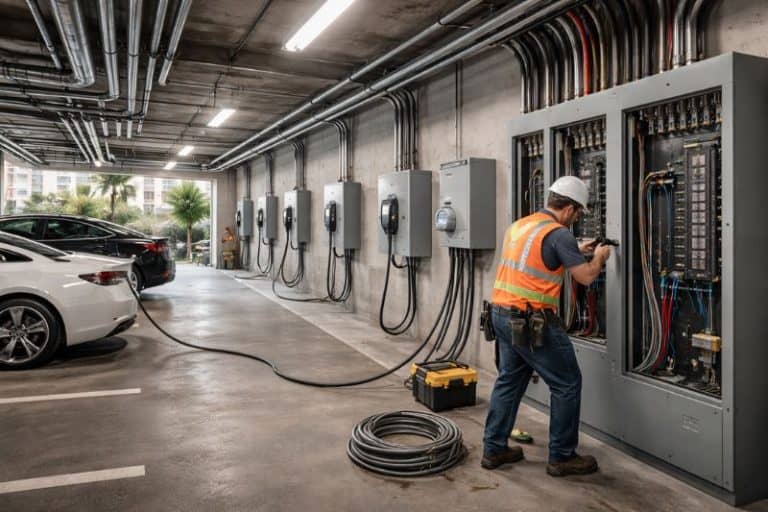
Commercial parking garages depend on emergency lighting to guide tenants and visitors safely to exits and elevators. When these lights fail, visibility drops quickly during an outage, creating significant liability exposure. Common garage failures include:
- Fixtures that operate only intermittently
- Damaged conduits or wiring in exposed areas
- Corroded battery packs
- Sensors that trigger too slowly
- Inconsistent illumination patterns
Property managers often first notice these failures during early evening outages or seasonal tests conducted in preparation for winter operations.
Emergency lighting failures may seem isolated or minor, but they often signal underlying electrical issues that require deeper evaluation. Addressing these problems promptly helps ensure that commercial buildings remain safe, code compliant, and prepared for seasonal load variations across Los Angeles.
How LADBS, Title 24, and fire life safety codes affect emergency lighting
Emergency and egress lighting requirements in Los Angeles are shaped by a combination of state and local codes. Property managers often focus on routine maintenance, but many inspection failures stem from incomplete understanding of the specific lighting expectations within LADBS guidelines, California Title 24 Energy Code requirements, and fire life safety standards. These codes work together to ensure that commercial buildings maintain safe, reliable illumination during any event where normal power is lost.
What Los Angeles inspectors look for
When LADBS inspectors evaluate emergency lighting, they test more than whether fixtures simply turn on. Inspectors check for:
- Immediate activation when normal lighting fails
- Adequate brightness along the full egress pathway
- Even illumination with no dark gaps
- Functional backup batteries capable of meeting duration requirements
- Clearly visible and consistently lit exit signs
- Fixtures that remain illuminated for uninterrupted evacuation times
If a single fixture or exit sign does not perform correctly, inspectors may require repairs before the property can pass. In multi unit commercial spaces, a single dark stairwell landing or corridor can result in a failed inspection because it affects overall emergency egress safety.
Required illumination levels and testing intervals
Emergency and egress lighting must maintain specific foot-candle levels to ensure safe visibility. Title 24 and national safety guidelines prescribe the minimum brightness required along pathways, stair treads, and areas leading to final exits. These standards are strictly enforced in Los Angeles because many commercial buildings serve large numbers of tenants and visitors each day.
Testing intervals also factor into compliance. Emergency lighting should be tested regularly, not only during annual inspections. Property managers are expected to:
- Conduct monthly quick tests
- Perform annual full-duration tests
- Replace batteries at regular intervals
- Maintain logs of testing and maintenance
Lack of documentation is one of the most common issues discovered during LADBS or fire life safety inspections. Even if lighting works properly, the absence of records can delay approval.
Code updates most property managers miss
Code updates often include small but important adjustments, such as changes to backup runtimes, fixture efficiency requirements, or acceptable technology for exit signage. Title 24 updates, in particular, aim to improve energy efficiency while maintaining safe lighting performance. Some recent changes include updates to LED egress fixture standards, sensor requirements, and energy usage thresholds.
Older buildings in Los Angeles, especially those built before the mid-1990s, may still contain legacy emergency lighting systems that no longer meet current code. These outdated systems may activate during outages but fail to meet runtime or brightness requirements. Property managers who rely on older components often discover code gaps only during inspections, making proactive upgrades essential for staying ahead of compliance issues.
Understanding how LADBS, Title 24, and fire life safety requirements intersect helps property managers avoid costly delays and ensures that commercial buildings remain fully prepared for emergencies throughout the winter season.
How property managers can prepare their buildings for emergency lighting inspections
Preparing for an emergency lighting inspection requires more than replacing a few fixtures or ensuring exit signs are illuminated. A complete inspection evaluates the entire system, from the electrical circuits powering egress lighting to the physical condition of fixtures and battery packs. By preparing in advance, property managers reduce the risk of inspection failures, avoid re-inspection fees, and ensure the building remains safely maintained during the busiest months of the year.
Correct circuit labeling and panel readiness
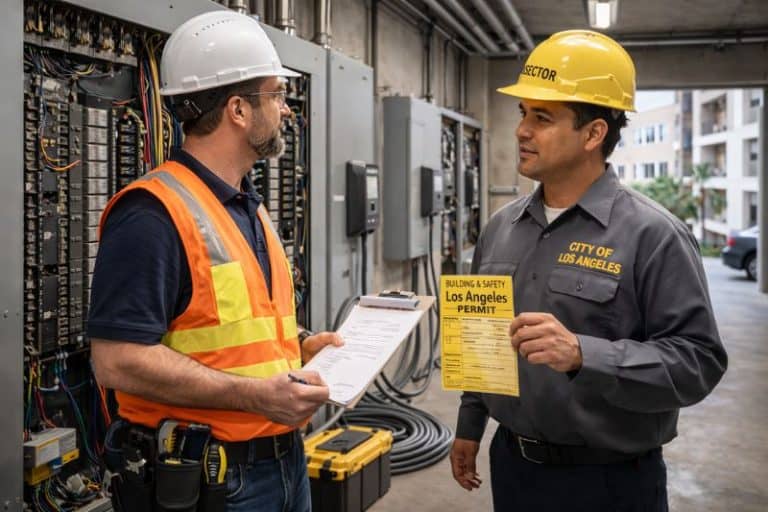
Accurate labeling plays a key role in emergency lighting inspections. LADBS inspectors often review the electrical panel to confirm that emergency lighting circuits are properly designated and isolated from standard power circuits. If circuits are mislabeled or unclear, inspectors may request corrections or additional verification.
Panel readiness also includes:
- Ensuring breakers are in good working condition
- Confirming that emergency circuits are not overloaded
- Checking that no recent modifications have compromised pathway integrity
If a panel contains weak breakers, poor labeling, or outdated components, emergency lighting may function inconsistently during outages or tests.
Testing batteries, fixtures, sensors, and failover systems
Emergency lighting must activate immediately and remain illuminated for the required duration. Property managers can prepare for inspections by performing their own tests before the official check. This includes:
- Running a full-duration battery test on all emergency fixtures
- Verifying that exit signs remain bright and uniformly illuminated
- Testing photocells and sensors for consistent activation
- Checking that fixtures do not flicker or dim during extended runtime
- Ensuring that no fixtures are obstructed or physically damaged
Winter is the best time to evaluate emergency lighting because cooler temperatures reveal battery weaknesses and fixture inconsistencies more clearly than warm-weather testing.
Documenting maintenance for liability protection
Inspectors frequently request documentation showing that emergency lighting has been maintained consistently. This includes logs for monthly and annual testing, notes on fixture repairs or replacements, and receipts for any recent upgrades. Clear documentation not only helps pass inspections but also strengthens liability protection in case of tenant incidents.
If a building experiences an emergency and lighting fails, documented maintenance demonstrates that the property manager took reasonable steps to maintain safety. Without documentation, it becomes harder to defend against claims, even if failures were caused by sudden, unpredictable issues.
Being prepared for emergency lighting inspections is not just about passing a regulatory check. It is about ensuring that commercial buildings remain safe, functional, and ready for any unplanned outage or emergency event. By taking a proactive approach, property managers can maintain compliance, protect tenants, and keep their properties operating smoothly throughout the winter season.
Modern emergency lighting upgrades for commercial properties
Emergency and egress lighting has evolved significantly in recent years, and modern systems offer far greater reliability, energy efficiency, and performance than older equipment still found in many Los Angeles commercial buildings. Property managers who upgrade their emergency lighting are not only preparing their buildings for LADBS inspections; they are also strengthening overall safety and improving long-term operational resilience. Winter is an ideal time to consider these upgrades, because seasonal conditions expose weaknesses that remain hidden during the rest of the year.
LED egress fixtures
LED emergency fixtures have become the standard in new and updated commercial buildings across Los Angeles. They offer a consistent level of illumination, use less energy, and maintain stable brightness even when backup batteries age. Older fluorescent or incandescent emergency fixtures often flicker during power loss or dim more quickly during runtime. LED fixtures provide a steady light output that supports safe evacuation, particularly in stairwells, corridors, and parking structures where visibility is critical.
Because many older buildings still rely on outdated fixtures, upgrading to LED versions can dramatically reduce maintenance needs. LEDs generate less heat, resist vibration, and perform well across temperature ranges, making them a significant improvement for garages and partially enclosed areas where traditional fixtures frequently fail in winter.
Centralized inverter systems
Some commercial properties benefit from centralized inverter systems, which supply backup power to multiple emergency fixtures from a single location. Instead of maintaining battery packs in every fixture, the building stores power in one main system that instantly feeds designated emergency circuits. This approach simplifies maintenance, improves runtime consistency, and provides a more stable power source during outages.
Los Angeles buildings that experience repeated emergency lighting failures due to aging batteries or inconsistent fixture performance often see major improvements after transitioning to inverter systems. They also streamline inspections, since inspectors can evaluate a single system rather than testing dozens of individual battery packs.
Smart controls, photocells, and low voltage pathways
Emergency lighting can be paired with modern control systems that enhance energy efficiency and improve performance. Smart photocells ensure that exterior egress lighting activates reliably at sunset, without the erratic behavior found in older sensors that struggle during colder months. Timers and occupancy sensors can also help maintain visibility in semi enclosed spaces such as stair towers and storage corridors.
For large commercial campuses or multi building properties, low voltage emergency lighting pathways offer another upgrade option. These systems provide reliable illumination with minimal energy use and are less susceptible to voltage drop, making them ideal for long corridors or sprawling parking structures.
Integrating emergency lighting with other building upgrades
When commercial buildings undergo renovations, such as panel upgrades, lighting retrofits, or space reconfigurations, emergency lighting is often evaluated at the same time. Integrating emergency lighting improvements into broader electrical upgrades ensures consistent performance and reduces the risk of overlooking critical components. Property managers who coordinate emergency lighting upgrades alongside other electrical improvements often see smoother inspections, fewer outage related issues, and better long-term reliability.
Modernizing emergency lighting is an investment in safety, compliance, and operational continuity. As building systems face heavier winter loads, these upgrades help property managers stay ahead of seasonal challenges and ensure their properties remain fully prepared for emergencies.
Scheduling emergency lighting assessments and repairs with RG Electric
Emergency and egress lighting is one of the most important systems in any commercial property, yet it is also one of the easiest to overlook until a test or inspection reveals a hidden problem. Winter brings shorter days and increased electrical load, making it the perfect season to schedule a comprehensive emergency lighting assessment. RG Electric works with property managers across Los Angeles to evaluate, repair, and upgrade these systems so that buildings remain safe and compliant year round.
What property managers should prepare
Before scheduling an emergency lighting assessment, property managers can gather helpful information that allows the electrician to evaluate the system efficiently. Knowing which areas have experienced dim or flickering fixtures, whether exit signs have lost brightness, or which stairwells and corridors feel inconsistently lit helps guide the inspection process. Property managers may also note any unusual behavior that occurs during cold evenings or during brief power dips, as winter conditions often reveal intermittent problems.
Having access to panels, storage rooms, mechanical areas, and rooftop enclosures ensures that the electrician can trace circuits accurately and examine backup components without delay. If records of previous tests or repairs exist, having them available helps identify patterns and pinpoint aging components.
How RG Electric tests emergency and egress systems
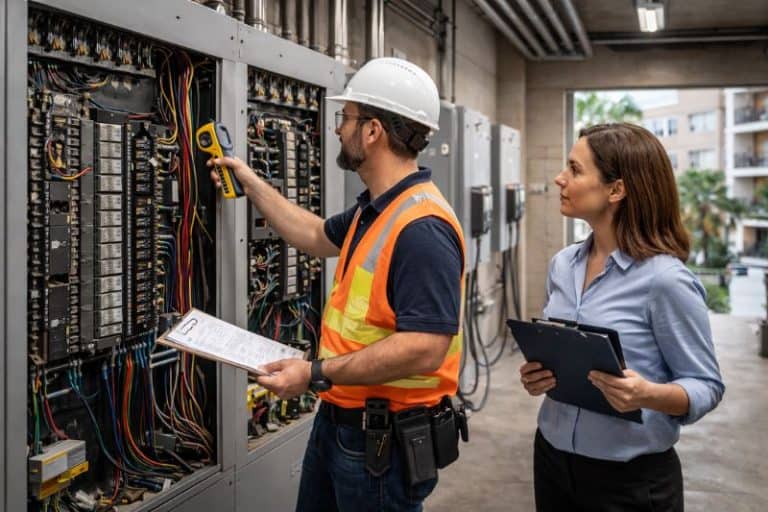
RG Electric begins with a full survey of emergency fixtures, exit signs, circuits, and battery backup components. Electricians test how quickly the lighting activates when normal power is interrupted and evaluate whether brightness remains consistent throughout the required emergency runtime. In stairwells, corridors, and garages, the team checks for uniform illumination and verifies that fixtures adhere to code requirements for visibility and safety.
RG Electric also inspects sensors, photocells, wiring pathways, and panels that support emergency lighting circuits. In some older buildings, flickering or failing fixtures originate from aging wiring or weak breakers rather than the fixtures themselves. Identifying the correct cause helps prevent repeat failures during winter and reduces the risk of unexpected outages.
Once the assessment is complete, RG Electric provides a clear, actionable plan outlining required repairs and recommended upgrades. Property managers receive guidance on which improvements are urgent, which can be scheduled proactively, and which options may reduce long term maintenance needs.
Call RG Electric for emergency lighting services
Emergency and egress lighting is essential for protecting the safety of tenants, visitors, and staff in Los Angeles commercial buildings. Ensuring that these systems function properly during winter is one of the most effective ways to reduce liability and maintain code compliance throughout the year.
Call RG Electric at (323) 521-5131 or request a free estimate at
https://www.rgelectric.net/contact-us/
to schedule your emergency lighting assessment and ensure your property is fully prepared for the winter season.
Electrical work is hazardous. Consult a licensed electrician like RG Electric for inspections, permits, and code compliant installations.