
 Call (323) 5215131
Why Electrical Repairs in Los Angeles Cost More Than Homeowners Expect — and What Actually Drives the Price
Updated August 2026
When an electrician hands you an estimate in Los Angeles, the number is sometimes higher than you expected. That gap between what you imagined and what the job actually costs is one of the most common friction points RG Electric encounters, and it almost always comes from the same place: most people don’t know what goes into a professional electrical repair until they’re standing in front of one. As a licensed C10 electrical contractor, License #910807, we’ve had this conversation hundreds of times. This article walks through exactly what drives electrical repair costs in Los Angeles, so you can evaluate any estimate with confidence.
Why Electrical Repairs Aren’t Priced Like Other Home Services
A lot of homeowners come into their first electrical service call expecting an hourly rate. That’s how many trades work, and it seems like a reasonable assumption. But licensed electrical contractors in Los Angeles don’t typically charge by the hour. We look at the full scope of what’s needed, including labor, materials, permit requirements, and code compliance, and provide an estimate based on the complete job.
That approach protects you. It means the price you agree to before work starts is the price you pay when it’s done. No surprises when the technician has been on site for two hours instead of one. No bill that grows as the job does. What’s in the estimate is what the job costs.
The flip side is that the estimate reflects everything the job requires, not just the time it takes to perform the visible portion of the work. Understanding what’s included is the key to reading an electrical estimate clearly.
The Five Things That Actually Drive Electrical Repair Costs
Materials Are Priced for Safety, Not Convenience
Licensed electrical contractors use materials that meet California code. That means specific wire gauges, rated breakers, GFCI-protected outlets where required, and components from manufacturers whose equipment performs to standard.
RG Electric installs Siemens panels, for example, because they’re top-tier equipment that holds up over time. A handyman working for less might use whatever is cheapest at the hardware store. That difference in material cost shows up in the estimate, and it also shows up in how the installation performs five years from now.
When you see a materials line item in an electrical estimate, you’re not being charged for convenience. You’re being charged for components that will pass inspection and perform safely for the life of the installation.
Code Compliance Is Not Optional
California updates its electrical codes regularly, and Los Angeles enforces them. When a licensed contractor opens a wall or a panel, the work that comes out of that opening has to meet current standards, not the standards from when the house was built.
That means a repair that looks simple from the outside can require additional work once the scope is visible. A homeowner who calls about a tripping circuit breaker in Los Angeles might have a straightforward fix, or the technician might find outdated wiring behind the panel that has to be addressed before the new work can be completed to code. We follow code to the teeth. That means we’re not going to skip a code-required step to reduce the estimate, and we’re not going to put our 20-plus year license at risk to save a customer a few hundred dollars.
Code compliance also protects you directly. Work done below code can void your homeowner’s insurance, fail a sale inspection, or expose you to liability. The cost of doing it right the first time is always less than the cost of fixing work that wasn’t done correctly.
Permits Add Cost and Time, But They’re There for a Reason
Most significant electrical repairs in Los Angeles require a permit from the city. Pulling a permit means the work gets inspected by a city inspector who verifies it meets code before signing off. That process costs money and adds time to the job, and it’s reflected in the estimate.
Some contractors skip permits to keep costs down. That’s a serious problem for the property owner. Unpermitted electrical work can prevent a home sale, trigger fines during a city inspection, and void insurance coverage on a claim. If a fire or injury results from unpermitted work, the liability exposure falls on the homeowner, not the contractor who did the work.
When RG Electric pulls a permit, we handle the entire process, including scheduling the inspection and making sure the work is ready to pass. The permit cost in your estimate is the cost of protection, not a line item to be negotiated away.
Diagnostic Work Is Skilled Labor
The part of an electrical repair that isn’t visible to the homeowner is often the part that costs the most to do correctly: figuring out what’s actually wrong.
Electrical faults don’t always announce themselves. A room that loses power might have a tripped breaker, a failed outlet, a short somewhere in the circuit, or a wiring problem inside the wall. Finding the actual source requires a trained technician with diagnostic experience, the right tools, and the ability to trace a problem through a system that was built decades ago and modified multiple times since.
That diagnostic work is why RG Electric charges a service fee for repair calls. The technician’s time and travel to your property, combined with the expertise needed to find the problem accurately, is a real cost. What you’re paying for in a service call isn’t just the part that gets replaced. It’s the knowledge that identified what needed replacing.
What’s Behind the Wall Can Change the Scope
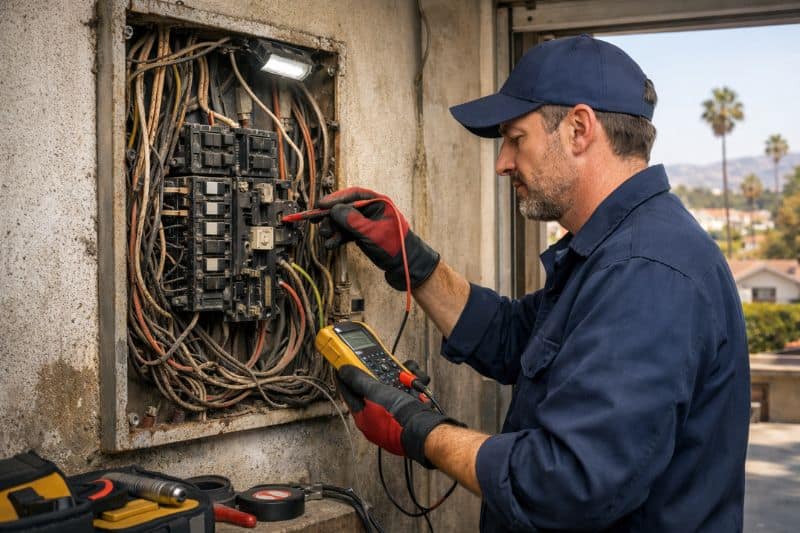
Los Angeles has a lot of older housing stock, and older homes carry older wiring. When a technician opens a panel or accesses a circuit in a home built before 1980, what they find behind the wall doesn’t always match what the repair was expected to require.
Double-tapped breakers, ungrounded circuits, deteriorated insulation, and outdated junction boxes are common in homes that have been partially updated over the years. In some cases the full picture doesn’t become clear until a licensed contractor evaluates the home’s wiring in Los Angeles as a whole, not just the original complaint. A city inspector reviewing a permitted repair can and will flag these issues, even if the original repair had nothing to do with them. At that point, the scope of work expands because it has to, not because the contractor is looking for additional revenue.
We’ve had situations where we replaced panels in an apartment complex and the inspector opened a fourth panel we hadn’t touched, found a code violation, and required it to be corrected before issuing approval for the work we did. That’s how inspections work in Los Angeles. The estimate you receive reflects what we can see, and professionals will always be transparent when the scope changes once the work is opened up.
The Handyman Cost Comparison
The most common reason homeowners are surprised by a licensed contractor’s estimate is that they’ve received a lower number from an unlicensed worker. That lower number deserves scrutiny.
An unlicensed handyman working below market rate is almost always cutting something, whether that’s materials, permits, code compliance, or all three. The savings are real in the short term. The exposure is also real, and it compounds over time.
Hiring unqualified professionals is one of the most common electrical mistakes we see in Los Angeles. Outlets wired incorrectly, GFCIs missing near water sources, circuits run without proper grounding, outdoor boxes installed without weatherproofing. When RG Electric gets called in to assess a home after a handyman has done electrical work, we’re frequently starting from a worse position than if the work had never been done at all.
A licensed contractor’s estimate is higher because it reflects the full cost of doing the job correctly. That cost includes the insurance and bonding that protect you if something goes wrong, the permit and inspection process that verifies the work meets code, and the workmanship guarantee that backs the job after the technician leaves.
What RG Electric’s Estimates Include
Every estimate from RG Electric is itemized and transparent. There are no hidden fees. What’s listed is what you pay when the work is complete.
Our process starts with a service call where the technician identifies the problem, reports findings to our supervisor Roy, and we develop a clear estimate based on everything the job requires. Our customer care coordinator then walks you through every line item before any work begins. If you have questions about why something is included, we’ll explain it. If the scope changes once we’re inside the wall, we tell you why before we proceed.
We also back all workmanship with a 12-month guarantee. If something connected to the work we performed causes a problem within twelve months, we come back without charging you a new service call. You’re already our customer.
When a Repair Becomes a Larger Conversation
Some repairs are straightforward. A GFCI outlet that needs replacing, a breaker that needs to be swapped out, an outdoor outlet that needs a weatherproof cover. These jobs have limited scope and the estimate reflects that.
Other service calls reveal something bigger. A kitchen that loses power might point to an overloaded circuit, which points to a panel that no longer has the capacity the home needs. A bathroom outlet that keeps tripping might indicate a wiring problem that runs deeper than the outlet itself. In those cases, the repair cost isn’t the whole story.
Understanding the difference between a repair that solves a problem and a repair that delays a larger one is part of what a professional electrical assessment provides. Our electrical repair services in Los Angeles are designed to give you an accurate picture of what the work actually requires, including when a deeper evaluation is in your best interest. If the job leads toward a panel conversation, our electrical panel services team handles that process from evaluation through inspection.
What Los Angeles Homeowners and Property Managers Should Know Before Calling
A few things that help any electrical service call go more smoothly:
Know your panel. If you have a Zinsco, Federal Pacific, Challenger, or Pushmatic panel, mention it when you call. These are known fire hazards and recalled equipment, and that context changes how the technician approaches the job.
Document what you’re experiencing. When did the problem start? Is it in one room or multiple? Does it happen at a specific time or under specific conditions? The more information you can provide, the more efficiently the technician can diagnose the problem.
Expect a service fee for diagnostic work. New work, such as adding a circuit or installing a fixture, comes with a free estimate. Diagnosing an existing problem is a service call with a fee. That fee covers the technician’s time and expertise, and it’s credited toward the repair if you move forward with the work.
Ask for permits on any significant repair. If a contractor offers to skip the permit to save money, that’s not a favor. It’s a liability transfer to you. And if you’re dealing with something urgent, our emergency electrical repair team in Los Angeles is available for situations that can’t wait.
The Real Cost of Getting It Right
Electrical repairs in Los Angeles cost what they cost because professional electrical work is skilled, code-governed, permit-required labor performed with materials rated for safety and longevity. The estimate reflects all of that.
What it doesn’t reflect is the cost of getting it wrong. Failed inspections, insurance denials, repeat service calls to fix work that wasn’t done correctly the first time, and the liability exposure that comes with unpermitted work in a home or apartment building add up quickly. The gap between a licensed contractor’s estimate and a handyman’s quote is almost always smaller than the gap between a repair done right and one that needs to be done again.
We stand behind our work. We follow code to the teeth. And we explain everything clearly so you know exactly what you’re paying for and why before a single wire gets touched.
For immediate assistance or to schedule a professional evaluation, call RG Electric directly at (323) 521-5131.