
 Call (323) 5215131
Are Zinsco, Federal Pacific, Challenger, and Pushmatic Panels Still Dangerous in Los Angeles?
Updated July 2026
Yes, and the reason has nothing to do with age. Most property managers in Los Angeles become aware of their building’s electrical panel for the first time when an insurance company flags it. The panel may have been supplying power without incident for decades. Breakers reset when they trip. Nothing looks wrong from the outside. And then an underwriter or inspector identifies the brand, and suddenly the property has a compliance problem that needs to be resolved before the next renewal. RG Electric is a licensed C10 electrical contractor, License #910807, serving homeowners, property managers, and building owners across Los Angeles County. This post explains why four specific panel brands, Zinsco, Federal Pacific Electric, Challenger, and Pushmatic, are treated differently from other aging equipment, what their actual failure risks are, and what to expect when replacement becomes necessary.
Why these four panels are not simply old equipment
Age alone does not make an electrical panel dangerous. Many panels installed in the 1970s and 1980s are still operating safely today. The reason Zinsco, Federal Pacific, Challenger, and Pushmatic panels are treated as a separate category by insurers, inspectors, and licensed electricians is not their age. It is their documented failure modes.
A circuit breaker has one essential job: to interrupt the flow of electricity when a circuit is carrying more current than the wiring can safely handle. When a breaker fails to trip under overload conditions, the wiring behind it continues to carry current, heats up, and eventually creates conditions that lead to fire. The specific concern with each of the four panel brands listed here is that their breakers have documented histories of failing to perform that core function, not occasionally and not only in extreme cases, but at rates that have caused insurers and inspectors to treat their presence as an unacceptable risk regardless of apparent condition.
This is why a panel that appears to be working fine can still be flagged as a required replacement. The failure risk does not announce itself in advance. The panel delivers power normally right up until the moment a breaker that should trip does not, and the consequences of that failure play out in the wiring behind the walls.
The conclusion: a panel from one of these four brands that appears to be functioning correctly is not a safe panel. It is a panel whose failure mode has not yet been triggered.
Why Los Angeles has so many of these panels
The concentration of these panels in Los Angeles is a product of the city’s growth history. Large portions of Los Angeles, the San Fernando Valley, Koreatown, West Adams, the Eastside, and much of the Westside, were built or substantially developed between the 1940s and the 1980s. During that period, these four panel brands were widely distributed and accepted by inspectors because they met the standards of their era.
Electrical demand at the time was a fraction of what modern homes and apartment buildings require. There were no EV chargers, far fewer large appliances, and significantly less continuous load on residential circuits. Panels designed for that load profile are now operating in buildings where the load has increased substantially, which accelerates the wear on components that were already marginal by modern standards.
Because electrical panels are out of sight in utility rooms, exterior enclosures, and hallway closets, they rarely receive attention unless something goes wrong. In rental properties and apartment buildings, panels are frequently inherited by new management teams without any record of the last evaluation. The result is that many Los Angeles properties are still operating with original panels from five or six decades ago, and their owners are unaware of the risk profile those panels carry.
The conclusion: if your building was constructed or substantially developed between the 1950s and 1980s in Los Angeles, the probability that at least one panel is from one of these four brands is meaningful enough to warrant a professional evaluation.
Zinsco panels: the bus bar problem
Zinsco panels were widely installed in Southern California from the 1950s through the late 1970s. They are recognizable by their brightly colored breaker handles, typically red, blue, or green, and the Zinsco or Magnetrip label on the inside door. The bus bars in Zinsco panels are aluminum, which is the starting point for the primary failure mode.
Aluminum bus bars expand and contract with heat cycles more than copper does. Over decades of thermal cycling, the connection between the breaker and the bus bar loosens. A loose connection creates resistance, resistance creates heat, and heat creates arcing. As arcing continues, the plastic components surrounding the connection point can melt, and the breaker itself can fuse to the bus bar, meaning it can no longer be removed, reset, or tested without damaging the panel.
The consequence of a fused or heat-damaged breaker connection is that the breaker may no longer trip when the circuit is overloaded. Power continues flowing through a circuit that the breaker was supposed to interrupt, and the wiring in that circuit heats up without protection. Because this process happens inside the panel enclosure, behind a metal door, there is typically no visible warning before the damage becomes serious.
A common first response from property owners is to ask whether replacing individual breakers addresses the concern. It does not. Replacement breakers installed into a Zinsco panel connect to the same aluminum bus bars with the same degraded contact surfaces. The new breaker inherits the same connection problem that caused the original failure. Insurers and inspectors are aware of this, which is why they do not accept breaker replacement as a substitute for panel replacement in Zinsco installations.
The conclusion: a Zinsco panel with colored breakers that appear to be functioning normally may have fused breaker connections behind the panel face that cannot be detected without opening the panel. The only reliable remediation is replacement.
Federal Pacific Electric panels: documented breaker failure rates
Federal Pacific Electric panels, sold under the Stab-Lok brand, are identified by their orange or brown breaker handles and a black faceplate. They were installed extensively in Los Angeles apartment buildings and single-family homes from the late 1950s through the 1980s. The primary concern with FPE panels is not bus bar degradation. It is breaker mechanism failure.
Independent testing and field research have documented that a significant percentage of Stab-Lok breakers fail to trip under overload conditions. The breaker appears to be in the correct position, continues to allow current to flow, and does not respond as it should when the circuit exceeds its rated capacity. This failure does not produce an immediately visible symptom. The lights stay on, appliances continue to run, and the panel looks unchanged from the outside. What is happening behind the walls is that the wiring is carrying more current than it was designed for, and the insulation is degrading under sustained heat.
Insurance companies do not wait for a fire to decide that a panel is unacceptable. FPE panels have generated enough documented claims and enough research on their failure rates that many carriers will not insure a property containing one. For property managers with multi-unit buildings, a single FPE panel identified during an underwriting review can trigger a building-wide evaluation and a deadline for replacement as a condition of continued coverage. The pressure is not hypothetical. It is a recurring situation that our team addresses regularly for apartment building owners throughout Los Angeles.
The conclusion: the failure mode of a Federal Pacific Stab-Lok panel is invisible until a circuit overloads and the breaker does not trip. By that point the wiring has been carrying excess current long enough to create a fire hazard. Replacement eliminates that risk. Nothing else does.
Challenger panels: reliability and parts availability
Challenger panels are less universally recognized as a risk than Zinsco or FPE, but they are treated with caution by insurers and inspectors nonetheless. They were installed primarily in the 1970s and 1980s in Los Angeles properties, and the concerns associated with them center on breaker reliability over time and the practical difficulty of maintaining them.
Challenger breakers can become inconsistent as they age, loosening internally, failing to maintain clean contact with the bus bar, or tripping at lower loads than their rating suggests they should. Sourcing correct replacement breakers is increasingly difficult, which means that panels that have been partially repaired over the years may contain mismatched or non-original components that do not perform consistently. The combination of aging original breakers and inconsistent replacement history makes a Challenger panel difficult to evaluate as a reliable safety device, which is the basis for the insurer concern.
Insurance companies assess Challenger panels on a case-by-case basis more than Zinsco or FPE, which are often treated as categorical replacement requirements. However, in multi-unit properties or buildings that already carry other risk factors such as aging wiring, prior claims, or deferred maintenance, a Challenger panel frequently tips the balance toward a required upgrade. Property managers who are aware that their building contains Challenger panels should factor that into their planning horizon for electrical capital expenditures.
The conclusion: Challenger panels may not trigger an automatic replacement requirement in every insurance context, but they represent an aging system with limited serviceability and documented reliability concerns. A professional assessment that documents the current condition and establishes a replacement timeline is the appropriate response.
Pushmatic panels: mechanical degradation over time
Pushmatic panels are immediately recognizable by their push-button breakers, a distinctive design that replaces the standard toggle switch with a button that presses in to reset after tripping. They were manufactured by Bulldog Electric and installed in Los Angeles properties primarily from the 1950s through the 1970s. Their design was considered innovative at the time, but the mechanical characteristics of that design create specific problems today.
Push-button breakers become stiffer with age, and the internal mechanisms that respond to overload conditions degrade over decades of thermal cycling. A breaker that is difficult to reset manually, or that requires significant force to operate, may not respond correctly during an automatic trip event. Unlike modern toggle breakers, which move visibly and completely to a center position when tripped, Pushmatic breakers can fail partially, leaving their operational status ambiguous even to an experienced technician.
Replacement parts for Pushmatic panels are scarce and of inconsistent quality. A panel that has been partially serviced over the years may contain a mix of original and replacement components with different performance characteristics. This serviceability problem compounds the age-related mechanical degradation and makes Pushmatic panels increasingly impractical to maintain as dependable safety devices.
Insurance carriers treat Pushmatic panels as obsolete technology. The combination of aged mechanical components, limited serviceability, and the absence of modern safety features means the panel cannot be brought up to current standards without full replacement. For rental properties and apartment buildings where insurance carriers are already applying increased scrutiny to electrical systems, a Pushmatic panel is a straightforward replacement requirement.
The conclusion: Pushmatic panels cannot be adequately maintained with available replacement parts, and their mechanical design does not support the installation of modern protective devices. Replacement is the only path to a code-compliant, insurable installation.
The insurance landscape in Los Angeles right now
The insurance market in Los Angeles has tightened significantly in the years following the 2025 fire season. Carriers that remained in the California market are applying more rigorous underwriting criteria to older properties, and electrical systems are a primary focus of that scrutiny. For property managers, this means that panels that were quietly grandfathered through previous renewals are increasingly being flagged as conditions for continued coverage.
The practical consequence is that proactive replacement is now genuinely different from reactive replacement. A property owner who replaces a Zinsco or FPE panel before the insurer identifies it controls the timeline. They can schedule work at a convenient time, communicate with tenants in advance, work through the permit process at a normal pace, and present the completed documentation at renewal. A property owner who receives a compliance letter from their insurer is typically working against a 30 to 90 day deadline, and every one of those dynamics changes under deadline pressure.
RG Electric, C10 #910807, provides inspection reports, photos, and permit documentation in a format that satisfies insurer and LADBS requirements. For property managers who need to demonstrate compliance to a carrier, having that documentation ready at renewal is the difference between a smooth renewal and a coverage dispute.
The conclusion: the insurance pressure around recalled panels is not easing. Property managers who address it proactively control the timeline and the budget. Those who wait for a compliance letter address it under conditions they did not choose.
What a panel replacement involves
The replacement process for any of these four panel types follows a consistent sequence, though the specific scope varies by building type, service size, and what the inspector finds once the panel is opened.
Every replacement starts with a site evaluation. We inspect the existing panel, assess the building’s current and anticipated load, verify the grounding system, and identify any related wiring issues that the inspector will likely flag once the panel is replaced. For multi-unit buildings, this evaluation maps which panels serve which units and common areas, so the replacement plan accounts for the full scope before work begins. The estimate from this evaluation is itemized and covers everything the project will require.
Panel replacements in Los Angeles require a permit from LADBS. We handle the permit application, submit the required load calculations, and coordinate the inspection appointment so the inspector can review the work before the panel is closed. For projects that also require LADWP coordination for a service upgrade, we handle that communication as well. Property managers do not need to navigate the permitting process independently.
The old panel comes out and a UL-listed replacement goes in. Siemens is our standard recommendation for most residential and multi-unit applications. All terminations are torqued to manufacturer specifications. The grounding system is verified and corrected if needed. The panel directory is labeled accurately and completely at closeout. Power interruption during a standard single-panel replacement is typically limited to a portion of the workday. For multi-unit buildings with multiple panels, we phase the work to keep power to unaffected areas while each panel is replaced.
Once the installation is complete and the inspector signs off, we provide a documentation packet that includes the permit, the inspection certificate, photos of the completed installation, and the panel directory. That packet is what the insurer needs to update the property record and confirm compliance. It is also what protects the property owner if the electrical system is ever scrutinized in connection with a claim or a sale.
The conclusion: a panel replacement with RG Electric produces a closed permit, an inspector sign-off, and a documentation packet. That documentation is what insurance carriers, real estate buyers, and LADBS require when asking for proof of compliance.
Identifying which panel your building has
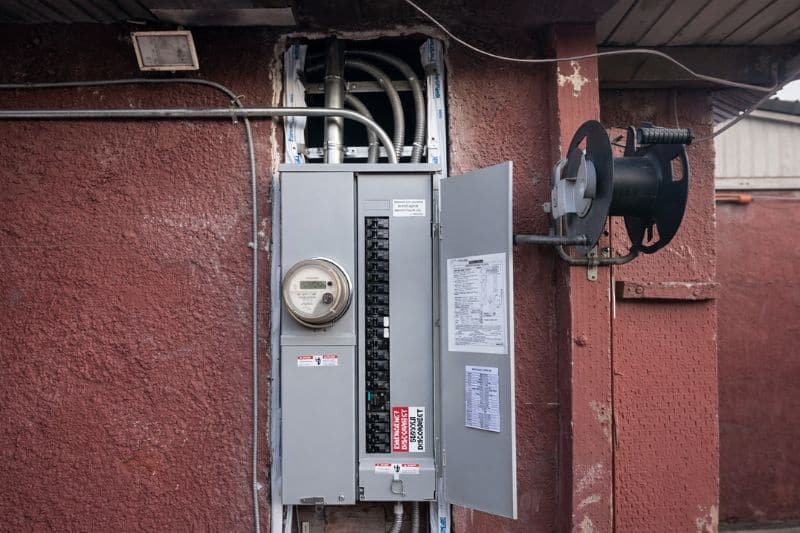
Many property managers do not know which panel brand their buildings contain until someone asks. If the property was inherited from a previous management company, or if the original construction documents are incomplete, the panel identity may be genuinely unknown. The fastest way to find out is to open the panel door and look for the manufacturer’s label on the inside surface or the panel frame. Zinsco and Magnetrip labels are usually clearly printed. FPE Stab-Lok panels have orange or brown breakers. Pushmatic panels are immediately identifiable by their push-button design.
If the label is faded, missing, or the panel has been partially modified, a licensed electrician can identify the brand from the bus bar design, breaker type, and physical layout. We can confirm panel identity during any service visit, and if a recalled brand is present, we document the finding in writing so the property owner has a record of when the risk was identified.
For multi-unit buildings with multiple panels, it is worth confirming the brand of every panel on the property rather than assuming uniformity. Buildings from the development periods when these panels were common sometimes contain a mix of brands, particularly if sections of the building were constructed or expanded at different times.
Acting before the insurer forces the issue
The case for proactive panel replacement is straightforward. The risk associated with Zinsco, FPE, Challenger, and Pushmatic panels does not change based on whether the insurer has identified it yet. The panel’s failure mode is present regardless of what appears on the property’s insurance record. Acting before a renewal letter arrives means controlling the timeline, the budget, and the communication with tenants. Acting after a letter arrives means all of those elements are constrained by a deadline that the insurer set.
Property managers who oversee multiple buildings are in the best position when they identify all recalled panels across their portfolio and develop a phased replacement schedule that addresses the highest-risk installations first. That approach makes the capital expenditure predictable and avoids the scenario where multiple buildings receive compliance letters in the same renewal cycle and all require emergency-timeline responses simultaneously.
RG Electric, C10 #910807, (323) 521-5131, works with property managers throughout Los Angeles, in Encino, Sherman Oaks, Downtown LA, Inglewood, Torrance, Koreatown, and across the San Fernando Valley, to evaluate, plan, and execute panel replacement projects of all sizes. Our electrical panel services in Los Angeles cover the full replacement process from diagnostic through permit closeout. For multi-unit buildings requiring phased replacement across multiple panels, our commercial electrical services in Los Angeles handle the coordination, permitting, and sequencing so the project proceeds without extended disruption to tenants.
For immediate assistance or to schedule a professional evaluation, call RG Electric directly at (323) 521-5131.