
 Call (323) 5215131
Is a Zinsco Panel Dangerous If It’s Still Working? What LA Property Managers Need to Know
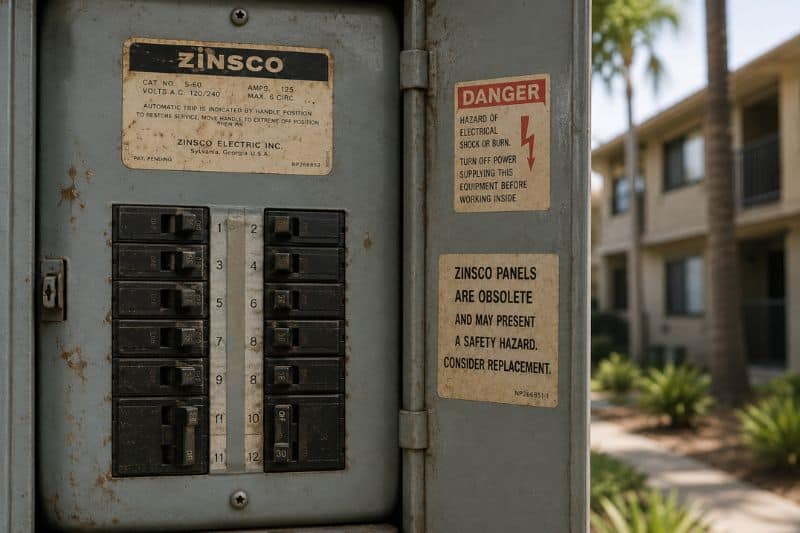
The question comes up regularly. A property manager in Sherman Oaks or Koreatown inherits a building, opens the utility room door, and finds a panel with brightly colored breaker handles, a Zinsco label on the inside door, and no visible signs of trouble. The lights work. Tenants are not complaining. The breakers reset when they trip. From the outside, nothing looks wrong. The question that follows is almost always the same: if it’s still working, does it actually need to be replaced?
RG Electric, licensed C10 #910807, replaces Zinsco panels throughout Los Angeles for property managers, building owners, and homeowners. The answer to that question is not a matter of opinion or insurer preference. It is a matter of how Zinsco panels are designed and what that design does over time. This post explains the failure mechanism in plain terms, what it means for a building that still appears to be operating normally, and what property managers in Los Angeles need to understand before the insurance renewal cycle forces the decision for them.
Why “Still Working” Is the Wrong Standard for a Zinsco Panel
When people evaluate whether an appliance or piece of equipment needs to be replaced, the default standard is whether it still performs its primary function. A water heater that still produces hot water is working. An HVAC system that still conditions air is working. By that logic, a panel that still supplies power to every unit in a building is working, and the case for replacing it seems weak.
The problem with applying that standard to a Zinsco panel is that supplying power is not the function that makes a panel a safety device. The safety function of an electrical panel is interrupting power when a circuit is carrying more current than the wiring behind it can safely handle. That is what a circuit breaker exists to do. And a Zinsco panel can continue delivering power to every circuit in a building while being completely unable to perform that interruption function reliably.
A panel that powers a building but cannot reliably protect it is not working in any sense that matters for safety. It is delivering electricity. It is not protecting the wiring, the structure, or the people inside from what happens when that electricity exceeds safe limits. Those are different functions, and only one of them is visible from the outside.
The conclusion that follows is this: the standard most property managers apply when evaluating whether a panel needs replacement, which is whether it currently delivers power without obvious problems, is the wrong standard for a Zinsco panel. The relevant standard is whether the breakers will perform their protective function when a fault occurs. That question cannot be answered by looking at the panel from the outside, and for Zinsco panels, the documented answer is that they frequently cannot.
How a Zinsco Panel Fails, and Why It Fails Silently
Understanding why Zinsco panels carry the risk profile they do requires understanding one specific design characteristic: the bus bars are aluminum.
A bus bar is the conductive bar running through the panel that each breaker connects to. Current flows from the utility service into the panel, along the bus bars, through each breaker, and out to the circuits it protects. The connection between each breaker and the bus bar is where the Zinsco failure mode begins.
The aluminum expansion problem
Aluminum expands and contracts with temperature changes more than copper does. Every time a Zinsco panel cycles through load changes, the aluminum bus bar expands slightly under heat and contracts as it cools. Over years and decades of those thermal cycles, the mechanical connection between the breaker and the bus bar loosens. A connection that was secure when the panel was installed gradually develops play, and play in an electrical connection creates resistance.
Resistance in an electrical connection generates heat. That heat accelerates the oxidation of the aluminum surface, which increases resistance further, which generates more heat. The process is self-reinforcing. As arcing develops at the connection point, the plastic components inside the breaker housing begin to degrade. The breaker body can melt into the bus bar, fusing the two together in a way that makes the breaker impossible to remove, reset, or test without damaging the panel further.
Why the breaker stops tripping
A breaker that has been compromised by heat damage and arcing at its bus bar connection does not trip reliably under overload conditions. The internal mechanism that responds to excess current depends on the integrity of the breaker’s components. When those components have been degraded by sustained heat, the breaker may allow current to continue flowing through a circuit that has exceeded its rated capacity. The wiring behind that breaker continues to carry more current than it was designed for. The insulation on that wiring heats up. If the condition persists, the result is a fire inside the wall cavity, where it is not visible until it has progressed significantly.
Why none of this is visible from the outside
The entire failure process described above happens inside a metal enclosure behind a closed door. The panel continues to supply power. The breakers continue to appear in their normal positions. There is no alarm, no indicator light, and no tenant complaint that corresponds to a breaker that has lost its ability to trip. The building looks exactly the same as it did before the failure mode developed. Property managers have no way to assess the internal condition of a Zinsco panel through normal observation, which means the absence of visible problems is not evidence that the panel is safe.
The consequence is straightforward: a Zinsco panel in a Los Angeles apartment building or single-family property can be fully compromised as a protective device while appearing completely normal from the outside. The property manager sees a panel that works. What the panel cannot do is what no one will know until a fault occurs and the breaker that should have interrupted it does not. By that point, the protection the panel was supposed to provide has already failed.
What a Zinsco Panel Looks Like and How to Confirm You Have One
Many property managers who have inherited older Los Angeles buildings do not know with certainty which panel brands are installed. The electrical room may not have been part of any recent evaluation, and original construction documents are often incomplete or unavailable. Identifying a Zinsco panel does not require an electrician, though confirming its condition does.
The most recognizable visual characteristic of a Zinsco panel is the breaker handle color. Zinsco breakers are typically red, blue, or green, a design feature that was considered distinctive when the panels were manufactured. The interior panel door usually carries a Zinsco label, and some panels are labeled Magnetrip, which was a Zinsco brand name for a specific breaker line. The panel frame itself may carry both names, or only one.
If the label is faded, missing, or the panel has been partially modified over the years, the aluminum bus bar and the distinctive breaker connection design are still recognizable to a licensed electrician. For multi-unit buildings with multiple panels, it is worth confirming the brand of every panel on the property rather than assuming they are all the same. Buildings constructed or expanded in phases during the 1950s through 1970s, which describes a significant portion of the apartment stock in Van Nuys, North Hollywood, Inglewood, and the Westside, sometimes contain a mix of brands installed at different times.
If a Zinsco panel is confirmed, that identification should be documented in writing with the date. That record matters if the panel is later flagged by an insurer, if the property changes ownership, or if the electrical system is scrutinized in connection with a claim. Knowing when the risk was identified, and what action followed, is part of the documentation trail that protects a property owner from secondary liability.
The conclusion here is practical: identifying a Zinsco panel is something a property manager can do in a utility room walkthrough. Confirming its current internal condition, and determining whether the bus bar connections show degradation or arcing damage, requires opening the panel under safe conditions with the right equipment. That evaluation is part of what RG Electric documents during a pre-replacement assessment, and it is the basis for the itemized scope provided before any work is approved.
Why Replacing Breakers Does Not Solve the Problem
A common first response from property owners who learn about the Zinsco failure mode is to ask whether replacing the individual breakers addresses the risk. It is a reasonable question. If the breaker is what fails, replacing the breaker seems like it should restore the protection.
It does not, for a reason that is specific to how Zinsco panels are constructed. A replacement breaker installed into a Zinsco panel connects to the same aluminum bus bars with the same degraded contact surfaces. The new breaker inherits the existing connection problem immediately. The thermal cycling that caused the original breaker connection to loosen has been acting on the bus bar itself for decades, and the surface condition of that bus bar does not change when a new breaker is inserted. The new breaker is subject to the same failure mode from the moment it is installed.
Insurance carriers and inspectors are aware of this. A property manager who replaces Zinsco breakers and presents that work as a mitigation measure during an underwriting review will not satisfy the insurer’s requirement, because the insurer’s requirement is not about the breakers specifically. It is about the panel as a system, and the panel as a system remains a Zinsco panel regardless of how many individual breakers have been swapped.
The only resolution that addresses the documented failure mode is full panel replacement. A new panel with a copper bus bar, modern breaker connections, and UL-listed components does not carry the failure mode that defines the Zinsco risk profile. The replacement also accommodates modern safety features, including AFCI protection on bedroom circuits and the load capacity that current buildings actually require, neither of which a Zinsco panel can provide regardless of its apparent condition.
The conclusion is this: if a contractor or a property maintenance contact suggests that replacing breakers in a Zinsco panel is an acceptable alternative to panel replacement, that suggestion reflects either a misunderstanding of the failure mechanism or an attempt to defer the cost of a replacement that will eventually be required anyway. The bus bar condition that drives Zinsco failures is not corrected by new breakers, and insurers will not treat it as corrected.
The Insurance Reality in Los Angeles Right Now
The insurance market in Los Angeles has changed substantially in the period following the 2025 fire season. Carriers that remained in the California market are applying more rigorous underwriting criteria to older properties, and electrical systems, specifically panels with documented failure histories, are a primary focus of that scrutiny. For property managers with buildings that contain Zinsco panels, this shift has practical consequences that are already affecting renewal cycles.
The pattern that has become common is this. A property that has carried the same insurer for years comes up for renewal. The underwriter reviews the property details, identifies a Zinsco panel in the building records or through a required inspection, and issues a compliance condition: replace the panel within 30 to 90 days or coverage will not be renewed. The property manager now has a deadline they did not choose, a contractor search that has to happen under time pressure, a permit process that has to move faster than a standard project timeline, and a tenant communication situation that has to be managed without the lead time a proactive project would allow.
None of that pressure exists for a property manager who replaces the panel before the insurer identifies it. The proactive replacement is scheduled at a convenient time, communicated to tenants with normal advance notice, permitted and inspected at a standard pace, and presented to the insurer at renewal as completed documentation. The insurer receives a compliance confirmation rather than issuing a compliance deadline. The property manager controls the timeline rather than responding to one.
For property managers who oversee multiple buildings, the timing question compounds. If several buildings in a portfolio contain Zinsco panels and all of them come up for renewal within the same cycle, multiple compliance deadlines can arrive simultaneously. A phased replacement schedule that addresses the highest-risk installations first, planned in advance, converts that scenario into a manageable capital expenditure sequence. Waiting for insurer pressure to initiate that sequence removes the ability to phase it strategically.
The conclusion for Los Angeles property managers is direct: the insurance question about a Zinsco panel is not whether the insurer will eventually require replacement. Based on the current underwriting environment, the question is when that requirement will arrive and whether the property manager will be in a position to meet it on their own terms or the insurer’s terms. Acting first is not just safer for the building. It is better financially and operationally for everyone managing the property.
California Habitability Law and What It Requires of Electrical Systems
California Civil Code Section 1941 establishes a landlord’s legal obligation to maintain rental properties in a habitable condition. The statute is not limited to visible problems like broken windows or leaking roofs. It covers the electrical system explicitly, requiring that wiring and electrical equipment be maintained in good working order and in compliance with applicable codes at the time of installation or as subsequently required.
The relevant question for a landlord with a Zinsco panel is what “good working order” means when applied to a panel whose documented failure mode is a breaker that does not trip under overload conditions. The panel delivers power. By the standard most property owners apply, it is working. But a circuit breaker that cannot reliably interrupt current during a fault is not in good working order as a safety device, regardless of whether it has caused an incident yet. The gap between “supplying power” and “functioning as designed” is where the habitability obligation becomes a legal exposure.
California courts have consistently interpreted the habitability standard to include conditions that pose a risk of harm, not only conditions that have already caused harm. A landlord who is aware that a component of the electrical system has a documented failure history and has not taken corrective action is in a different legal position than a landlord who had no knowledge of the risk. The awareness itself changes the liability profile.
For tenants in Los Angeles, the habitability framework provides specific remedies when a landlord fails to maintain a habitable unit. Those remedies include rent withholding, repair-and-deduct rights, and the right to vacate and terminate the lease without penalty if the condition is severe enough. A building-wide electrical safety deficiency affecting multiple units can trigger those remedies across the entire tenant population simultaneously, which converts a deferred maintenance decision into a portfolio-level legal exposure.
The conclusion under California habitability law is this: a Zinsco panel in a rental property is not a neutral condition that a landlord can defer indefinitely without legal consequence. Once the risk is documented, the landlord’s knowledge of that risk becomes part of the liability picture. The habitability obligation does not wait for a fire or a tenant complaint to apply. It applies to conditions that pose a foreseeable risk, and the Zinsco failure mode is documented, known, and foreseeable.
LADBS Inspection Implications When a Zinsco Panel Is Found
The Los Angeles Department of Building and Safety conducts electrical inspections at several points in a property’s lifecycle: when a permit is pulled for new work, during complaint-driven inspections initiated by tenant reports, and as part of the periodic inspection program that applies to multi-unit residential buildings. For property managers with Zinsco panels, each of these inspection contexts carries specific implications.
Permit-triggered inspections
When a permit is pulled for any electrical work in a building, the LADBS inspector who signs off on that work has authority to note conditions in other parts of the electrical system that do not meet current code requirements. A landlord who pulls a permit for a subpanel upgrade, a new circuit, or an EV charger installation may find that the inspector’s review extends to the main panel, and a Zinsco main panel identified during that review can become a condition of final approval for the permitted work. This is not a hypothetical scenario. It is a recurring situation in older Los Angeles buildings where permitted work opens the electrical system to a broader inspector review than the property owner anticipated.
The practical consequence is that deferred Zinsco panel replacement can become a forced Zinsco panel replacement triggered by unrelated permitted work. A landlord who was planning to address the panel in a future budget cycle may find that a tenant’s requested EV charger installation, or a lighting upgrade in common areas, initiates an inspection that accelerates the timeline involuntarily.
Complaint-driven inspections
Tenants in Los Angeles have the right to request a habitability inspection from LADBS when they believe their unit or building has a code violation or unsafe condition. A tenant who is aware that the building contains a recalled electrical panel, whether from their own research or from a notice that has circulated in the building, can initiate that inspection request. An LADBS inspector responding to a habitability complaint has broad authority to document conditions throughout the common electrical infrastructure, not only in the specific unit that filed the complaint.
A complaint-driven inspection that results in a documented finding and a correction notice creates a formal record that the condition was identified, reported to the owner, and assigned a correction deadline. That record has implications beyond the inspection itself. It becomes part of the building’s compliance history, it is potentially discoverable in litigation, and it establishes a date from which a landlord’s knowledge of the condition can be measured.
The C10 licensed contractor requirement
LADBS requires that electrical panel replacements be performed by a licensed C10 electrical contractor and that a permit be pulled before work begins. This requirement exists regardless of the property type, the size of the panel, or the urgency of the situation. A panel replacement performed without a permit by an unlicensed contractor does not satisfy the LADBS correction requirement, does not produce the inspection certificate that insurers require, and does not provide the legal protection that a permitted and inspected installation gives the property owner.
For property managers responding to an LADBS correction notice or an insurer compliance deadline, this means that the contractor selection is not a matter of finding whoever is available fastest. The work has to be done by a licensed C10 contractor, permitted through LADBS, and inspected before the panel is closed. RG Electric holds C10 license #910807 and handles the complete permit and inspection process as part of every panel replacement project in Los Angeles.
The conclusion on LADBS implications is this: a Zinsco panel does not have to be flagged by an insurer to trigger a formal correction requirement. Any permitted work on the property, any tenant complaint that initiates a habitability inspection, or any periodic multi-unit inspection can result in a documented finding and a correction deadline. Property managers who are waiting for a specific trigger before addressing the panel are operating without control over what that trigger will be or when it will arrive.
How Liability Exposure Compounds When a Known Risk Goes Unaddressed
The liability picture for a landlord with a Zinsco panel changes significantly at the point when the risk is documented. Before any inspection, insurer flag, or written notice, a landlord may genuinely have had no specific knowledge that the panel in their building carried a documented failure history. That is a defensible position, even if the condition existed. After the risk is identified in writing, whether through an insurer’s renewal condition, an LADBS inspection report, a contractor’s written assessment, or even a tenant’s written complaint, the landlord’s legal position is different.
A landlord who receives written notice that a Zinsco panel has been identified as a fire hazard or an insurance compliance requirement, and who then defers action for months without a documented plan to address it, has created a record of knowing inaction. If an electrical fire occurs in that building during the period of documented inaction, the liability exposure is not limited to the fire damage itself. It extends to the question of whether the landlord had knowledge of a foreseeable risk and failed to act within a reasonable time. California courts have found landlords liable under exactly those circumstances, and the damages in cases involving fire, injury, or displacement of multiple tenants reflect the severity of the underlying failure.
The compounding dynamic works in the opposite direction as well. A landlord who receives written notice of a Zinsco panel risk and responds with a documented assessment, a scheduled replacement, and a completed permit and inspection creates a record of reasonable response. That record does not eliminate all liability, but it demonstrates that the landlord took the identified risk seriously and acted within a timeframe that a reasonable property owner would recognize as appropriate. The documentation trail from a licensed C10 contractor, including the pre-replacement assessment, the permit, the inspection certificate, and the completed panel directory, is what that record looks like in practice.
For property managers who oversee multiple buildings, the liability compounding question applies at the portfolio level. A manager who has received notice about a Zinsco panel in one building and has not audited the rest of the portfolio for the same condition is in a more exposed position than one who initiated a portfolio-wide review. The knowledge that one building contains a recalled panel creates a reasonable basis for investigating whether others do as well, and the failure to investigate can be characterized as a choice rather than an oversight.
The conclusion on liability compounding is direct: documented knowledge of a Zinsco panel without a documented response plan is the worst position a landlord can be in. It combines the legal exposure of awareness with the practical exposure of inaction. The appropriate response to documented knowledge is a scheduled assessment, a permitted replacement, and a completed documentation packet, in that order, and within a timeframe that reflects the seriousness of the identified risk.
What the Replacement Process Looks Like for LA Property Managers
A Zinsco panel replacement in a Los Angeles apartment building or single-family property follows a consistent sequence. Understanding that sequence helps property managers plan accurately and avoid the budget and timeline surprises that come from treating the project as simpler than it is.
Pre-project evaluation and scope
Every replacement starts with a site evaluation. RG Electric inspects the existing panel, assesses the building’s current load profile, verifies the grounding system, and identifies any related wiring conditions that the LADBS inspector is likely to flag once the panel is opened. For multi-unit buildings, this evaluation maps which panels serve which units and common areas so the full replacement scope is defined before the permit is pulled. The estimate that comes from this evaluation is itemized and covers the complete project, including any grounding corrections identified during the walk. There are no scope additions after approval unless the inspector finds conditions in other parts of the building that were not accessible before work began.
Permits and LADBS coordination
Panel replacements in Los Angeles require a permit from LADBS. RG Electric handles the permit application, submits the required load calculations, and coordinates the inspection appointment. For projects that require LADWP coordination, specifically meter disconnection and reconnection when a service upgrade is part of the scope, that communication is handled by our team as well. Property managers do not need to navigate the permitting process or the utility coordination independently.
The replacement and power interruption
The old Zinsco panel is removed and a UL-listed replacement is installed. Siemens panels are the standard for most residential and multi-unit applications because of their reliability, parts availability, and inspector familiarity in the Los Angeles market. All terminations are torqued to manufacturer specifications, the grounding system is verified and corrected if needed, and the panel directory is labeled accurately at closeout. Power interruption for a standard single-panel replacement is typically limited to a portion of the workday. For multi-unit buildings requiring replacement of multiple panels, the work is sequenced to keep power to unaffected areas while each panel is replaced in turn.
Documentation for the insurer
Once the inspector signs off, RG Electric provides a documentation packet that includes the permit, the inspection certificate, photos of the completed installation, and the labeled panel directory. That packet is what the insurer needs to update the property record and confirm compliance at renewal. It is also what protects the property owner if the electrical system is scrutinized in connection with a future claim or a real estate transaction. Having that documentation on file, with a clear date and a licensed contractor’s signature, closes the compliance question definitively.
RG Electric’s electrical panel services cover the full replacement process, from the initial site evaluation through permit, installation, inspection, and documentation. For property managers with multi-unit buildings who need to phase replacement across several panels, our commercial electrical services team handles the coordination and sequencing to minimize disruption to tenants and common areas throughout the project.
What LA Property Managers Should Do Next
If you manage a building in Los Angeles and you are not certain whether it contains a Zinsco panel, the first step is a utility room walkthrough. Open every panel door, look for the Zinsco or Magnetrip label on the inside surface, and note the breaker handle color. If you find red, blue, or green handles and a Zinsco label, document the finding with the date.
If the panel identity is confirmed, the next step is a licensed evaluation before your next insurance renewal cycle arrives. An evaluation gives you an itemized scope and a timeline you control. It gives your insurer documentation that the issue has been identified and is being addressed. And it gives your tenants the notice and scheduling consideration that a deadline-driven project cannot.
If you manage multiple buildings and are uncertain which of them may contain Zinsco panels, a portfolio-level audit is the most efficient approach. Identifying every recalled panel across the portfolio at one time, then building a phased replacement schedule based on risk priority and renewal dates, converts what could be a series of emergency responses into a planned capital project. That is a significantly better outcome for the budget, the tenants, and the property’s insurance standing.
The risk a Zinsco panel carries does not change based on how long it has been supplying power without an incident. The failure mode is present whether the panel was installed two years ago or forty years ago. What changes is the probability that the degradation has progressed far enough to affect breaker performance, and in a panel that has been in service since the 1960s or 1970s in a Los Angeles apartment building, that probability is not theoretical. It is the realistic condition of a component that has been thermally cycling for decades inside a metal enclosure that has never been opened for evaluation.
RG Electric serves property managers and building owners throughout Los Angeles, including Encino, Sherman Oaks, Van Nuys, Downtown LA, Koreatown, Inglewood, Torrance, Culver City, and the broader San Fernando Valley. We are licensed C10 #910807, bonded, and insured, and we handle permits, LADBS coordination, and insurer documentation as part of every panel replacement project.
For immediate assistance or to schedule a professional evaluation, call RG Electric directly at (323) 521-5131.