
 Call (323) 5215131
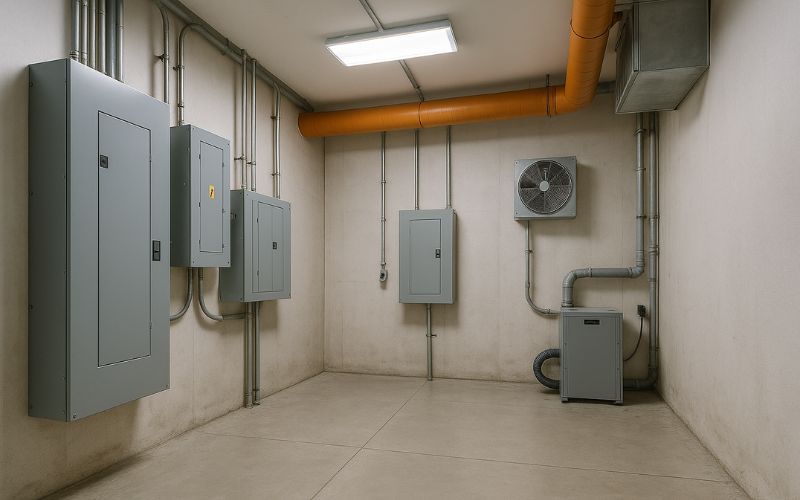
Why electrical room safety becomes critical during Los Angeles winters
Electrical rooms are one of the most overlooked areas in commercial buildings across Los Angeles, yet they are responsible for powering every essential system that keeps tenants safe and facilities operational. During winter, when buildings experience heavier electrical loads and increased occupancy, the condition of the electrical room becomes even more important. What may have gone unnoticed during the summer can quickly turn into a safety hazard once colder weather and seasonal activity place more stress on panels, circuits, and emergency systems.
Los Angeles winters may be mild compared to other regions, but the combination of cooler temperatures, early sunsets, and higher electrical demand creates conditions that amplify existing weaknesses. Tenants rely on more interior lighting, space heaters in office suites become more common, and holiday decorations increase load on circuits that are already nearing capacity. All of this pushes panels and breakers harder, making accessibility and electrical room safety crucial for preventing outages and fire hazards.
Winter load increases and storage misuse
One of the biggest challenges that property managers face in December and January is clutter. Electrical rooms often become the default storage space during the holiday season. Boxes, decorations, unused furniture, and janitorial supplies get pushed into these rooms, sometimes blocking panel access entirely. Even a few inches of obstruction can create significant hazards, both for emergency response and routine maintenance.
Blocked panels are one of the most common violations found during winter inspections. When a breaker trips during peak demand, a technician must be able to reach the panel immediately. If storage materials prevent quick access, it can delay restoration, increase liability, and create unsafe conditions for tenants who may be relying on emergency systems, lighting, or elevator service.
Moisture exposure and temperature variation
Although Los Angeles is known for its dry climate, winter introduces more moisture into electrical rooms than many property managers expect. Condensation can form in poorly ventilated or unconditioned spaces. Older buildings often have electrical rooms located near exterior walls or basements where temperature shifts pull in moisture. When this moisture interacts with outdated equipment, corroded bus bars, or weakened breakers, it increases the risk of tripping or overheating.
Moisture also raises the likelihood of insulation breakdown on older wiring, particularly in buildings that still rely on aluminum branch circuits or cloth-insulated wiring. These conditions become most visible during winter, which is why this season tends to expose hidden hazards that were previously unnoticed.
Why year-end inspections uncover the most violations
By December, many commercial buildings have gone nearly an entire year without a thorough electrical room inspection. LADBS inspectors, insurance auditors, and fire-life safety officials commonly review electrical spaces at year end because this is when buildings experience the highest demand and, therefore, the highest risk. If an electrical room does not meet code requirements for clearance, labeling, ventilation, or equipment condition, winter inspections will reveal it.
Property managers often discover violations only after an outage, a tripped breaker, or a failed inspection. Winter highlights the gaps in maintenance practices and makes it clear which electrical rooms need upgrades or professional evaluation. Addressing these issues now helps avoid unplanned downtime during one of the busiest seasons for commercial buildings in Los Angeles.
What electrical rooms are required to include under Los Angeles and OSHA rules
Electrical rooms in commercial buildings are governed by a combination of NEC requirements, LADBS enforcement, and OSHA workplace safety rules. These standards are designed to ensure that anyone who enters the space, technicians, inspectors, or building staff, can reach equipment safely and operate it without obstruction. For Los Angeles property managers, understanding these requirements is essential not only for compliance, but also for maintaining safe conditions during winter when electrical loads increase.
Clearance and working space requirements
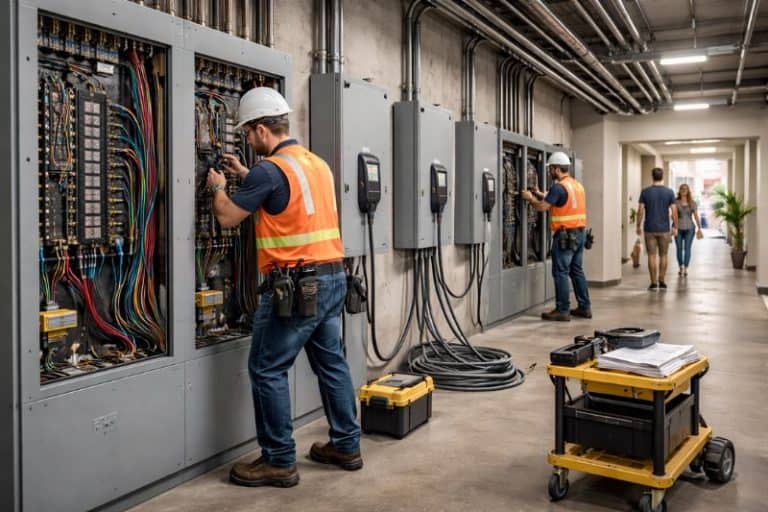
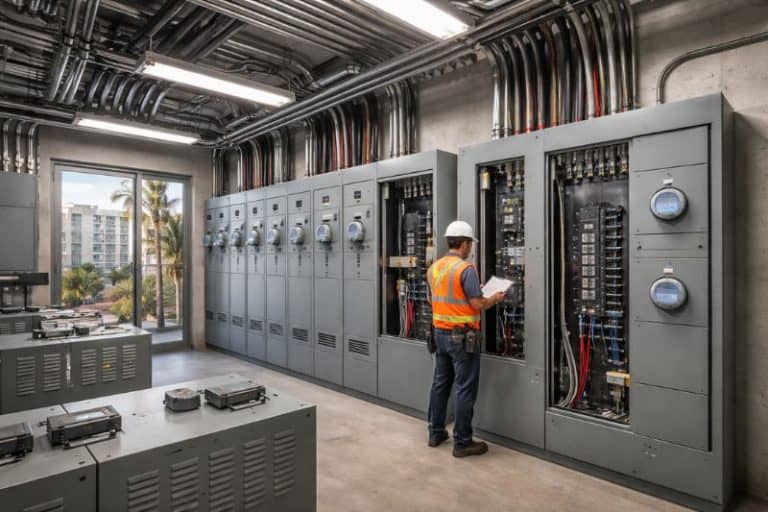
Commercial electrical rooms must provide clear working space in front of all electrical panels and equipment. NEC and OSHA guidelines typically require at least 36 inches of unobstructed depth in front of a panel and a minimum width equal to the width of the panel or 30 inches, whichever is greater. This space must remain free of storage, debris, temporary shelving, or janitorial equipment.
During winter, this rule becomes especially important. Heavier loads can cause breakers to trip more frequently. If a technician cannot safely reach the panel to diagnose the issue, tenants may experience prolonged outages or unsafe conditions.
Access and locking standards for commercial buildings
Electrical rooms must remain locked to prevent unauthorized entry, yet accessible to those who need to service or inspect equipment. In Los Angeles, property managers must ensure that emergency personnel, maintenance teams, and electricians can quickly enter the space during an outage or safety event. Posting signage that identifies the room as “Electrical Room” is often required, and the door should never be blocked from swinging fully open.
Because electrical panels and equipment are typically serviced during outages or emergencies, access restrictions can slow down response times. Winter is when these delays are most problematic due to heavier tenant occupancy and greater reliance on indoor systems.
Where Los Angeles buildings fall out of compliance
Many commercial properties drift out of compliance slowly over time. Storage materials accumulate. Furniture gets pushed into empty corners. Paint supplies, janitorial equipment, or unused seasonal décor may be placed inside the room “just until later.” Winter often brings these violations to the surface, especially when inspectors arrive or an outage forces staff to enter the room quickly.
For buildings experiencing recurring panel issues or load problems, it may be time to schedule emergency electrical repairs in Los Angeles at:
https://www.rgelectric.net/emergency-electrical-repairs-in-los-angeles/
If outdated panels or overloaded circuits are contributing to electrical room violations, property managers can review commercial electrical services at:
https://www.rgelectric.net/commercial-electrical-services-in-los-angeles/
For wiring problems discovered during an electrical room inspection, evaluate wiring services at:
https://www.rgelectric.net/wiring-services-in-los-angeles/
For panel upgrades, breaker replacements, or outdated electrical equipment, see electrical panel services at:
https://www.rgelectric.net/electrical-panel-services-in-los-angeles/
These links allow property managers to take action quickly without overloading the article with internal navigation.
Common electrical room violations found in Los Angeles commercial properties
Electrical room violations are among the most frequent issues discovered during LADBS inspections, insurance audits, and seasonal maintenance reviews. Winter conditions tend to highlight these problems, but many of them build up quietly throughout the year. When the electrical system is under stress, even small violations can create safety hazards or cause operational disruptions.
Blocked panels and storage hazards
The most common violation, by a wide margin, is blocked panel access. Holiday supplies, extra chairs, cleaning carts, storage boxes, and maintenance tools often accumulate in electrical rooms. Although this may seem harmless, even minor clutter reduces working space, prevents proper ventilation, and violates clearance requirements. During a winter outage, blocked panels can delay service and increase liability.
Water intrusion, corrosion, and ventilation issues
Older LA buildings frequently struggle with moisture inside electrical rooms. Cracks in exterior walls, roof drainage problems, or poor ventilation can allow dampness to reach equipment. When cool winter air interacts with warm indoor air, condensation may form on metallic surfaces. Over time, this contributes to rusted conduit, corroded breakers, and degradation of wiring insulation.
Ventilation problems are just as common. Many electrical rooms were built decades ago with limited airflow. Winter’s cooler air and higher humidity can make existing ventilation problems worse, causing equipment to run hot or trip more often.
Incorrect labeling, outdated gear, and overloaded circuits
Another major category of violations involves panel labeling and equipment condition. Many electrical rooms still contain unlabeled circuits, faded panel directories, or handwritten notes that no longer reflect the building’s actual configuration. This makes outage response slower and increases the risk of accidentally shutting down critical systems during service.
Outdated electrical gear is also extremely common. Buildings with original 1960s or 1970s panels, especially Zinsco, Federal Pacific, Pushmatic, or Challenger models, often experience winter failures because these panels are not designed to handle modern loads. Commercial tenants running heaters, LED lighting, and equipment place demands on circuits that far exceed what older panels were built to support.
Finally, overloaded circuits appear more frequently in winter. When lighting demand increases and office suites use more electronic equipment, hidden wiring issues become more obvious. Electrical room inspections often reveal scorch marks, warm breakers, or discoloration on bus bars, signs that the system is operating beyond its designed capacity.
Why electrical rooms become unsafe during the winter season
Winter changes the way commercial electrical systems behave, even in a mild climate like Los Angeles. Cooler temperatures, increased tenant activity, and holiday-driven electrical loads all work together to stress equipment in ways that aren’t as visible in spring or summer. Electrical rooms are particularly vulnerable during this time because they often house the equipment most affected by these seasonal shifts. As demand rises, any weaknesses in the electrical room’s layout, ventilation, or condition become far more noticeable.
Holiday storage overflow and blocked access
One of the most consistent winter hazards is the misuse of electrical rooms as seasonal storage. Decorations, boxed supplies, unused fixtures, and janitorial carts get tucked into whatever open space is available. Property managers intend for this storage to be temporary, but it often remains well past the holidays. By the time a breaker needs to be reset or a panel needs to be inspected, the clutter has created a barrier that slows response time and violates clearance rules.
Blocked access is more than an inconvenience. In a commercial building, a tripped breaker may affect exit lighting, fire alarm circuits, heating systems, or tenant operations. If technicians can’t reach the panel quickly, and safely, the risk of extended outages or safety violations increases. Winter exposes how much improper storage can impact overall building performance.
Higher electrical demand exposing weak breakers or panels
Winter is the season when loading patterns reveal unseen vulnerabilities. Even a small increase in heater use, lighting demand, or tenant occupancy can push older commercial panels toward their limit. Breakers that have weakened with age or been subjected to repeated tripping may begin to malfunction. In some cases, equipment that performed adequately throughout the year begins overheating or failing under winter’s heavier load.
Electrical rooms in older buildings are especially prone to these failures. Panels may contain outdated designs, bus bars showing signs of wear, or breakers that no longer respond as intended. Winter load increases act as a stress test, revealing which components are no longer capable of supporting tenant needs. When these problems arise, the electrical room becomes a focal point for diagnosing underlying issues.
Condensation, temperature shifts, and under-maintained equipment
Winter brings moisture in the form of condensation, and electrical rooms, often located in basements, mechanical spaces, or exterior-access areas, are prime spots for condensation to collect. When warm building air meets cooler surfaces inside an unconditioned electrical room, moisture can form on panels, conduits, and breakers. This contributes to corrosion, weakened connections, and recurring nuisance trips.
Temperature fluctuations can also affect older wiring insulation and lead to expansion and contraction of metal components. Over time, this movement can loosen terminals, weaken connections, or cause intermittent faults. Winter is simply the time when these issues become more pronounced because the equipment is forced to operate under conditions it has not been prepared for.
An electrical room that may have seemed harmless during summer can quickly become a winter hazard when condensation, clutter, and load demand converge. Recognizing these risks helps property managers stay ahead of problems rather than reacting to emergencies.
How proper electrical room maintenance protects tenants, reduces outages, and supports insurance compliance
Electrical rooms are not just service areas, they are the central command stations for everything that keeps a commercial building functioning smoothly. When maintained properly, they support reliable performance and provide an essential layer of protection against outages, fires, and code violations. Winter is the ideal time to ensure that electrical rooms are operating safely, because it is the season when commercial buildings depend on their electrical systems the most.
Fire-risk reduction
Electrical rooms that meet code requirements and remain clean, dry, and accessible dramatically reduce the risk of electrical fire. Clutter, dust accumulation, and flammable storage items increase the likelihood of ignition if a breaker overheats or an arc fault occurs. Proper clearance and good ventilation help prevent equipment from running too hot during periods of high demand. Eliminating storage from the room removes combustible materials that might otherwise turn a minor equipment issue into a major fire hazard.
Faster emergency response and outage recovery
In a commercial building, downtime is expensive. Tenants may lose business, operations may be disrupted, and life-safety systems may be compromised if power cannot be restored quickly. When electrical rooms are clear, accessible, and properly labeled, technicians can diagnose and correct issues far more efficiently. This is especially important in winter when outages tend to occur unexpectedly and affect multiple parts of a building.
A clean, organized electrical room with adequate clearance ensures that technicians are not delayed by obstacles or confused by unclear labeling. Faster response means tenants experience less inconvenience and building operations return to normal more quickly.
Better inspection outcomes for LADBS and insurance companies
Electrical room compliance is a major focus of both LADBS and commercial insurance providers. Inspectors frequently check for clearance around panels, proper labeling, working space conditions, ventilation, grounding quality, and signs of outdated equipment. Insurance carriers may also evaluate electrical rooms when determining coverage, calculating premiums, or assessing liability after an incident.
Winter is when many inspections occur because it is the end of the calendar year. Maintenance teams preparing for these inspections often discover that conditions have drifted out of compliance during busy periods. By ensuring electrical rooms remain safe and well-maintained, property managers can avoid costly citations, reduce insurance risks, and demonstrate that their building meets safety and operational standards.
What Los Angeles property managers should evaluate during a winter electrical room check
Winter is the season when electrical rooms are under the most pressure, making it the ideal time for property managers to take a close look at conditions that may not have been noticeable earlier in the year. A winter electrical room check is not a full inspection, but a focused walk-through that helps identify early warning signs of overload, moisture intrusion, blocked access, or deteriorating equipment. These checks prepare the building for colder months and help prevent outages when tenant demand is highest.
Panel condition and breaker health
One of the most important items to evaluate is the state of the electrical panels. Property managers should look for signs of discoloration, warm breakers, loose covers, or evidence of overheating. Panels that show rust or corrosion around the edges may have experienced moisture exposure, which becomes more pronounced during winter. Breakers that trip repeatedly or appear worn may need further evaluation by a licensed electrician.
Clearance, accessibility, and proper labeling
Clearance is often the first issue that appears during winter. Decorations, storage boxes, and janitorial supplies may have encroached into required working space. Property managers should ensure that at least 36 inches of clear access is available at all times in front of electrical equipment. Doors must be able to swing fully open and should be kept free of clutter on both sides.
Labeling is equally important. Panel directories should be legible, accurate, and updated to reflect any electrical changes that occurred throughout the year. Inaccurate labeling slows emergency response and may lead to accidental shutdown of critical circuits.
Grounding, wiring condition, and outdated components
Older buildings in Los Angeles may still rely on grounding systems that no longer meet modern standards. Winter is a good time to confirm that grounding conductors are securely connected and that no wiring appears brittle, frayed, or exposed. In buildings with older equipment, property managers should look for signs that electrical components like panels, disconnects, transformers, or feeders, are approaching the end of their service life. Any outdated or obsolete equipment should be flagged for assessment.
Moisture, ventilation, and environmental concerns
Electrical rooms must be dry and well-ventilated, especially during winter when temperature swings create condensation. Property managers should check for water stains, roof leaks, standing water, or dampness around conduits and panel bases. If the room feels humid or musty, ventilation may need adjustment to prevent future corrosion and breaker failures.
A winter check helps identify these issues early so property managers can schedule corrective work before an outage or inspection reveals larger problems.
How RG Electric brings electrical rooms back into code compliance
When an electrical room falls out of compliance, the risks extend far beyond failed inspections. Unsafe electrical rooms can lead to delayed emergency response, equipment failures, and liability in the event of fire or injury. RG Electric works closely with Los Angeles property managers to bring electrical rooms back into safe, code-compliant condition, especially during the winter season when buildings depend most on stable electrical performance.
Winter-focused inspections and diagnostics
RG Electric begins by assessing the electrical room for clearance issues, equipment condition, moisture exposure, ventilation, grounding quality, and panel performance. Technicians evaluate breaker health, circuit stability, and any signs of overheating or corrosion. Because winter is peak season for electrical demand, the evaluation also includes an assessment of load patterns to determine whether circuits or panels are nearing capacity.
Correcting hazards and modernizing equipment
Once the assessment is complete, RG Electric corrects any violations identified within the electrical room. This may include removing storage items, improving clearance, updating labeling, repairing grounding systems, or addressing moisture intrusion. If outdated or unsafe equipment is discovered, such as aging breakers, worn bus bars, or obsolete panels, RG Electric can replace or upgrade the components to restore safe operation and prepare the system for winter load requirements.
For buildings experiencing recurring outages or breaker trips, RG Electric can perform deeper diagnostics to identify wiring problems, weakened breakers, or unbalanced circuits. These corrections not only improve reliability but also help buildings stay compliant during LADBS inspections and insurance evaluations.
Schedule your winter electrical room safety inspection
A safe electrical room is essential for preventing outages, ensuring reliable tenant operations, and passing winter inspections in Los Angeles. If your building hasn’t been evaluated this season, now is the ideal time to schedule an assessment and correct any issues before colder weather and holiday activity increase demand.
Call RG Electric at (323) 521-5131 or request a free estimate at https://www.rgelectric.net/contact-us/
to schedule your electrical room safety inspection.
Electrical work is hazardous. Consult a licensed electrician like RG Electric for inspections, permits, and code compliant installations.