
 Call (323) 5215131

Electrical Load Calculations for Los Angeles Multi-Unit Properties
Updated March 2026
If you manage a multi-unit property in Los Angeles, you’ve probably dealt with tenant complaints about tripped breakers, dimming lights, or circuits that can’t keep up with modern demands. These aren’t nuisance problems. They’re symptoms of an electrical system that was never sized for what tenants are actually running today, and in a city where older housing stock meets aggressive electrification mandates, the gap between what a building was designed to handle and what it’s actually being asked to do grows wider every year.
Electrical load calculations are the diagnostic foundation that closes that gap. They tell you exactly how much power your building requires, where the system is running out of capacity, and what upgrades are needed to keep tenants safe, satisfy LADBS inspectors, and protect your property from the liability and repair costs that follow an overloaded system. Whether you manage a duplex in Encino or a 60-unit complex in Koreatown, understanding your building’s load profile is not optional. It’s how responsible property management works.
RG Electric (License C10 #910807) performs electrical load assessments for multi-unit and commercial properties throughout Los Angeles. This guide explains what load calculations involve, why they’re particularly critical in LA’s regulatory and infrastructure environment, and what the process looks like from start to finish.
What Electrical Load Calculations Actually Measure
A load calculation determines the total electrical demand a building places on its service panel and the utility connection supplying it. The National Electrical Code (NEC) defines the methodology, and LADBS requires NEC-compliant calculations before issuing permits for panel upgrades, new circuits, or major renovations.
The calculation accounts for every electrical load in the building, organized into two categories. Continuous loads are devices that run for three or more hours at a time, including common-area lighting, HVAC systems, and elevator motors. The NEC requires continuous loads to be calculated at 125% of their rated amperage to account for the sustained heat they generate in conductors and equipment. Non-continuous loads are intermittent, covering things like tenant appliances, garbage disposals, and plug-in devices.
For a multi-unit building, the calculation also applies a demand factor, which accounts for the statistical reality that not every unit is running every appliance at the same time. A 20-unit building in Van Nuys doesn’t actually need 20 times the capacity of a single unit at peak load, but it needs substantially more than many older panels were designed to provide, especially as tenant device loads have increased with smart home technology, home office setups, and EV charging.
The result of a proper load calculation is a number: the minimum service amperage the building requires to operate safely. That number drives every subsequent decision about panel capacity, circuit sizing, and whether a service upgrade from LADWP is needed.
Why Load Calculations Are a Pressing Issue in Los Angeles Right Now
Los Angeles has a specific combination of factors that makes electrical load management more urgent here than in most other markets.
The housing stock is old. A significant percentage of multi-unit properties in neighborhoods like Mid-City, Echo Park, Hollywood, and the San Fernando Valley were built before the 1980s, many before the 1960s. Those buildings were designed around panel sizes and circuit capacities that made sense when the primary electrical loads were lights and a refrigerator. They were not designed for mini-split HVAC units in every unit, home offices drawing continuous power, or Level 2 EV chargers in the parking structure.
California’s electrification push has accelerated this problem. The state is actively incentivizing and in some cases mandating the elimination of gas appliances in favor of electric alternatives. That means buildings that were adequately sized in 2015 may already be approaching capacity in 2026, and buildings that are already operating at or near their limits are one tenant upgrade away from a real problem.
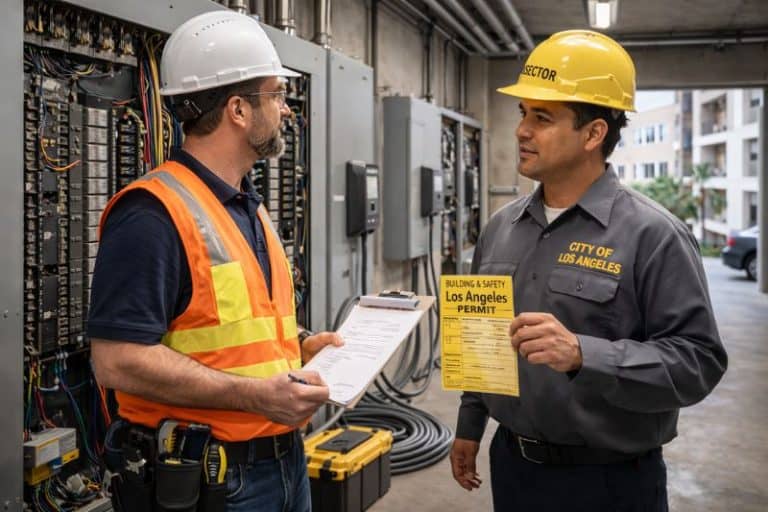
LADBS has kept pace with these changes by tightening permit and inspection requirements. Any electrical upgrade that requires a permit, which includes panel replacements, new circuit installations, and EV charger additions, must be supported by a load calculation showing the system can handle the added demand. Properties that skip this step, either because the previous owner never addressed it or because prior work was done without permits, face compliance exposure that becomes visible at the worst possible time: during a sale, during an insurance audit, or after a fire.
For property managers in Culver City, Sherman Oaks, Torrance, and Inglewood, the practical question is not whether a load assessment is necessary. It’s how long you can afford to defer it before a system event forces the issue.
Warning Signs That Your Building’s System Is Already Overloaded
Overloaded electrical systems rarely fail all at once. They degrade over time, and the early warning signs are easy to rationalize away as minor annoyances rather than indicators of a system operating beyond its design limits.
Frequent breaker trips are the most obvious signal. If tenants are regularly resetting breakers or if the same circuits trip repeatedly, the panel is telling you something. Breakers are protection devices, not inconveniences. When they trip repeatedly on the same circuit, the circuit is carrying more than it was designed to carry, and the heat building in those conductors between trips is doing cumulative damage to insulation and connections.
Lights that dim noticeably when a large appliance turns on indicate a system running close to its voltage limits. In a well-sized system, the momentary current draw of a motor starting up should not produce visible light flicker. When it does, the system lacks the headroom to absorb normal demand spikes without voltage sag.
Buzzing or humming sounds at the panel or at outlets are never benign. These sounds indicate arcing at connections or components operating under stress. Warm panels, warm outlet covers, or any outlet that feels hot to the touch indicate current flowing through a connection or conductor that is not sized to handle it.
In a multi-unit property, tenant complaints about power quality, devices running hot, or repeated appliance failures in a single unit may all trace back to the same root cause: a system that has not been evaluated against the actual load the building is carrying.
How RG Electric Performs a Load Assessment
A load assessment for a multi-unit property is a structured process, not a quick visual inspection. Here is what it involves when RG Electric conducts one.
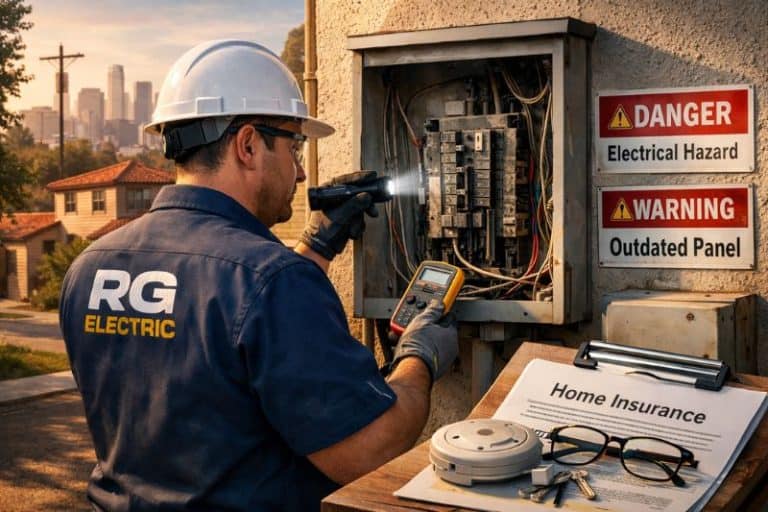
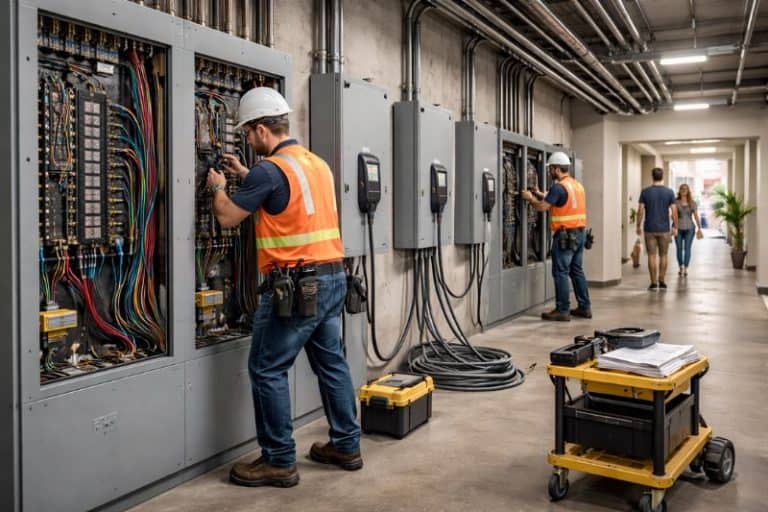
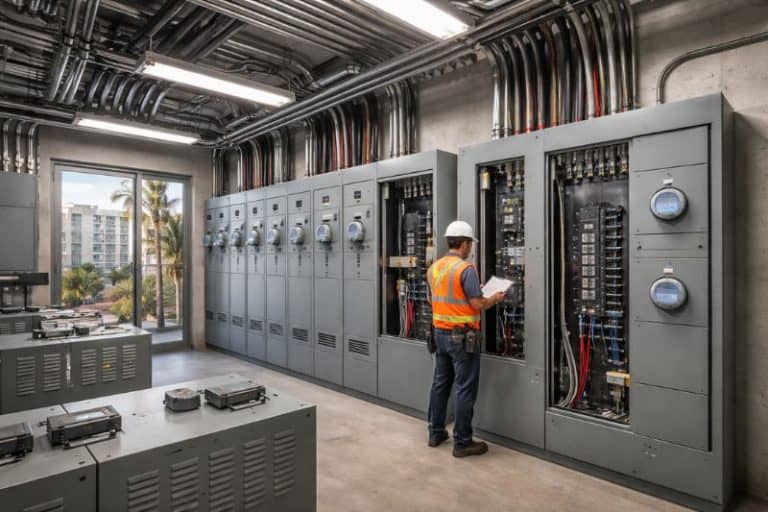
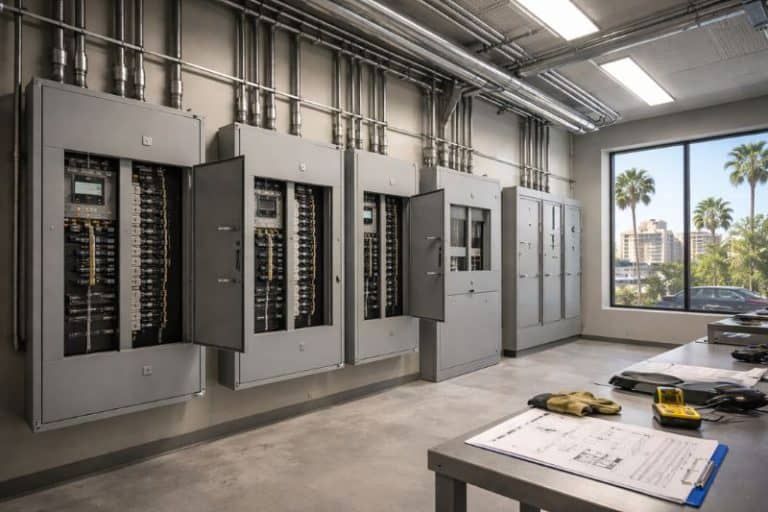
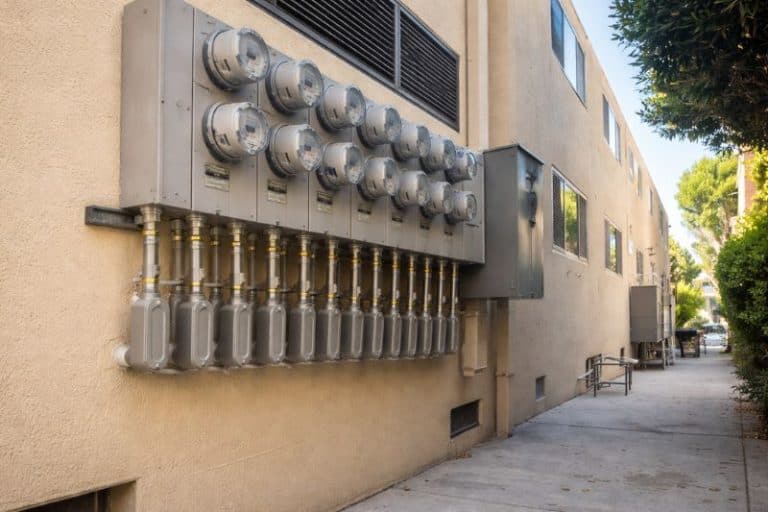
We begin with a physical walkthrough of the property, documenting panel types, service amperage, meter configurations, and the condition of visible wiring. For properties with known issues or inconsistent power behavior, we deploy temporary monitoring devices that track circuit demand over time, capturing peak loads rather than just steady-state consumption. This matters in multi-unit buildings where load patterns are driven by tenant behavior and shift throughout the day.
We use NEC-compliant load calculation software to model the building’s total demand, accounting for both current loads and any planned additions, including EV charging infrastructure, HVAC upgrades, or new appliance circuits. The software applies the appropriate demand factors for multi-unit residential and commercial occupancies and flags any circuits or panels operating above their rated capacity.
Thermal imaging is part of our assessment toolkit for properties showing signs of stress. Thermal cameras detect heat anomalies in panels, junction boxes, and wiring runs that are invisible to standard inspection but indicate exactly where the system is being pushed beyond its design parameters. A panel that looks clean visually may show alarming thermal signatures at specific breakers or bus connections.
The output of the assessment is a written report that documents the building’s current load profile, identifies any capacity deficits or code compliance gaps, and provides specific recommendations for upgrades with priority sequencing. We also prepare the load calculation documentation required by LADBS for any permitted work, coordinating with the utility on service upgrades when the assessment indicates the existing LADWP service connection needs to be increased.
Property managers in Downtown LA and Beverly Hills who have gone through this process typically describe the same outcome: a clear picture of what the system can actually handle, a prioritized list of what needs to change, and documentation that holds up during inspections and insurance reviews.
Compliance, Permitting, and What LADBS Actually Requires
Load calculations are not just a best practice in Los Angeles. They are a permit requirement for a wide range of electrical work, and LADBS inspectors will ask for them.
Any electrical panel upgrade requires a load calculation showing the new panel is appropriately sized for the building’s demand. New circuit installations for high-load equipment, including EV chargers, HVAC units, and commercial kitchen equipment, require calculations demonstrating the existing service can support the added load. Major renovations that involve adding square footage or changing occupancy type trigger a full reassessment of the building’s service requirements.
LADWP has a parallel set of requirements for properties requesting a service increase, meaning an upgrade from, say, 200A to 400A or 600A service at the meter. This is a separate approval process from LADBS permitting, and the timeline can extend a project if it isn’t initiated early. RG Electric coordinates both tracks concurrently, which is the only way to keep permitted electrical projects on schedule in Los Angeles.
For property managers dealing with deferred maintenance or inherited systems of unknown history, a load assessment also serves as a baseline documentation exercise. Having a current, professional load calculation on file for your property is a defensible position during an insurance audit or due diligence review. Not having one creates uncertainty that buyers, lenders, and insurers price accordingly.
What Proactive Load Planning Protects
There’s a straightforward business case for load planning that goes beyond code compliance. Multi-unit properties in Los Angeles operate in a competitive rental market where tenant expectations have risen and insurance requirements have tightened. The electrical system is infrastructure that affects every unit, every day, and the cost of managing it reactively is reliably higher than the cost of managing it proactively.
Properly sized systems have fewer outages. Fewer outages mean fewer tenant complaints, lower turnover from tenants who get frustrated and leave, and fewer emergency service calls at times when labor rates are highest. In a building where the panel is adequately sized and every circuit is operating within its rated capacity, the electrical system becomes invisible to tenants, which is exactly where you want it.
Insurance is a growing pressure point for property managers across the San Fernando Valley and the broader LA market. Underwriters have become more rigorous about electrical system documentation, particularly for older buildings. Properties with outdated panels, uninspected systems, or a history of electrical complaints face higher premiums, reduced coverage limits, or outright policy non-renewals. A current load assessment and a documented upgrade history are concrete risk management tools that affect real insurance outcomes.
Property value is the long-term consideration. Buyers and their lenders scrutinize electrical infrastructure closely, and a building with an outdated, over-capacity system requires either a price concession or a deferred maintenance disclosure. Buildings with documented, current electrical systems that can support EV charging, modern HVAC, and tenant demand without modification command better prices and shorter due diligence periods.
For commercial properties in Koreatown, Downtown LA, and Santa Monica, the business continuity dimension adds another layer. A tenant operating a business out of your commercial space cannot afford power interruptions. Ensuring the system can reliably support their load is part of what they’re paying for.
Load Calculations and EV Charging Infrastructure
EV charging deserves its own discussion because it’s the single biggest driver of new load demand in multi-unit residential properties right now, and it’s not a future concern. It’s a present one.
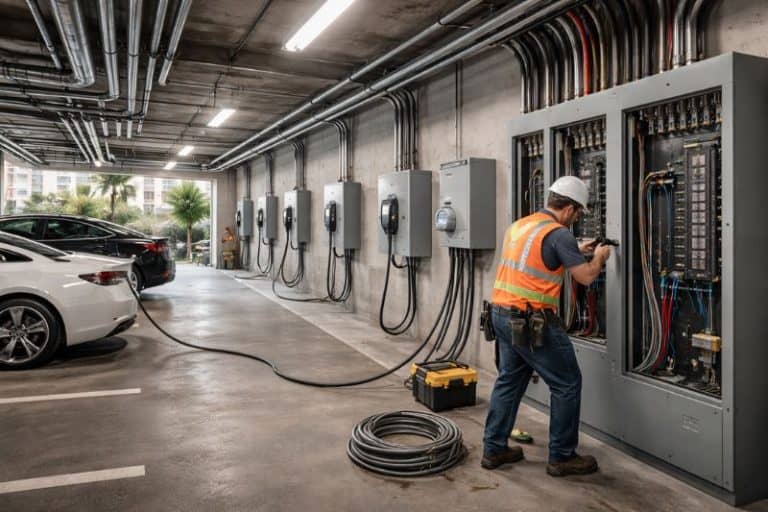
California requires new multi-unit developments to include EV-ready parking infrastructure, and existing buildings are under increasing pressure from tenants who own electric vehicles and need charging access as a condition of renewing their lease. A Level 2 EV charger draws between 30 and 50 amps continuously for several hours. Add three of those to a building that was designed around a 150A panel and you have a serious capacity problem.
The correct approach to EV charging in multi-unit properties starts with a load calculation, not with charger installation. The calculation tells you whether the existing panel can support the added load, whether a panel upgrade is required first, and how many charging circuits can be added without compromising the rest of the building’s electrical service. In some cases, load management systems can optimize when charging occurs to stay within panel limits without requiring a full service upgrade, but that determination requires knowing what the numbers actually are.
Properties in Van Nuys, Encino, and Sherman Oaks that are planning EV infrastructure additions should budget for a load assessment as the first step in that project, before any charger purchasing or contractor commitments are made.
What Happens After the Load Assessment
A load assessment is a diagnostic, not a repair order. The output is information, and what you do with that information depends on what the assessment finds.
In some cases, the assessment confirms the system has adequate capacity for current and near-term demands, with minor adjustments recommended. That’s a valuable result. It means the property has been professionally evaluated, the documentation exists, and the next assessment is a scheduled maintenance item rather than an emergency response.
More commonly, the assessment identifies specific capacity deficits and provides a prioritized upgrade path. Panel replacement may be the primary recommendation for buildings where the existing equipment is undersized, aging, or identified as a high-risk panel type. Circuit additions to create dedicated runs for high-load equipment are a common secondary recommendation. In buildings with significant demand increases planned, a LADWP service upgrade to increase the available amperage at the meter may be part of the picture.
RG Electric develops upgrade plans that sequence work by priority, separating what needs to happen immediately for safety and compliance from what can be phased across a planned maintenance cycle. For large properties, this prevents a single assessment from becoming an overwhelming capital expenditure and allows work to proceed in a way that minimizes tenant disruption.
Our commercial electrical services cover the full scope of multi-unit property work, from the initial assessment through permitted upgrades, inspections, and ongoing maintenance. Property managers who work with us on an ongoing basis benefit from a continuous relationship with a team that knows the building’s history rather than starting from zero each time a new issue surfaces.
Frequently Asked Questions
How often should a multi-unit property have a load assessment?
Every time you add a significant electrical load, whether that’s EV charging circuits, new HVAC equipment, a commercial tenant with specialized power requirements, or a major renovation. Outside of those triggers, a baseline assessment every five to seven years is a reasonable maintenance interval for an older LA building. If the building has never been professionally assessed, do it now regardless of when the last work was done.
Does a load calculation require shutting down power to the building?
The assessment itself does not require a shutdown. Monitoring devices are installed non-invasively, thermal imaging is conducted with the system live, and the documentation review and software calculations are performed off-site. Any permitted work that follows the assessment may require temporary circuit shutdowns, but those are scheduled in advance and managed to minimize disruption to occupied units.
What is the difference between a load calculation and an electrical inspection?
An electrical inspection evaluates the condition and code compliance of the existing system, looking for defects, code violations, and safety hazards. A load calculation evaluates the system’s capacity against the building’s actual and projected demand. They measure different things, and a complete picture of a building’s electrical health requires both. RG Electric typically conducts both as part of a comprehensive assessment for multi-unit properties.
Will LADBS require a load calculation for my specific project?
For any permitted electrical work, yes. Panel replacements, new service installations, EV charger circuits, and major renovation projects all require load calculation documentation as part of the permit application. LADBS inspectors will review this documentation and reject permits that don’t include it. RG Electric prepares all required LADBS documentation as part of our permitted project services.
My building’s panel was upgraded five years ago. Do I still need a load assessment?
Potentially, yes, depending on what has changed since the upgrade. If tenant loads have increased, if EV charging has been added or is planned, or if new high-draw equipment has been installed since the upgrade, the panel that was correctly sized five years ago may be operating differently today. A load assessment compares current demand against current capacity, not against the capacity assumptions that applied when the panel was installed.
Schedule a Load Assessment for Your Los Angeles Property
If your multi-unit property is showing signs of electrical strain, if you’re planning to add EV charging, or if the system has never been professionally assessed against current NEC requirements, a load calculation is the right starting point. It gives you accurate information about what the system can handle, what needs to change, and what the LADBS permitting requirements are for any planned upgrades.
RG Electric serves multi-unit and commercial properties throughout Los Angeles, including Encino, Sherman Oaks, Van Nuys, Beverly Hills, Santa Monica, Koreatown, Downtown LA, Culver City, Inglewood, Torrance, and the broader San Fernando Valley. For immediate assistance or to schedule a professional evaluation, call RG Electric directly at (323) 521-5131.